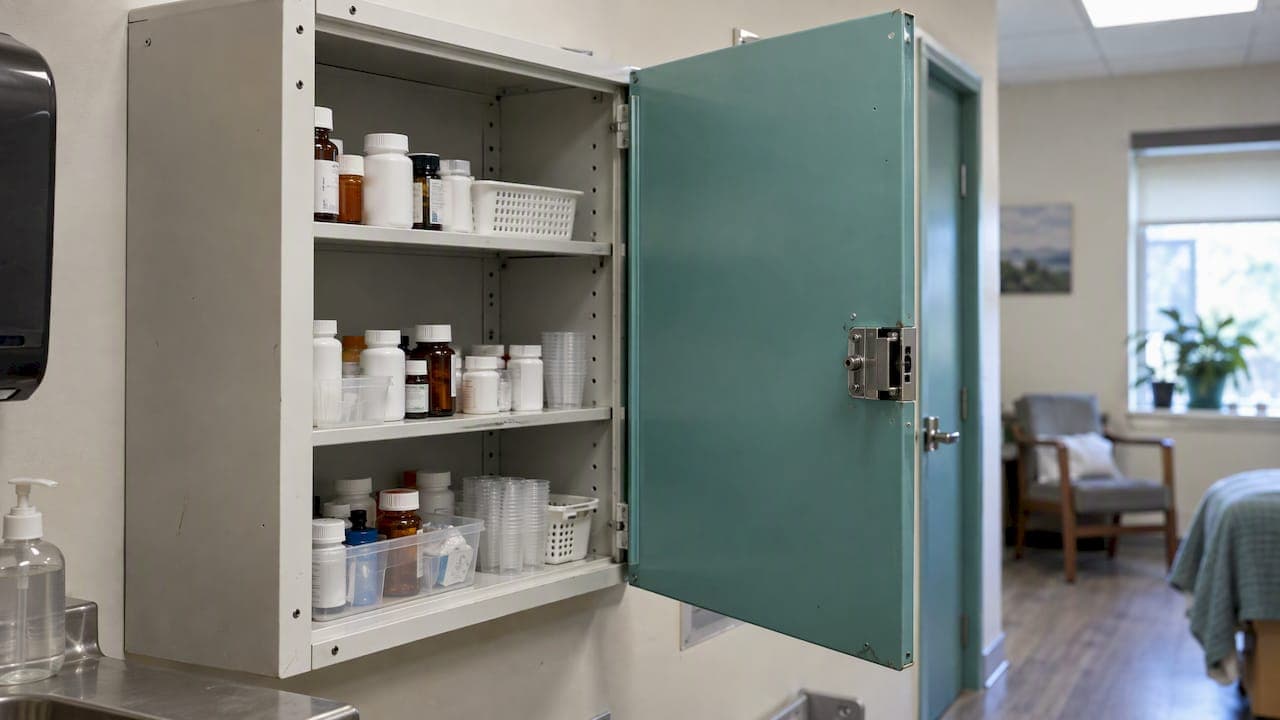
A rehab's medication policy is the set of rules for how your medications are reviewed, stored, given and changed while you are in residential care. In a well-run program, a licensed clinician reviews everything you take, trained staff hold and give it, controlled drugs are locked and counted, and nobody is pushed off a legitimate prescription just to fit a program's philosophy. This guide walks through each step, so you can judge any program, including ours, before you admit yourself or someone you love.
TL;DR
- Expect a full medication review at admission. A licensed prescriber decides what continues, what changes and what is held, and you should not stop or alter doses on your own.
- In residential settings, medications are typically kept by staff in locked storage. Controlled drugs are kept separately and counted at every shift change.
- Medication-assisted treatment (MAT) is an accepted part of care. If a program does not offer it in-house, it should arrange it elsewhere, not turn you away from it.
- A relapse or a missed dose should trigger a review of the treatment plan, not automatic discharge.
- Ask about all of this before admission, in writing if you can. The checklist near the end gives the questions.
Table of Contents
- What "medication" means in a residential program
- What happens to your medications at admission
- Storage and administration: how it should work
- Continuing your prescriptions, or starting MAT, in rehab
- Medications that need extra care
- Co-occurring mental health conditions
- Missed doses, refusals, and relapse
- Education and group work around medication
- Our perspective
- Questions to ask before you admit
- How we can help
- FAQ
- Sources
What "medication" means in a residential program
People searching for this topic usually mean one of three different things, and a good policy treats each separately.
Addiction medications. Medication-assisted treatment uses FDA-approved medications together with counseling and behavioral therapies, a "whole-patient" approach to substance use disorders, according to a Colorado state toolkit on MAT in residential settings. Examples include buprenorphine, methadone and naltrexone for opioid use, and medications that reduce alcohol cravings. You can read how we approach this on our MAT program page.
Withdrawal-management medications. During detox, a physician may prescribe short-term medications to ease withdrawal symptoms and keep you safe. These are adjusted daily, which is why medical detox with round-the-clock supervision matters.
Your existing prescriptions. Blood pressure pills, insulin, antidepressants, antipsychotics, ADHD medication, seizure medication, pain medication, sleep aids. These are where most policy friction happens, because some are essential and some are risky in early recovery.
A policy that only talks about one of these categories is incomplete.
What happens to your medications at admission
The first step is reconciliation: building a single, verified list of everything you take.
Programs in Los Angeles County that follow the county's substance use disorder guidance are told to assess whether a patient needs a medical evaluation to clarify whether current controlled-substance treatment is appropriate. The same county guidance on addiction medications says medications given on-site must be handled by authorized staff, stored securely, and logged when a patient self-administers.
In practice, prepare like this:
- Gather current prescriptions in their original labeled pharmacy bottles, if you can.
- Write a list of drug names, doses, timing and the reason for each.
- Note your prescribers' and pharmacy's phone numbers, so staff can verify what you take.
- Include over-the-counter products, vitamins and supplements. Some interact with detox medications.
- Tell the admissions team about anything you take that is a controlled substance.
Many programs will not accept loose pills, unlabeled containers or medications that belong to someone else, because staff cannot verify what they are. Ask the specific program what it accepts, since this varies. If a medication is not permitted, the right answer is a prescriber-led substitute or plan, not a silent gap in your regimen. Ask what happens in that case before you pack.
Be honest at this stage. Admitting a benzodiazepine, a stimulant or an opioid you were taking is not a confession, it is safety information. Abruptly stopping some medications, especially benzodiazepines and alcohol-related sedatives, can be dangerous, which is exactly why a physician needs the full picture.
Storage and administration: how it should work
The county guidance describes a clear standard. Medications given on-site are kept in a locked cabinet. Controlled medications are held in a separate locked bin or safe and inventoried at each shift change.
What this means for you:
- Staff hold your medications. You are not carrying a bag of pills in a shared residence.
- Doses are scheduled and logged. You take medication at set times with a record of each dose.
- Counts protect everyone. Shift-change inventories deter diversion and catch errors early.
- Emergency medications may stay with you. The same guidance lists naloxone among emergency medications patients may keep on their person.
Naloxone deserves its own note. California's Department of Health Care Services says licensed residential programs are allowed to use naloxone. A program that provides it must write policies for storage, documentation and disposal, and staff who administer it must complete documented training. If you or a family member has an opioid history, ask whether naloxone is on site and who is trained.
Continuing your prescriptions, or starting MAT, in rehab
The short answer is yes, in most cases, under a prescriber's direction.
The Colorado toolkit says licensed providers should continue a person's MAT regimen, and a provider not licensed to offer MAT should refer the person to an agency that does. The Los Angeles County guidance adds that residential agencies should coordinate administration of addiction medications according to their level of care and whether medications are available on-site or through outside partners.
If a program does not offer MAT itself, the toolkit says staff should arrange access through a community provider. That includes scheduling appointments, helping with transportation and completing a release of information so the providers can talk to each other. A program that tells you to "come back when you are off it" is out of step with that standard.
Your rights if you are on MAT
Federal rules protect people on prescribed addiction medication. SAMHSA's Know Your Rights brochure explains that covered recovery residences may not categorically exclude people in MAT or require them to abstain from it. It also says courts and other government agencies may not single out people in MAT and require them to stop legally prescribed medication as a condition of child-welfare, probation or parole requirements. The same brochure notes that federal anti-discrimination law protects people currently using illegal drugs from discrimination by health care providers, for example in being denied surgery or dental care for that reason alone.
That brochure dates from 2009, so if your situation involves a legal dispute, confirm current rules with an attorney or your state's protection and advocacy office. Do not rely on a brochure alone.
Our own blog post on MAT in residential rehab covers how daily care and medication fit together in a small program.
Medications that need extra care
Not every medication is treated the same way. These categories get the most scrutiny, and for good reason.
| Category | Typical concern | What a careful program does |
|---|---|---|
| Controlled substances (opioids, benzodiazepines, stimulants) | Diversion, misuse, dangerous withdrawal | Verifies the prescription, evaluates ongoing need, stores in a locked bin, counts each shift |
| Psychiatric medications | Stopping suddenly can destabilize mood or cause withdrawal | Continues what is working, reviews with a prescriber, coordinates with your outside psychiatrist |
| MAT medications | Missed doses, interactions, access if not offered in-house | Continues or arranges access through a community provider |
| Over-the-counter products and supplements | Interactions, alcohol-containing products | Staff review before use |
| Emergency medications (naloxone, inhalers, epinephrine) | Must be reachable fast | Keeps within reach, per program policy |
The common thread: decisions are made by a licensed prescriber, not by whoever is on shift and not by the patient alone.
Co-occurring mental health conditions
Many people entering treatment also live with anxiety, depression, trauma or bipolar disorder. A medication policy that treats psychiatric medication as optional can undo the whole stay. Stopping an antidepressant or mood stabilizer the day you walk in can raise your risk of leaving early or relapsing.
The better model is integrated: one team looks at substance use and mental health together, so changes in one medication are weighed against the other condition. That is the premise of dual diagnosis treatment. If anxiety is the driver, our piece on anxiety and addiction treatment explains how those pieces interact.
Missed doses, refusals, and relapse
These are the moments when a policy shows its character.
If you decline a dose. Under the county guidance, staff document it and notify the licensed prescribing clinician. Medication orders and adjustments come from that clinician. You are free to raise concerns; the point is that the prescriber hears about them and not that anyone pressures you.
If you do not follow the MAT plan or you relapse. The guidance says the medical provider and residential staff should review and revise the treatment plan rather than discharge the client. Relapse is treated as information about the plan.
If you skip or change doses on your own. This is risky. Skipping doses or altering dosage without medical guidance can hinder recovery and carry serious consequences, so tell staff if a medication is making you feel worse and let the prescriber adjust it.
The Colorado toolkit also notes that decades of research show MAT benefits greatly outweigh the risks tied to diversion. That is why a sound policy manages diversion with locked storage, counts and observation rather than by banning the medication.

Education and group work around medication
The Colorado toolkit recommends that all clients, whether or not they take MAT, attend a psychoeducational group about it. The idea is simple: a house where some people take medication and others judge them for it is a house where people hide doses. Education reduces stigma for everyone and helps clients on MAT feel safe being open about it.
If a program describes group therapy but never mentions how medication is discussed, ask.
Our perspective
We built Connected Recovery Inc. as a boutique program with 12 beds, and that size shapes how we think about medication. In a small house, the people managing your medications are the same people who know your face, your sleep, your mood and your family situation. That makes it easier to notice when a dose is not right, and it makes 24/7 medical supervision something you feel rather than a line on a brochure.
We believe three things. First, medication is a tool inside a plan, not the plan. It works best alongside therapy, case management and aftercare. Second, nobody should have to choose between treating a mental health condition and treating addiction, which is why we treat both together. Third, a medication policy should be explainable in plain words before you commit. If a team cannot tell you who prescribes, who stores, who administers and what happens when something goes wrong, keep asking until it can.
We also think families deserve the same clarity. Ask us directly and we will walk you through how it applies to your situation.
— Jim
Questions to ask before you admit
Bring this list to any admissions call, ours included.
About intake
- Who reviews my medications, and are they a physician or other licensed prescriber?
- What do you need from me and my pharmacy before arrival?
- What happens if one of my medications is not allowed on site?
About daily handling
- Who stores and gives medications? Are controlled medications locked separately and counted?
- Is naloxone on site, and are staff trained to use it?
- How are doses logged?
About MAT
- Do you offer MAT in-house? If not, who do you refer to and who handles appointments and transportation?
- Can I continue a medication I am already taking?
- Is there a group that explains MAT to all clients?
About problems
- What happens if I refuse a dose, miss one, or relapse?
- Who do I talk to if I think a dose is wrong?
About privacy and aftercare
- Who can see my medication information, and what releases will I sign?
- How do you hand off my prescriptions when I leave?
That last question matters. Medication plans that stop at the door are a leading reason early recovery wobbles. Our aftercare planning and relapse prevention services are designed so your prescriptions, appointments and supports line up before you go home.
How we can help
If you are comparing programs for yourself or an adult family member, our residential treatment program in Van Nuys, Los Angeles combines medically supervised detox, medication-assisted treatment, dual diagnosis care and aftercare planning in a 12-bed setting. Call or send a message through our website and our admissions team can answer the questions above, confirm what we can continue from your current prescriptions and discuss how insurance or private pay works for your situation.
FAQ
Can I bring my own medications to rehab?
Usually you bring them to intake rather than keep them. Programs typically want prescriptions in original labeled bottles so staff can verify them, and a prescriber then decides what continues. Ask your specific program what it accepts before you pack.
Will rehab take me off my psychiatric medication?
Not automatically. A licensed prescriber should review each medication and continue what is helping you, adjusting only for a clear medical reason. Tell the admissions team about every psychiatric medication you take, and do not stop one on your own.
Can I be on methadone or buprenorphine in residential treatment?
Often, yes. State and county guidance says programs should continue a person's MAT or refer them to a provider that offers it, and federal protections apply in many settings. Ask whether the program gives it on site or arranges it through a partner.
What happens if I relapse while in treatment?
Under Los Angeles County guidance, the medical provider and residential staff should revise the treatment plan rather than discharge a client who relapses or does not follow a MAT plan. Programs differ in practice, so ask how they handle it.
Sources
- Medication-Assisted Treatment (MAT) in Residential Settings, Colorado toolkit
- Los Angeles County SAPC, Administration, Storage and Disposal of Addiction Medications
- California DHCS, Information Notice 19-009 on naloxone in licensed residential programs
- SAMHSA, Know Your Rights for Individuals on Medication-Assisted Treatment