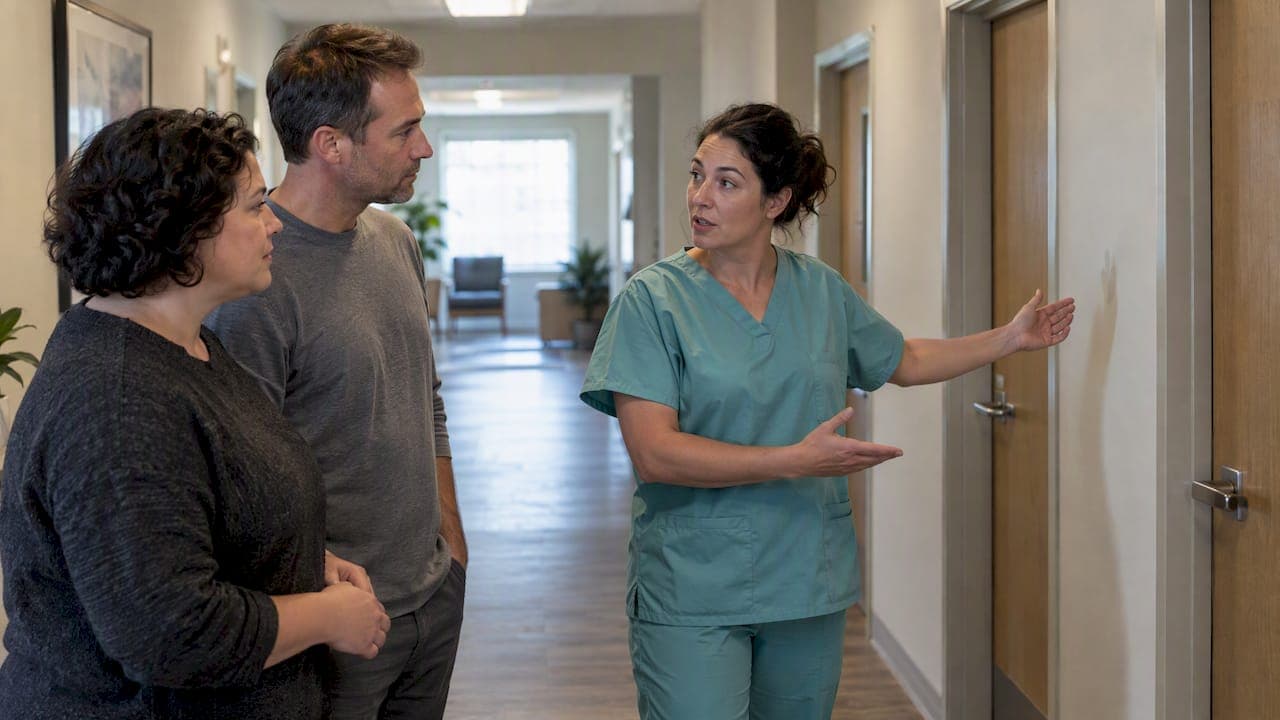
There is no single national policy on couples rehab. Each facility sets its own rules on whether two partners can be admitted at the same time, whether they share a room, which therapy they do together and what each person can learn about the other's care. Some programs treat partners side by side. Many admit them separately and bring them together only for family or couples sessions. A few will not admit both at once.
This guide explains what those policies usually cover, what the research says about treating partners together, and what to ask before you call. We are a 12-bed residential and detox facility in Van Nuys, Los Angeles, and we will be plain about where we fit.
TL;DR
- Couples rehab is a clinical approach, not a standard product. Policies on admission, rooming and joint sessions differ by facility, so confirm them in writing before you commit.
- Partners are not treated as one patient. Each person gets their own assessment, treatment plan, insurance verification and medical clearance for detox.
- Federal law (42 CFR Part 2) means a facility cannot share information about one partner with the other without that person's specific written consent, even if one partner pays the bill.
- Joint therapy is generally not recommended where intimate partner violence has occurred. A responsible facility screens for it first.
- Our programs are built around individual care in a small setting. Ask our admissions team how we would handle two partners who both need treatment.
Table of Contents
- What "couples rehab" means in practice
- The policy questions that matter most
- Safety screening comes first
- Confidentiality between partners
- Insurance, payment and the 16-bed rule
- Can one partner force the other into rehab?
- Perspective: why we put the individual first
- A realistic path for a couple who both need help
- Questions to ask any facility before admitting a couple
- Treatment at Connected Recovery
- FAQ
- Sources
What "couples rehab" means in practice
The phrase covers three different arrangements, and the policy questions differ for each.
- Concurrent treatment. Both partners are admitted to the same facility at the same time, each with their own plan, clinicians and often separate living quarters.
- Shared-program treatment. Partners attend some groups or sessions together and may be allowed to room together after assessment.
- Couples therapy inside individual treatment. One or both partners complete their own treatment, and the relationship is addressed in dedicated sessions or through a family program.
The best-studied model is Behavioral Couples Therapy. Behavioral Couples Therapy is designed for married or cohabiting people seeking help for alcohol or drug problems, and it sees the patient together with the spouse or live-in partner. In outpatient research it typically runs 12 to 20 weekly sessions over three to six months, centered on a recovery contract and on improving how the couple communicates and supports abstinence.
Notice what that means for a residential policy. The evidence supports using the partnership to support sobriety. It does not say that two people in active addiction should be placed together for the length of their stay. NIDA's overview of behavioral therapies describes couples and family treatments as a way of treating a person in the context of the family and social systems where substance use may develop or be maintained. That is a clinical method, not a housing arrangement.
The policy questions that matter most
When a couple searches for a facility, the same handful of questions decide whether a program is workable. Here is what each one means.
Can both of us be admitted at the same time?
That depends on bed availability, clinical need and the facility's own rules. At a small residence, two open beds on the same day is a real constraint. It is also common for partners to be at different stages: one needs medical detox now, the other is ready in a week. Staggered admission is often the safer path, because withdrawal from alcohol or benzodiazepines in particular can be dangerous and needs medical supervision on its own timeline. Read about how medical detox works before you assume you can start together.
Will we share a room?
Most facilities that admit couples decide this case by case, and many default to separate rooms, at least through detox and early stabilization. The reasoning is clinical: early recovery is a time to build your own footing, and a partner who is struggling or craving can pull the other one off course. Ask whether rooming is ever allowed, who decides, and what triggers a change.
What will we do together, and what will we do apart?
A well-run policy separates individual work from joint work. Individual therapy, medical care and groups usually stay separate. Joint sessions come later, once both people are medically stable and each has a clear commitment to abstinence. The research summary on Behavioral Couples Therapy notes it generally calls for couples who are married or living together, and facilities screen carefully before starting joint sessions.
What happens if one of us leaves, or relapses?
This is the question couples forget. If one partner leaves treatment against medical advice, the other is still a patient with their own plan. A clear policy states that each person's stay does not depend on the other's, and that nobody is pressured to leave to follow a partner out the door.

What if we are not a good fit for joint treatment?
This one matters most for safety, and it gets its own section below.
Safety screening comes first
Couples treatment is not a fix for a troubled relationship. The SAMHSA advisory on family therapy in substance use treatment states that joint counseling for couples in which intimate partner violence has occurred is generally not recommended. Research on behavioral therapies for drug use points the same way: if the foundation of a relationship is abusive, many clinicians recommend stabilizing each person separately before attempting any joint work.
A facility with a real couples policy should be able to tell you:
- How and when it screens each partner for intimate partner violence, and whether it does so privately, not in front of the other partner.
- What it does when screening raises concern, such as separate treatment tracks, separate living arrangements and safety planning.
- Who on the clinical team is trained to make that call.
If you are afraid of your partner, say so to the admissions clinician when you are alone. You can also contact the National Domestic Violence Hotline at 1-800-799-7233. Do not rely on a joint intake call to raise it.
Confidentiality between partners
This is the policy that surprises families most. Under federal rules, substance use treatment records have stronger protection than ordinary medical records. 42 CFR Part 2 covers information about people receiving diagnosis, treatment or referral for substance use disorder from federally assisted programs, including information on referral and intake. Without the patient's written consent, a program generally cannot disclose that a person is a patient at all.
For a couple, that has practical consequences:
- Your partner does not get updates by default. Even if your partner is paying the bill, that does not entitle them to clinical information. Each person must sign their own release of information.
- Consent is specific. You choose what may be shared, with whom and for how long, and you can revoke it. A single blanket release for everything is not how this is meant to work.
- Both partners in treatment means two sets of consents. A good facility asks each person separately what the other may know, for example whether your partner may be told you are still in the program, or only whether you are well enough to join a joint session.
- You are told your rights at admission. Part 2 requires programs to give patients notice of the federal confidentiality requirements when they are admitted.
HHS also updated these rules in a final rule announced February 8, 2024 to align parts of Part 2 with HIPAA. The core idea for families stays the same: your treatment information is yours to share. We explain the basics in our guides to substance use privacy rights and HIPAA protections in rehab.
SAMHSA guidance for practitioners adds that a facility should have a documented clinical policy for how it manages the dual-patient dynamic, including confidentiality between partners when both are in treatment. If a program cannot describe one, treat that as an answer.
Insurance, payment and the 16-bed rule
Each partner is a separate patient
Health insurance can help cover addiction treatment for both partners, but couples are not treated as a single patient for insurance purposes. Each person needs their own benefits check, their own authorization for detox or residential care, and their own level-of-care determination. One partner may be approved for residential treatment while the other is approved for a different level. Plan for that, and ask the admissions team to verify both policies before either of you arrives.
We are a private pay and insurance-funded facility. We do not publish prices, so the right step is a confidential benefits check with our team rather than a number from a web page.
What the "16-bed rule" is
Searchers also ask about the "60% rule" and "16-bed rule" in the same breath as couples policy. Neither is a couples policy. The 16-bed rule is the Medicaid Institution for Mental Diseases exclusion. Federal Medicaid guidance explains that it generally bars federal Medicaid payment for adults aged 21 to 64 in facilities with more than 16 beds, unless a state waiver applies. It is a funding rule for facilities, not a clinical rule about who can be treated together. It does mean that facility size can matter to how a program is funded, which is one reason to ask any program about its bed count.
Can one partner force the other into rehab?
Families often ask whether a wife can have her husband committed, or the reverse. In the United States, involuntary commitment for substance use is a state civil legal process, not a federal one, and the rules vary widely. Colorado's process shows how formal it can be: it starts with an emergency commitment and can lead to a longer court-ordered commitment of up to 270 days. Other states, including California, have their own laws and thresholds, so speak with the county behavioral health department or an attorney about the state where your partner lives.
Two points apply everywhere. First, privacy law still protects the patient during involuntary treatment, so the petitioner does not automatically receive treatment details. Second, treatment tends to work better when the person has some stake in it. Many families get further with a planned, honest conversation and an offer of a specific admission date than with a court process.
Perspective: why we put the individual first
We keep our residence intentionally small, at 12 beds, because we want every client to be known by the people caring for them. That shapes how we think about couples.
When two partners call, they usually ask for the same thing: to go through this together. We understand that. Fear of being separated is often what keeps a couple from getting help at all. But in our experience the first weeks of recovery are about two jobs that cannot be shared: getting through withdrawal safely and understanding your own addiction. Each person needs their own clinicians, their own treatment plan and a quiet place to think. If one partner is in crisis, the other should not have to carry that in the next room.

Co-occurring conditions raise the stakes. Many people who use substances also live with anxiety, depression or trauma, and research supports treating both together, by the same clinical team. SAMHSA's guidance on integrated care warns against the fragmented care that results when people must navigate separate systems. With two partners, the risk doubles, because each one may have a different diagnosis and a different medication need. Our dual diagnosis program exists for that reason. You can read more in our guide to co-occurring disorder diagnosis.
So here is what we tell couples. Couples rehab is not on our published list of programs, and we will not promise you shared rooms or joint admission before an assessment. What we can offer is a candid conversation about sequencing: who needs detox first, how each of you can be treated well, and how the relationship gets worked on through our family program and aftercare planning once each of you is steady. Partners who get sober as individuals, then rebuild together, tend to have something solid to build on.
— Jim
A realistic path for a couple who both need help
If you and your partner both need treatment, this sequence reduces risk and keeps either of you from being pulled off course by the other.
- Call separately if you can. Each of you should have a private conversation with admissions about your own substance use, health history, medications and safety concerns.
- Get both benefits checked. Provide each policy, and ask what each plan authorizes for detox and residential care.
- Medical clearance comes first. Alcohol, benzodiazepine and opioid withdrawal each carry different risks. The detox timeline for each of you may differ.
- Decide what each partner may know. Sign your own releases of information, with limits you choose.
- Plan the joint work. Agree on when family sessions or couples therapy begin, and what condition each person must meet first, such as medical stability and a clear commitment to abstinence.
- Plan the return home. If you live together, the home environment is the real test. Build an aftercare plan for each of you, including how you will handle alcohol or drugs in the house. Our overview of the continuum of care explains how the steps connect.
Questions to ask any facility before admitting a couple
| Topic | What to ask | A good answer sounds like |
|---|---|---|
| Admission | Can we be admitted on the same day? | Depends on beds and medical need, with a clear explanation |
| Rooming | Do couples ever share a room? | Case by case after assessment, with stated criteria |
| Screening | How do you screen for partner violence? | A private, documented process by trained clinicians |
| Confidentiality | What can my partner know about my care? | Only what I consent to in writing, per person |
| Clinical team | Are we treated by the same team? | Separate individual plans, coordinated carefully |
| Insurance | Are our benefits checked separately? | Yes, each person has their own verification |
| Discharge | What if one of us leaves early? | Each stay stands alone, no pressure to follow |
If a program answers all of these without hesitation, it probably has a real policy. If you hear mostly promises about togetherness and few specifics, keep asking.
Treatment at Connected Recovery
We are a boutique, 12-bed facility in Van Nuys offering medical detox, residential treatment, medication-assisted treatment and dual diagnosis care, with 24/7 medical supervision and aftercare planning. If you and a partner are both considering treatment, contact our admissions team to talk through timing, insurance and what a safe plan looks like for each of you. The conversation is confidential.
FAQ
Can couples go to rehab together?
Sometimes. Some facilities admit partners at the same time, while many admit them individually and bring them together for family or couples sessions. Each facility sets its own rules, so ask about admission, rooming and joint sessions before you commit.
Do couples have to be married to attend couples therapy in rehab?
Not always, but the best-studied model, Behavioral Couples Therapy, is designed for married or cohabiting partners. Facilities may apply their own criteria, and they screen for safety before any joint sessions begin.
Can I find out if my partner is in treatment?
Not without their written consent. Federal confidentiality rules generally prevent a program from confirming whether someone is a patient unless that person signs a release. Paying the bills does not change this.
Does insurance cover rehab for both partners?
It can, but each partner is treated as a separate patient. Each needs a benefits verification and authorization under their own policy, and the coverage and level of care may differ between the two of you.
Is couples rehab a good idea if there has been violence at home?
Generally no. SAMHSA advises that joint counseling is generally not recommended where intimate partner violence has occurred. Many clinicians suggest stabilizing each person separately first. Tell an admissions clinician privately, or call the National Domestic Violence Hotline at 1-800-799-7233.
Sources
- Behavioral Couples Therapy for Alcoholism and Drug Abuse (PMC)
- Behavioral Therapies for Drug Abuse (PMC)
- The Importance of Family Therapy, SAMHSA Advisory
- SAMHSA guidance on integrated care for co-occurring disorders
- 42 CFR § 2.12, Applicability (Cornell LII)
- 42 CFR § 2.22, Notice to patients (Cornell LII)
- HHS Fact Sheet: 42 CFR Part 2 Final Rule
- Medicaid guidance on the IMD exclusion (CMS)
- Colorado BHA: substance use commitment