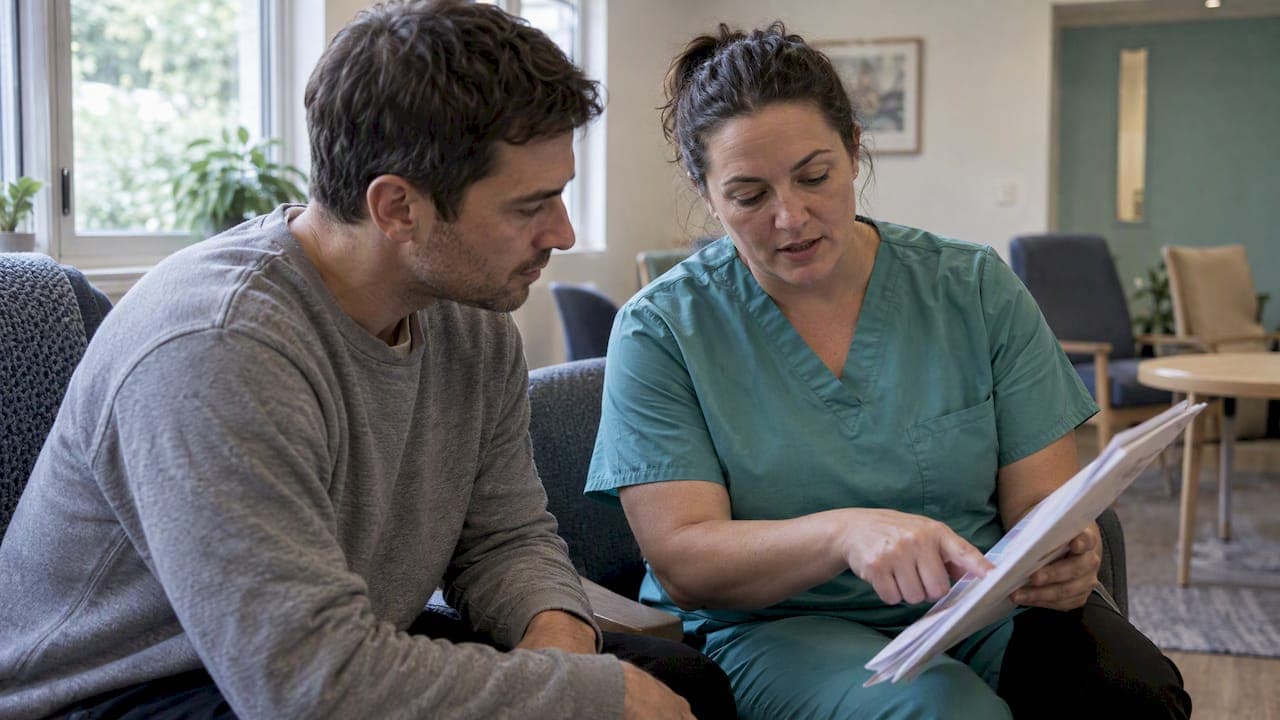
An inpatient rehab schedule is a structured daily routine that blends medical monitoring, medication administration when needed, individual and group therapy, case management, and planned wellness or recreation time, typically organized from wake-up to lights-out. The schedule shifts during the first 24 to 72 hours of detox, and a credible program will put the full plan in writing and individualize it to each patient.
TL;DR:
- During the first 24 to 72 hours, detox usually prioritizes frequent vital checks and clinically timed medication; alcohol withdrawal can peak during this window.
- MedlinePlus lists seizures, severe confusion, hallucinations, fever, irregular heartbeat, and declining responsiveness as alcohol withdrawal emergencies requiring immediate medical response.
- Before admission, request the current written schedule and treatment plan, including individual therapy frequency, medication checks, family contact rules, and discharge planning milestones.
- For patients with mental health conditions alongside substance use, programs may schedule earlier psychiatric evaluations, add focused groups, or adjust medications and rest periods.
- Discharge planning should begin before the final day, with referrals, medication continuity, and appointments arranged; aftercare may include intensive outpatient care, weekly counseling, or sober living.
Table of Contents
- Sample Inpatient Daily Schedule From Wake to Lights-Out
- What Happens During Detox and the First 24 to 72 Hours
- What Patients Actually Do: Therapy, Medical Care, and Daily Activities
- How Schedules Are Personalized and What to Request in Writing
- Transitioning Out: Discharge Planning and Life After Inpatient Care
- Scheduling Adjustments for Co-Occurring Mental Health Conditions
- How Sleep and Rest Are Built Into the Daily Routine
- Family Program Sessions and Where They Fit in the Week
- Relapse Prevention Woven Into the Weekly Schedule
- Case Management Sessions and How Often They Happen
- Why Structure and Medical Safety Should Drive Your Choice
- How Connected Recovery Structures a Day of Care
- FAQ
- Sources
Sample Inpatient Daily Schedule From Wake to Lights-Out
Most residential programs follow a block schedule rather than a rigid hour-by-hour grid, but the blocks repeat enough that you can picture a typical weekday. A sample timetable, built around common structures used across residential programs, looks something like this:
- 7:00 to 8:00 AM: wake-up, hygiene, and vital-sign checks, which let nursing staff catch early withdrawal or medical issues before the day starts.
- Morning: breakfast and medication rounds, when prescribed medications are administered under supervision.
- Morning: a process group or psychoeducation session focused on building coping and relapse-prevention skills.
- Late morning: individual therapy, scheduled on rotation since most programs cannot offer one-on-one sessions to every patient at the same time.
- Midday: lunch, followed by a rest or free period.
- Afternoon: a group session, often cognitive-behavioral or skills-based.
- Afternoon: recreation or wellness time, such as walking, yoga, or an expressive therapy like art or music.
- Late afternoon: case management check-in, family contact window, or a scheduled call with a counselor about discharge planning.
- Evening: dinner and medication rounds.
- 7:00 to 8:30 PM: a support-group meeting, educational film, or a lighter evening group.
- Before lights-out: wind-down time, journaling, or reading.
Weekends tend to carry fewer formal groups and more recreation, visitation, or mutual-support meetings. Medical appointments, psychiatric evaluations, and lab work can bump other blocks on any given day, which is normal rather than a sign that the program is disorganized.
Each block exists for a reason. Medication rounds exist for safety and withdrawal management. Group therapy builds skills in a setting where patients can practice them with peers. Recreation supports physical and emotional regulation, which matters for people whose sleep and stress systems have been disrupted by substance use. SAMHSA's guidance on what to expect from treatment frames a full day of scheduled activity as a tool that builds structure and supports abstinence, not simply a way to fill time.
Pro Tip: Ask for the actual printed or digital schedule the facility uses that week, not a marketing version, so you can see real session names, times, and staff coverage.
What Happens During Detox and the First 24 to 72 Hours
The first days of inpatient care often look nothing like the sample schedule above, because withdrawal management takes priority over programming. Expect frequent vital-sign checks, nursing assessments, and medication given on a schedule set by clinical need rather than a printed timetable.
Withdrawal timing varies by substance. According to MedlinePlus, alcohol withdrawal tends to begin within 8 hours of the last drink and typically peaks between 24 and 72 hours, while opioid withdrawal may begin within 12 hours after the last heroin use or within 30 hours after the last dose of methadone.

One figure worth knowing: alcohol withdrawal can become life-threatening, and MedlinePlus lists seizures, severe confusion, hallucinations, fever, irregular heartbeat, and declining responsiveness as emergency warning signs that require immediate medical response rather than routine care.
Because of this risk window, a program with 24/7 medical staff on-site is built to catch these signs early, which is part of why detox is often recommended in a supervised setting rather than at home. Once vital signs stabilize and acute withdrawal symptoms ease, most patients move into the fuller daily schedule with groups, individual sessions, and planned activity.
What Patients Actually Do: Therapy, Medical Care, and Daily Activities
A full day in residential treatment mixes several distinct components, each targeting a different part of recovery.
- Individual therapy usually happens once or a few times weekly and may draw on cognitive-behavioral techniques or motivational interviewing to address personal triggers and goals.
- Group therapy fills more of the daily schedule than individual sessions because it lets staff reach more patients while building peer accountability.
- 12-step facilitation sessions, where offered, function as preparatory individual counseling that introduces mutual-support concepts rather than as medical treatment itself.
- Medication rounds and nursing checks happen multiple times a day, and for opioid use disorder, medication is considered a first-line treatment usually combined with behavioral therapy rather than used alone.
- Psychiatric review is scheduled for patients with medication needs or co-occurring mental health conditions.
- Case management and discharge-planning meetings address practical needs like insurance, housing, and follow-up care.
- Wellness activities, including yoga, exercise, and expressive therapy, round out the day and support physical and emotional regulation.
A residential schedule, as SAMHSA and NIDA's combined guidance on treatment suggests, is built from this full mix rather than consisting only of group meetings.
How Schedules Are Personalized and What to Request in Writing
No two patients should receive an identical copy of the sample schedule above. SAMHSA's guidance recommends that every inpatient leave with a written treatment plan covering diagnosis, goals, and next steps, built from an honest intake assessment rather than a generic template.
Before committing to a program, ask for the following in writing:
- Wake-up and lights-out times, and how much flexibility exists around them.
- Frequency of medical checks and medication rounds, especially during the first week.
- How often individual therapy is available, not just group sessions.
- Family-contact, visitation, and phone-access rules.
- Expected length of stay and how insurance coverage affects that timeline.
- Discharge-planning milestones and when that process begins.
- How the schedule changes if a co-occurring mental health condition is diagnosed.
- Who to contact if the written schedule and the actual daily routine do not match.
A credible answer names specific staff roles, specific time windows, and a process for updating the plan, rather than vague reassurances.
Pro Tip: Request the written treatment plan on paper or by e-mail before admission day, so you have something concrete to compare against the actual routine once your loved one is admitted.
Transitioning Out: Discharge Planning and Life After Inpatient Care
Discharge planning typically starts well before the final day, not as a last-minute step. Case managers coordinate referrals, confirm medication continuity, and schedule the first follow-up appointments so the transition does not leave a gap in care. Our discharge planning guidance walks through what that clinical handoff typically includes.
After discharge, daily structure usually steps down rather than disappearing:
- Intensive outpatient programs often meet several times a week for a few hours per session, built around counseling, group therapy, and family education.
- Standard outpatient counseling typically meets weekly or biweekly.
- Sober-living environments add house routines like curfews and chores alongside outside treatment.
- Mutual-support groups add regular, often weekly, peer meetings that complement but do not replace clinical care.
NIDA's treatment principles frame recovery as a continuum, where residential care, step-down levels, and aftercare each play a distinct role and where an adequate duration of engagement across that continuum matters more than any single stage.
Scheduling Adjustments for Co-Occurring Mental Health Conditions
When a patient is managing a mental health condition alongside substance use, the standard schedule usually gets modified rather than replaced. Psychiatric evaluation happens earlier in the stay, and psychiatric review sessions recur more frequently than for patients without a co-occurring diagnosis.
Group therapy selection often changes too. Programs may add groups focused specifically on mood regulation, trauma, or anxiety alongside standard substance-use groups, and individual therapy sessions may run longer or more often to address both conditions together rather than in separate tracks. Medication rounds can also expand to include psychiatric medications on a different timing than medications used for withdrawal management, which means nursing staff track two medication schedules rather than one.
Rest periods and activity pacing sometimes shift as well, since some psychiatric medications affect sleep or energy levels. A program built for dual diagnosis care typically treats these adjustments as a normal part of the written treatment plan rather than as exceptions, since the underlying principle, as described in SAMHSA and NIDA guidance, is that the schedule should match the individual's actual clinical picture.

How Sleep and Rest Are Built Into the Daily Routine
Sleep disruption is common in early recovery, so most schedules protect specific blocks of rest rather than leaving it to chance. A consistent lights-out time anchors the evening, and a matching wake time anchors the morning, which helps reset a sleep cycle that substance use often disrupts.
Beyond nighttime sleep, many schedules include a short rest or quiet period after lunch, giving patients a break between morning groups and afternoon programming. This is less about napping and more about preventing the fatigue that can make therapy sessions less productive later in the day.
During detox, rest periods often expand and become less structured, since withdrawal symptoms can affect sleep quality and nursing staff may need to check in more frequently overnight. Once a patient stabilizes, the schedule typically returns to a steadier sleep and wake rhythm, which supports the kind of consistent daily structure that SAMHSA's guidance on treatment expectations ties to building control and supporting abstinence.
Family Program Sessions and Where They Fit in the Week
Family involvement is usually scheduled as its own recurring block rather than squeezed into visitation time. Many residential programs set aside a specific afternoon or evening each week for family therapy sessions, family education groups, or structured phone and video calls with a counselor present.
The timing matters because family sessions often happen after a patient has had time to stabilize and engage with individual therapy first, so there is clinical context to work from. A family session occurring early in a longer stay looks different from one happening near discharge, when the focus shifts toward home environment, communication patterns, and the family's role in aftercare.
Visitation and phone-contact rules are usually separate from formal family therapy, with their own windows during the week. When you ask a facility for its written schedule, it is worth asking specifically which blocks are clinical family therapy led by a counselor and which are informal contact time, since the two serve different purposes.
Relapse Prevention Woven Into the Weekly Schedule
Relapse prevention is not usually a single session near the end of a stay. It tends to show up as a thread running through several weekly groups, each addressing a different skill: recognizing triggers, planning for high-risk situations, and building a relapse-prevention plan that extends past discharge.
Many programs schedule a dedicated relapse-prevention group once or more per week, often later in the stay once a patient has enough stability to think concretely about situations they will face after leaving. Earlier sessions tend to focus on identifying personal triggers and warning signs, while later ones shift toward concrete plans, such as who to call and what steps to take if cravings intensify.
This work connects directly to discharge planning, since the relapse-prevention plan built during the stay typically becomes part of the written aftercare plan a patient leaves with. Scheduling it throughout the week, rather than as a single closing lecture, gives patients more chances to practice the skill before they need it outside a supervised setting.
Case Management Sessions and How Often They Happen
Case management sessions handle the practical side of treatment: insurance coordination, housing questions, legal or employment concerns, and the logistics of discharge. Most programs schedule a check-in with a case manager at least once a week, with more frequent contact in the first few days and again as discharge approaches.
Early case management sessions usually focus on intake logistics and immediate needs. Mid-stay sessions shift toward coordinating next steps, such as confirming insurance benefits for step-down care or arranging housing. Sessions near the end of the stay concentrate on discharge milestones, including scheduling the first outpatient or follow-up appointment before the patient leaves.
Because case management touches so many practical details, it is one of the items worth confirming in writing before admission: how often sessions happen, who the assigned case manager is, and when discharge planning formally begins.
Why Structure and Medical Safety Should Drive Your Choice
A full daily schedule is not filler. It is the mechanism that turns a short residential stay into something that actually changes behavior, especially when medical supervision is built into the first days of detox rather than added as an afterthought. Readers comparing programs should ask for the written treatment plan before admission, not after, and should weigh how clearly a facility integrates mental health care and discharge planning into that plan, not just how comfortable the facility looks.
— Jim
How Connected Recovery Structures a Day of Care
We built our residential setting around the idea that a daily schedule only works when it is matched to the person living it. Every patient receives medical supervision during medical detox, an individualized treatment plan for residential treatment, and integrated care for co-occurring mental health conditions through our dual diagnosis treatment program.

Because we keep our census small, our team can adjust medication rounds, therapy timing, and family sessions around a patient's actual clinical needs rather than fitting them into a one-size schedule.
- We provide 24/7 medical monitoring starting from admission, not only during acute withdrawal.
- We build a written, individualized treatment plan for every patient admitted.
- We integrate medication-assisted treatment where clinically appropriate through our MAT program.
If you want to see what a day with us actually looks like, request our current written timetable along with a benefits and coverage estimate before you decide. Explore our full range of addiction treatment programs to find the right starting point for your situation.
This article is general information, not a substitute for advice from a qualified doctor. Consult a qualified healthcare professional about your own circumstances before acting on anything here.
FAQ
What is the 3-hour rule for inpatient rehabilitation?
The 3-hour rule generally refers to a Medicare requirement for inpatient rehabilitation facilities, under which patients must be able to tolerate and benefit from at least 3 hours of intensive therapy per day, typically 5 days a week. This rule applies specifically to Medicare-certified inpatient rehabilitation facilities focused on physical rehabilitation, which is a different setting from residential addiction treatment programs.
What are the 5 stages of rehab?
Addiction treatment is more commonly described as a continuum of care rather than a fixed 5-stage model, moving through assessment, detoxification, residential or inpatient treatment, step-down care such as intensive outpatient treatment, and aftercare or ongoing support. NIDA's treatment principles frame recovery as a process across this continuum rather than a fixed sequence of five identical steps for every patient.
How many days does Medicare allow you to stay in a rehab facility?
Medicare coverage rules for rehabilitation stays vary by the type of facility and the patient's specific benefit period, and the authoritative sources reviewed here do not set a single universal day count that applies to every case. Coverage details are plan- and situation-specific, so confirming exact allowed days with Medicare or the admitting facility directly is the reliable way to get an answer that matches your coverage.
How many days does rehab typically last?
Length of stay varies by program type and clinical need rather than following one standard number, and NIDA's research-based guidance notes that treatment needs to last long enough to produce stable change, with longer engagement across the full continuum generally associated with better outcomes. There is no single predetermined length that applies to everyone, so a facility should explain how it determines your expected stay as part of your written treatment plan.
How does detox change the daily schedule compared to later in treatment?
During detox, the first 24 to 72 hours are built around medical monitoring, frequent vital-sign checks, and medication for withdrawal management rather than the fuller mix of groups and activities used later. MedlinePlus notes that alcohol withdrawal typically peaks within this window, after which most patients move into the broader schedule of therapy, case management, and wellness activities.
Sources
- Alcohol withdrawal: MedlinePlus Medical Encyclopedia
- Principles of Drug Addiction: A Research-Based Guide (Third Edition)
- Mental Health, Drugs and Alcohol Treatment: What to Expect? | SAMHSA