
Hallucinations during withdrawal are a medical warning sign, not something to wait out at home. They most often appear in alcohol withdrawal, usually within the first day, and they can be the first sign of a condition that becomes life-threatening by day two or three. If you or someone you love is seeing, hearing or feeling things that are not there after stopping alcohol or other drugs, call 911 or go to the nearest emergency room. The safest place to get through the rest of withdrawal is a medically supervised detox, such as our medical detox program in Van Nuys, where nurses and physicians watch for exactly these changes around the clock.
TL;DR
- Alcohol withdrawal hallucinations typically begin 12 to 24 hours after the last drink, and may start earlier. They can be visual, auditory or tactile.
- Hallucinations with confusion, fever, a racing pulse or sweating can mean delirium tremens, which usually appears 48 to 72 hours after the last drink and needs emergency care.
- Opioid withdrawal rarely causes hallucinations, but psychosis has been reported, especially after stopping methadone or long-term opioid therapy.
- Benzodiazepines are the first-line treatment for moderate and severe alcohol withdrawal, given under clinical monitoring.
- A small, supervised setting lets staff catch the shift from hallucinations to delirium early.
Table of Contents
- What withdrawal hallucinations are
- Alcohol withdrawal hallucinations: what they look and sound like
- When they start and how long they last
- Hallucinosis versus delirium tremens
- Can opioid withdrawal cause hallucinations?
- When to call 911
- How hallucinations are treated
- Why supervised detox is the safer route
- After the hallucinations stop
- Our approach in Van Nuys
- Perspective
- FAQ
- Sources
What withdrawal hallucinations are
A hallucination is a perception with no outside source: a voice no one else hears, a shape that is not there, a feeling of insects crawling on the skin. In withdrawal, the brain has adapted to a substance that slowed or calmed it. When the substance is removed, the nervous system overshoots into overactivity. In alcohol withdrawal, the loss of GABA-A receptor stimulation and a rise in dopamine contribute to autonomic hyperarousal and hallucinations.
Alcohol is by far the most common cause. A 2024 review in Annals of Emergency Medicine found that hallucinations occur in roughly 7 to 8 percent of patients with alcohol withdrawal syndrome. That is a minority, but it is a group that needs closer observation.
Alcohol withdrawal hallucinations: what they look and sound like
Clinicians use the term alcoholic hallucinosis for hallucinations that happen while the person is still aware of where they are and what day it is. The Annals of Emergency Medicine review describes tactile hallucinations as common, visual ones as less likely, and auditory ones, sometimes persecutory, as possible, with a normal sensorium (clear awareness of surroundings).
The Merck Manual notes that the hallucinations are often accusatory or threatening, while a 2023 review in Psychopathology describes voices that usually involve one or two speakers repeating words or short phrases. Either way, they are frightening, and a frightened person may act on them.
When they start and how long they last
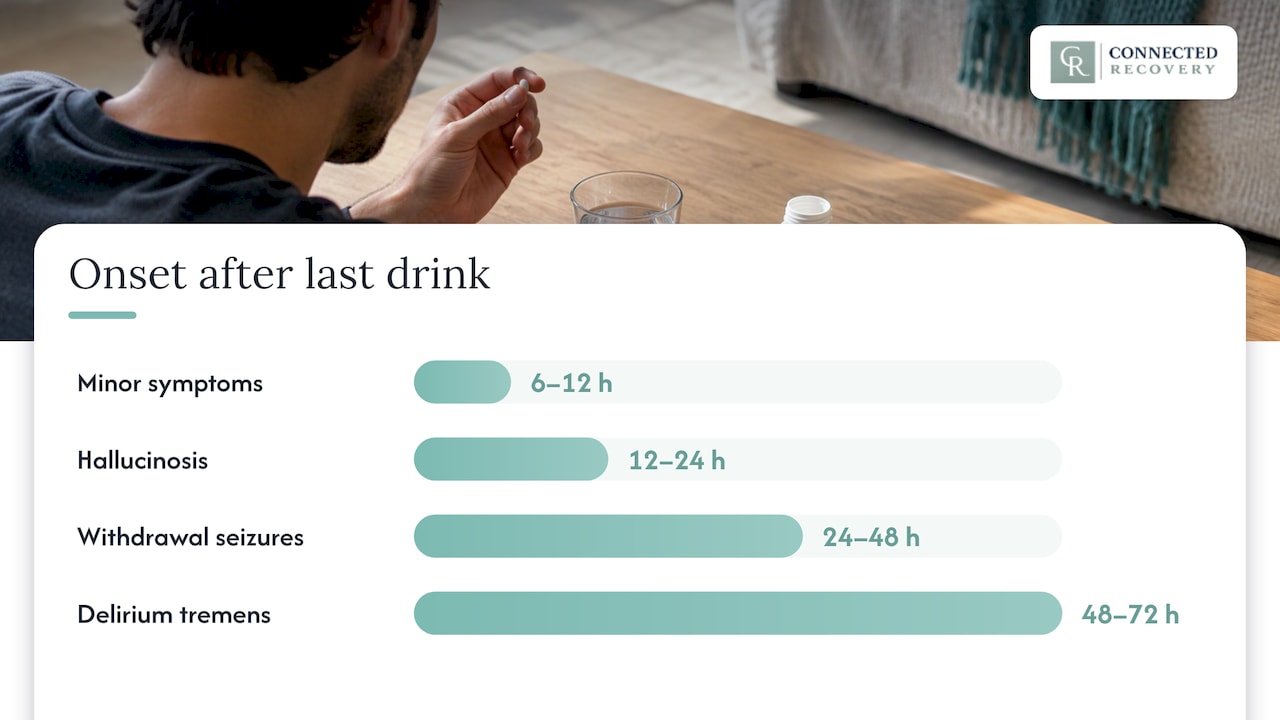
Sources differ slightly, because people differ. The pattern across the clinical literature looks like this:
| Time after last drink | What can happen |
|---|---|
| 6 to 12 hours | Minor symptoms: tremor, anxiety, sweating, insomnia, stomach upset |
| 12 to 24 hours | Alcoholic hallucinosis: visual, auditory or tactile |
| 24 to 48 hours | Withdrawal seizures |
| 48 to 72 hours | Delirium tremens, with symptoms sometimes lasting up to 5 days |
The timeline comes from the Cleveland Clinic Journal of Medicine. The American Academy of Family Physicians says alcoholic hallucinosis generally resolves within 48 hours. A 2016 review adds that hallucinations while conscious are a sign of moderate withdrawal that can last up to 6 days, and that hallucinosis can even begin while a person is still drinking. A 2020 emergency medicine review places the start as early as 8 to 12 hours after the last drink.
Two practical points follow. First, do not use the 24-hour mark as a finish line: the riskiest window for delirium is later, 48 to 96 hours after the last drink. Second, our hour-by-hour alcohol withdrawal timeline lays out the red flags in each window if you are supporting someone through it.
Hallucinosis versus delirium tremens
This is the distinction that matters most, and families often cannot tell the two apart.
Alcoholic hallucinosis. The person hallucinates but stays oriented. The BMJ's 2025 clinical review separates it from delirium by the absence of encephalopathy and autonomic dysregulation. Pulse, temperature and blood pressure stay relatively steady.
Delirium tremens (DTs). The AFP lists agitation, sweating, disorientation, mostly visual hallucinations, high blood pressure, low-grade fever and a fast heart rate, appearing 48 to 72 hours after the last drink and peaking around day 5. The Merck Manual describes marked delirium with gross disorientation, a pulse above 120 beats per minute and a temperature above 37.8°C (100°F), and a high risk of death.
Hallucinosis usually comes first and is transient, but it can be the early stage of the more dangerous condition. The same review notes that about one in three people with withdrawal seizures go on to develop delirium tremens. For more on that risk, see our guide to alcohol withdrawal seizures.
Can opioid withdrawal cause hallucinations?
Rarely. Classic opioid withdrawal is miserable but typically involves aches, nausea, sweating, anxiety and sleeplessness rather than hallucinations. Still, cases exist. A 2024 Cureus case report describes psychosis after methadone withdrawal, with paranoid delusions and auditory, visual and acoustic hallucinations. The authors point to changes in dopamine activity as one possible explanation.
A 2022 case report from the International Association for the Study of Pain describes a patient with no psychiatric history who developed persistent auditory hallucinations after stopping chronic opioid therapy. The takeaway is practical: hallucinations after stopping opioids deserve a prompt medical evaluation, and they are a reason to combine detox with psychiatric assessment. Our opioid addiction treatment and medication-assisted treatment programs are built around supervised withdrawal.
Other substances, including benzodiazepines, can also produce severe withdrawal with perceptual changes. The same goes for stopping any sedative suddenly, which is why tapering under medical guidance matters.
When to call 911
Do not wait for a morning appointment. Go to the nearest emergency room or call 911 if hallucinations come with any of these:
- Confusion about where they are, who you are, or what day it is
- Fever, drenching sweats, or a pulse that feels very fast
- Seizure, or shaking that will not stop
- Agitation, or fear that leads to dangerous behavior
- Severe vomiting, or inability to keep fluids down
Cleveland Clinic advises going to the nearest emergency room or calling 911 for any concerning alcohol withdrawal symptom. The AFP treats new-onset hallucinations, confusion or seizures as signs of complicated withdrawal that calls for emergency department referral.
There is also a vitamin side to this. The BMJ review warns that thiamine deficiency must be assessed and treated aggressively, because Wernicke encephalopathy, marked by confusion, abnormal eye movements and unsteady gait, is a medical emergency requiring immediate injected thiamine.
If the person is a danger to themselves or others, or you hear talk of self-harm, call 911 or the 988 Suicide & Crisis Lifeline. SAMHSA's National Helpline is also a free, confidential, 24/7 referral service in English and Spanish.
How hallucinations are treated
The ASAM Clinical Practice Guideline on Alcohol Withdrawal recommends benzodiazepines as first-line treatment for moderate and severe withdrawal, with longer-acting agents preferred. For people with hallucinations, it lists diazepam as an option, and psychiatric consultation with added antipsychotics where needed. For delirium, patients are sedated to light somnolence with benzodiazepines, very large doses may be needed, and antipsychotics are only an adjunct, not monotherapy.
There is a reason antipsychotics are used carefully. A 2020 review cautions that they can mask signs of progressing withdrawal and delay definitive treatment. That judgment call, and the dosing that goes with it, belongs to a clinician watching vital signs, not to a person at home. For readers who want to understand how benzodiazepine-based care is managed safely, this overview of benzodiazepine dependence management is a good companion. Some programs also use phenobarbital in appropriate settings.
Why supervised detox is the safer route
Hallucinations are unpredictable. A person can be oriented at noon and confused by night. That is the core problem with riding it out at home: nobody is measuring blood pressure, pulse and temperature, nobody can give medication the moment symptoms shift, and the family is left deciding in the dark whether this is a bad night or an emergency. We explain the risks in why alcohol detox at home needs medical supervision, and our note on blood pressure spikes in early detox shows one of the vital signs staff track.
Timing also matters. The first 72 hours set the pace of monitoring, as covered in our piece on inpatient alcohol detox length. Repeated detoxes can make each one harder, a pattern described in alcohol kindling, which is one more reason to do it right the first time.
After the hallucinations stop
Hallucinations that fade do not always mean the story is over. The BMJ review notes that psychotic symptoms can persist beyond acute withdrawal, and that up to 10 percent of cases could progress to a schizophrenia or bipolar spectrum disorder, which warrants mental-health follow-up. A 2023 review also warns that if hallucinosis lasts one to two weeks, there is a danger of chronic hallucinosis.
That is why detox is the first step and not the whole plan. Anxiety, depression and other mental health conditions often sit underneath substance use, and our dual diagnosis treatment addresses both together. Planning for what comes next is handled through aftercare planning and discharge planning.
Our approach in Van Nuys
Connected Recovery is a boutique, accredited 12-bed facility in Van Nuys, Los Angeles, serving adults. Our programs include medically supervised detox with 24/7 medical supervision, residential treatment, dual diagnosis care, medication-assisted treatment and aftercare planning, all under one roof. With only 12 beds, each person gets individualized attention, and the setting is meant to feel like a private retreat rather than an institution.
If you are worried about someone who is hallucinating, start with emergency care if they are in danger. When they are stable, our admissions team can talk through medical detox and residential treatment options, including private pay and insurance questions, in a discreet, confidential conversation.

Perspective
Families often call us after a bad night. The person has stopped drinking, they are seeing or hearing things, and no one knows whether to wait or act. Our answer is always the same: hallucinations are information, and the right response is a medical one.
What the research shows, and what we build our program around, is that the hours between hallucinosis and delirium are where close observation earns its keep. A small facility means the person watching your family member knows them, notices the change in tone or the damp forehead, and acts early.
We also think detox is only the first chapter. When hallucinations come with anxiety, depression or trauma, treating the substance use alone leaves half the problem. Integrated dual diagnosis care, medication-assisted treatment where appropriate and a real plan for aftercare are how we aim for recovery that lasts.
Jim
FAQ
How long do alcohol withdrawal hallucinations last?
Alcoholic hallucinosis generally resolves within about 48 hours, according to the AFP. In some people, symptoms of moderate withdrawal including hallucinations can last up to 6 days. If they continue for one to two weeks, tell a physician, because that can point to a longer-lasting condition.
Is alcohol hallucinosis the same as delirium tremens?
No. In hallucinosis, the person is hallucinating but still aware of their surroundings, and vital signs are usually steady. Delirium tremens involves confusion, fever, sweating and a fast pulse, and is an emergency. Because hallucinosis can come before DTs, any hallucination in withdrawal should be evaluated by a medical professional.
Can anxiety or lack of sleep cause hallucinations during detox?
Insomnia and anxiety are common early withdrawal symptoms, and they often show up alongside perceptual changes such as vivid dreams or illusions. Our article on anxiety and alcohol explains why this rebound happens. Seeing or hearing things that are not there is different, and should be treated as a reason to get medical help.
What should I do if someone is hallucinating during detox?
Stay with them, keep the room calm and well lit, and do not argue with what they perceive. Call 911 if they are confused, feverish, seizing or agitated. Once the emergency is over, a medically supervised detox gives them monitoring and treatment through the highest-risk days.
Sources
- Alcohol withdrawal syndrome: mechanisms, manifestations, and management (PMC, 2016)
- Managing Alcohol Withdrawal Syndrome, Annals of Emergency Medicine (2024)
- Acute Alcoholic Hallucinosis: A Review, Psychopathology (2023)
- Alcohol Toxicity and Withdrawal, Merck Manual Professional Edition (2025)
- Cleveland Clinic Journal of Medicine, Table 1 (2016)
- Alcohol Withdrawal Syndrome: Outpatient Management, AFP (2021)
- Management of Alcohol Withdrawal in the Emergency Department (PMC, 2020)
- BMJ clinical review on alcohol withdrawal (2025)
- Methadone Withdrawal-Induced Psychosis: A Case Report (2024)
- Case Report: De Novo and Persistent Psychosis After Withdrawal of Chronic Opioid Therapy (IASP, 2022)
- Alcohol Withdrawal: Symptoms, Treatment & Timeline, Cleveland Clinic (2024)
- ASAM Clinical Practice Guideline on Alcohol Withdrawal (2020)
- ASAM alcohol withdrawal guideline, approved draft (2020)
- SAMHSA National Helpline