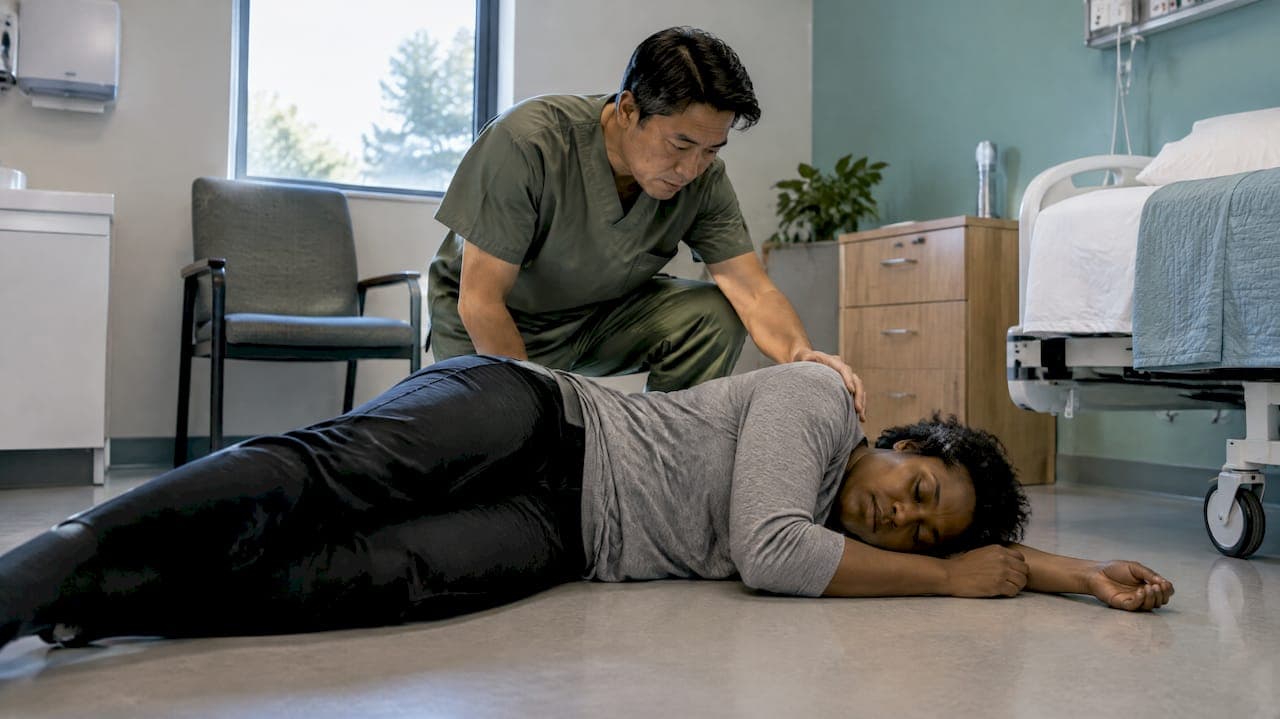
Alcohol withdrawal seizures are convulsions that can happen when someone who drinks heavily stops or cuts back sharply. They usually appear 6 to 48 hours after the last drink, and risk peaks around the 24-hour mark. They are a medical emergency. If someone is seizing, call 911. If you or someone you love drinks daily and wants to stop, the safest move is to arrange medical supervision before the last drink, not after symptoms begin.
TL;DR
- Withdrawal seizures are typically generalized tonic-clonic: shaking of the arms and legs with loss of consciousness. Most appear 12 to 24 hours after the last drink, though risk can last up to 48 hours.
- Seizures occur in roughly 5% to 10% of people in active alcohol withdrawal, and more than half of those who have one have repeated seizures.
- A past withdrawal seizure, epilepsy, brain injury, other drug use and repeated detoxes all raise the risk.
- A seizure is a reason to call 911 or go to the nearest emergency room, not to wait it out.
- Supervised medical detox, with monitoring and appropriate medication, is designed to catch and manage withdrawal before it turns dangerous.
Table of Contents
- What an alcohol withdrawal seizure is
- Why stopping alcohol can cause a seizure
- When seizures happen: the timeline
- Early warning signs before a seizure
- Who is most at risk
- How serious are they?
- What to do if someone has a seizure
- How supervised detox lowers the risk
- Our perspective
- Safe, supervised detox in Van Nuys
- FAQ
- Sources
What an alcohol withdrawal seizure is
An alcohol withdrawal seizure is a burst of abnormal electrical activity in the brain triggered by stopping alcohol after prolonged heavy use. The typical form is a generalized tonic-clonic seizure. The person stiffens, falls, shakes rhythmically and loses consciousness. According to emergency medicine literature, this is the usual presentation.
These seizures are different from epilepsy. A person can have no seizure history at all and still have one during withdrawal. The seizure is a symptom of the withdrawal state, not necessarily a sign of an underlying seizure disorder, though the two can overlap.
Why stopping alcohol can cause a seizure
Alcohol is a central nervous system depressant. With steady heavy drinking, the brain adapts to keep itself running. It turns down its own calming signals and turns up its excitatory ones. Researchers describe this as reduced inhibitory GABA activity and increased excitatory glutamate activity. While alcohol is in the system, the two effects roughly balance.
When alcohol is suddenly removed, the balance breaks. The brain is left with too much excitation and too little braking, a state of central nervous system hyperexcitability. A seizure is one way that overload shows up. The same research suggests the trigger for these seizures is mediated largely by brainstem mechanisms and differs from the pathways behind epileptic seizures.
This is why willpower, hydration or a few hours of rest do not solve the problem. The brain chemistry has already shifted, and it needs to be stepped down in a controlled way.
When seizures happen: the timeline
People often ask how long after quitting drinking a seizure can happen. The sources agree on a window, with small differences in wording:
| Source | Seizure timing |
|---|---|
| Harvard Health | 6 to 48 hours after the last drink; several seizures over a few hours are common; risk peaks at 24 hours |
| Emergency medicine review | Most common 12 to 24 hours after the last drink; risk can last up to 48 hours |
| Cleveland Clinic | Withdrawal symptoms generally begin within 6 to 24 hours of stopping heavy, long-term use |
| Academic review, 2016 | Acute symptomatic seizures may emerge 6 to 48 hours after the last drink |
The practical takeaway: the first two days are the highest-risk period for seizures. Delirium tremens, the most severe form of withdrawal, tends to come later, usually 48 to 72 hours after the last drink. That means a person can get through a seizure window and still face another serious phase. For an hour-by-hour look, see our alcohol withdrawal timeline with red flags.
What the "danger zone" really means
There is no single hour that makes withdrawal safe. The danger zone is the whole first 72 hours, with seizures concentrated early and delirium tremens later. Symptoms can also escalate quickly. Someone who feels shaky and anxious at hour 8 can be convulsing at hour 20.

Early warning signs before a seizure
Mild withdrawal symptoms often come first. They include:
- Tremor or shaking hands
- Sweating and a racing heart
- Nausea or vomiting
- Anxiety, irritability and trouble sleeping
- Headache
These symptoms alone do not predict a seizure, and a seizure can arrive without much warning. Clinical guidance from the American Society of Addiction Medicine (ASAM) says patients should be monitored for withdrawal seizures even when other prominent signs are absent. That is the core reason mild symptoms should never be treated as proof that it is safe to ride it out alone.
If anxiety is a big part of your drinking pattern, our piece on anxiety and alcohol, and when detox needs medical care explains how the rebound feeling can mask how much your body has adapted.
Who is most at risk
Not everyone who stops drinking has a seizure, but certain factors raise the odds. A 2016 academic review lists these:
- A history of withdrawal seizures. A similar prior event is a robust predictor of another one.
- Epilepsy or a seizure disorder.
- Structural brain lesions, such as from past head injury.
- Use of other drugs, especially sedatives.
- Repeated detoxifications. Each round of heavy drinking followed by abrupt stopping may make the brain more seizure-prone, a pattern researchers call kindling.
The kindling point matters for anyone who has quit "cold turkey" before and felt fine. A prior easy withdrawal does not guarantee the next one will be easy. If anything, a history of several unsupervised attempts is a reason to be more careful.
Combining substances adds another layer. Sedatives such as benzodiazepines and some other drugs carry their own withdrawal seizure risks. If you use more than one substance, tell the intake team plainly. Our article on seizure risk in tramadol withdrawal shows how this works for one common prescription drug.
How serious are they?
A single seizure is frightening and dangerous in itself: people can fall, hit their head, bite their tongue or stop breathing briefly. But the larger worry is what follows.
- According to the 2016 review, more than half of people who have one seizure have repeated seizures, and up to 5% may progress to status epilepticus, a prolonged seizure state that needs emergency treatment.
- Alcohol withdrawal is one of the most common causes of status epilepticus in the United States, even though multiple seizures are not common overall.
- A withdrawal seizure also raises the chance of delirium tremens. The same review reports that it can occur in up to 30% of such cases.
Harvard Health notes that delirium tremens is dangerous and life-threatening, and that severe vomiting, seizures or delirium tremens are safest treated in a hospital.
Can delirium tremens cause seizures?
They are linked, though the order usually runs the other way. A seizure often comes first and signals a more severe course, and delirium tremens, with confusion, hallucinations, fever and a racing heart, can follow. Seizures can also occur during delirium tremens. Either one calls for emergency care.
What to do if someone has a seizure
Call 911 or go to the nearest emergency room. Cleveland Clinic lists a seizure among the concerning withdrawal symptoms that require immediate medical attention. Do not wait to see if it passes, and do not let the person try to finish withdrawing at home afterward.
While you wait for help:
- Note the time the seizure started.
- Move hard or sharp objects away and cushion the head.
- Once shaking stops, roll the person onto their side.
- Do not put anything in their mouth and do not hold them down.
- Tell the paramedics when the last drink was and what else the person has taken.
In the emergency department, clinicians assess airway, breathing and circulation and give thiamine (vitamin B1) to help prevent Wernicke's encephalopathy, a practice described in current emergency medicine guidance. Benzodiazepines are the mainstay of treatment. ASAM's 2020 guideline advises treating a patient who has had a withdrawal seizure right away with a fast-acting agent such as lorazepam or diazepam, with injection preferred. The same guideline says a patient who has a seizure should be kept in a setting with close monitoring for 6 to 24 hours.
One more point from the research: a 2021 review found no evidence that phenytoin prevents withdrawal seizures in the emergency department, while benzodiazepines have the strongest evidence. This is why standard seizure medicines are not a substitute for proper withdrawal treatment.
How supervised detox lowers the risk
The point of medical detox is not comfort alone. It is to keep the brain's step-down controlled and to have trained eyes on you during the hours seizures are most likely. A well-run program generally includes:
- A medical assessment at intake: drinking history, past withdrawals or seizures, other substances, medical and psychiatric conditions.
- Regular symptom scoring and vital sign checks, so a change is spotted early.
- Medication to calm the overexcited nervous system, typically benzodiazepines, chosen and dosed by a clinician.
- Nutritional support, including thiamine.
- Round-the-clock staffing, because a seizure at 3 a.m. is no less dangerous than one at noon.
The first 72 hours set the pace for monitoring, which we explain in our guide to inpatient alcohol detox length. If you are weighing a home attempt, read why alcohol detox at home needs medical supervision first.
Why "just tapering at home" is risky
Some people try to taper by drinking a little less each day. For someone with a history of seizures, heavy daily use or multiple prior detoxes, that plan can fail at the worst moment: a missed drink, a bad night, a day without access. A clinician can judge whether outpatient management is even appropriate. That is the point of getting medical advice before you stop.
Our perspective
We built Connected Recovery around a simple observation: the people most at risk during withdrawal are often the ones who feel most pressure to do it quietly. They are worried about work, family or being seen. They try to handle it alone, and the first two days are exactly when that goes wrong.
With 12 beds, we can keep the setting small and personal. Our clients are not a number in a large unit. Our medical team provides 24/7 supervision, which matters because seizure risk does not follow business hours. We also treat co-occurring mental health conditions, because anxiety, depression and trauma frequently sit underneath heavy drinking and can make withdrawal harder to get through.
What we want people to know is that withdrawal is the beginning of the work, not the whole of it. A safe detox gets you through the dangerous hours. Residential treatment, therapy, medication-assisted options and aftercare planning are what help recovery last. We plan that path from the first day, so detox is not a dead end. If you are unsure whether you need to be supervised, call and ask. A conversation costs nothing, and a seizure at home can cost a great deal.
— Jim
Safe, supervised detox in Van Nuys
If you or a family member drinks heavily every day and wants to stop, our medical detox program offers 24/7 medical supervision in a small, private setting in Van Nuys, Los Angeles. After detox, clients can continue into residential treatment, and our alcohol addiction program is built around that continuum of care.

If mental health symptoms are part of the picture, our dual diagnosis treatment addresses both together. For questions about admissions, privacy or coverage, reach out through our website. If someone is having a seizure right now, call 911 first.
FAQ
How long after quitting drinking can you have a seizure?
Most withdrawal seizures occur 6 to 48 hours after the last drink, and the peak is around 24 hours. Several seizures within a few hours are common. Because the window is wide, anyone who drinks heavily and plans to stop should arrange medical supervision before the first day.
Can you have an alcohol withdrawal seizure without a history of epilepsy?
Yes. Withdrawal seizures come from the brain's rebound after alcohol is removed, not from epilepsy. Epilepsy, past head injury, other drug use and previous withdrawal seizures raise the risk, but a first seizure can still happen in someone with none of these.
Is one seizure a sign that more will follow?
Often, yes. Research reports that more than half of people with a withdrawal seizure go on to have repeated seizures, and some progress to status epilepticus. That is why a person who has had one needs emergency evaluation and close monitoring, not rest at home.
What are mild symptoms of alcohol withdrawal?
Mild symptoms include tremor, sweating, nausea, anxiety, irritability, headache and trouble sleeping. They can appear within hours of the last drink. Mild symptoms can worsen quickly, so they are a good reason to contact a medical provider, not a sign you are in the clear.
Can alcohol withdrawal seizures be prevented?
They can often be prevented or managed with medically supervised withdrawal. Clinicians monitor symptoms and use medication, usually benzodiazepines, to calm the nervous system. Preventing them depends on starting care early, so talk to a provider before you stop drinking.
Sources
- Update on the Neurobiology of Alcohol Withdrawal Seizures (Rogawski, 2005)
- Management of Alcohol Withdrawal in the Emergency Department
- Alcohol withdrawal syndrome: mechanisms, manifestations and management (2016)
- Introduction to Alcohol Withdrawal (PMC)
- Prevention of alcohol withdrawal seizure recurrence (2021)
- Alcohol Withdrawal, Harvard Health
- Alcohol Withdrawal: Symptoms, Treatment & Timeline, Cleveland Clinic
- ASAM Clinical Practice Guideline on Alcohol Withdrawal Management (2020)