
A single case agreement (SCA) is a contract your health plan signs with a treatment facility outside its network, for one patient and one stay. If your plan cannot offer a comparable in-network option in time, an SCA is the formal way to get an out-of-network program paid for. It is not automatic. Plans approve it when you can show that the network cannot meet your clinical need, so the strength of your request decides the outcome. At Connected Recovery, a 12-bed residential and detox facility in Van Nuys, Los Angeles, this is a question families raise when they want small-scale, personalized care and a plan that does not list the facility.
TL;DR
- An SCA is a one-patient, one-episode contract in which a plan agrees to pay a non-network provider. Its written terms set the services, the negotiated rate, and the duration and scope.
- Plans typically approve one when the network has no suitable provider within access standards, is at capacity, cannot meet a specific clinical need, or when continuity of care applies.
- The request usually starts with a documented clinical rationale and prior authorization. Do not start treatment before approval is in writing.
- If the plan delays or denies, you can file an internal appeal and then an independent external review, including an expedited track when the situation is urgent.
- Medicare, Medicaid and emergency admissions follow different rules, so ask your plan which path applies to you.
Table of Contents
- What a single case agreement actually is
- When a plan will approve one
- How to get a single case agreement, step by step
- What an SCA can cover and what it costs you
- Parity law is on your side when you ask
- How long it takes, and what to do if you are denied
- Questions to ask about any request
- Why a small facility can be the right clinical fit
- Our perspective
- Talk to us about your admission
- FAQ
- Sources
What a single case agreement actually is
Ordinary out-of-network coverage is a benefit written into your plan: you pay a higher deductible and coinsurance, and the plan reimburses a share of what it considers reasonable. An SCA is different. It is an exception the plan negotiates for you, case by case.
In one large national insurer's Maryland filing, the process is described like this: when a network gap exception is approved before treatment, the member pays the amount that applies to participating providers. If the plan and the provider then agree on an SCA, a Letter of Agreement specifies the authorized services, the negotiated reimbursement rate, and the duration and scope.
Two practical points follow from that:
- The cost to you can be closer to in-network levels. That is the main reason families ask for an SCA rather than relying on out-of-network benefits alone.
- The agreement is made between the plan and the facility. You cannot sign one yourself. The facility's admissions team and the plan's utilization management or case management staff do the negotiating, and you supply the clinical story and the paperwork.
Plan wording varies. Some insurers call it a network gap exception or a letter of agreement, and a Oregon Medicaid plan's handbook describes an SCA as a one-time agreement with a non-contracted provider for a specific member, and says an executed SCA is required before that provider can be paid. When you call, use all of those terms.
When a plan will approve one
Plans do not hand these out because a facility is a better fit in your opinion. They approve them against criteria. One behavioral health manager's policy lists the situations, and at least one must apply. Its clinical criteria include:
- No network resources for the required covered services within access standards of the member's residence.
- Network facilities at capacity, or practitioners unable to accommodate new patients.
- Clinical or service needs, such as clinical specialty, language, cultural sensitivity or gender, that network resources cannot meet.
- Member preferences that are relevant to treatment outcome.
- Continuity of care, with a documented history of out-of-network treatment.
- A network facility that is not contracted for a specific required modality.
The same policy says SCAs are not used when adequate network providers exist, for Medicare or Medicaid members, or for emergency inpatient admissions. Rules differ by plan and by state, though. A Michigan regional Medicaid-funded system, for example, has its own single-case procedure for substance use services that requires approval before treatment begins. So ask your specific plan how it handles your coverage type rather than assuming either way.
Which of those criteria fit residential detox and dual diagnosis
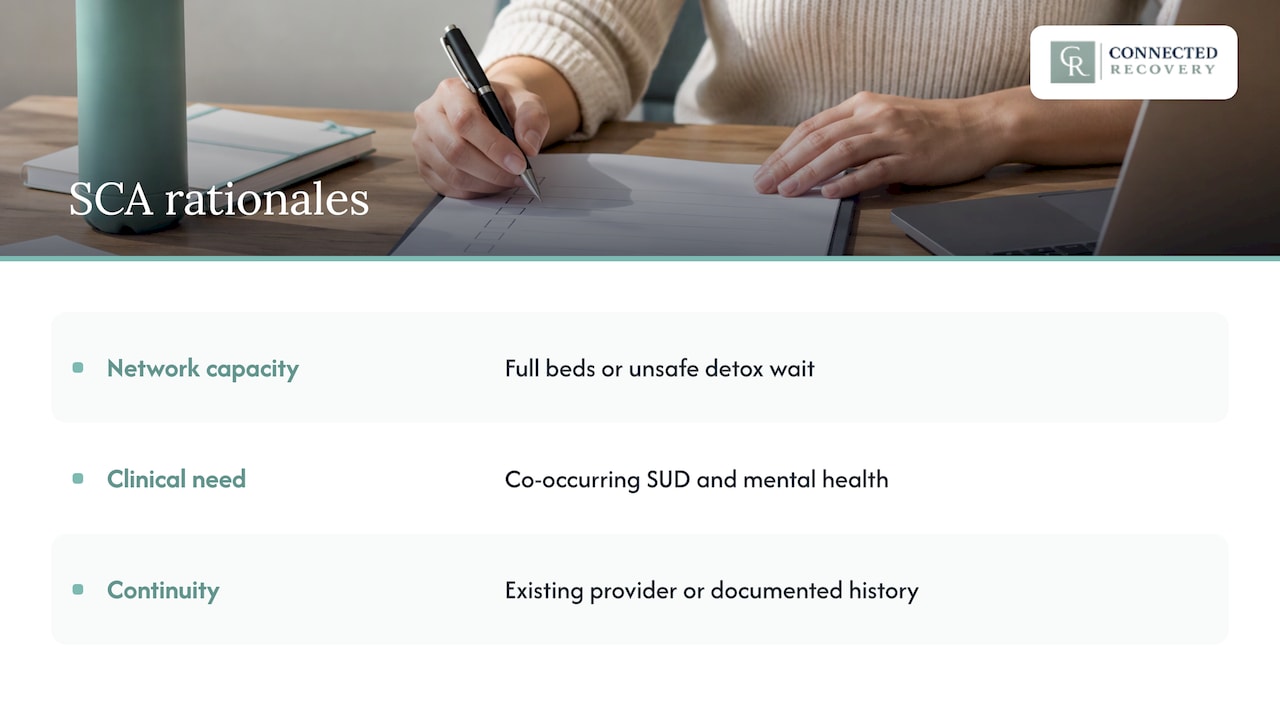
For addiction treatment, three of the criteria come up most often.
Network capacity and wait times. A person who needs medically supervised detox cannot wait weeks for an in-network bed. If the plan's listed facilities are full or cannot admit within a clinically safe window, document every call: the facility, the date, the person you spoke with and what they said.
A specific clinical need. Co-occurring conditions are the clearest example. When someone is facing both a substance use disorder and a mental health condition such as severe anxiety or depression, the treatment plan needs a program that addresses both at once. Our Dual Diagnosis Treatment integrates the two. If the network offers only substance-only programs, that gap is the clinical rationale to put in writing. Our article on anxiety and addiction treatment explains why the two are treated together.
Continuity of care. If you are already in treatment with a provider and the plan's network ends, or you have a documented history with a provider who has helped you, continuity of care can support the request.
How to get a single case agreement, step by step
1. Confirm your benefits and the network gap
Call the member services number on your insurance card and ask three things: whether your plan covers residential and detox levels of care, whether it has out-of-network benefits, and how it handles single case agreements or network gap exceptions. Write down the representative's name, date and reference number.
Then ask for a list of in-network detox and residential facilities and call them. What matters is not whether a facility exists on paper but whether it can admit you, treat your condition and do so within a reasonable time. Our guide to five exact questions to verify residential rehab coverage gives the wording to use on these calls.
Where it goes wrong: people accept a verbal "we don't do that" and move on. A refusal that is not documented is hard to use later. Ask the plan to confirm in writing that no suitable in-network provider is available.
2. Get the clinical rationale in writing
The request is a medical-necessity argument. A plan's guide for out-of-network providers in Pennsylvania, for example, requires a clinical rationale consistent with its out-of-network authorization policy, and it requires the provider to call before faxing forms; faxed forms without a call cannot be processed. Even where your plan's process differs, expect to supply:
- A diagnosis and an assessment of the level of care needed.
- A history of substance use, prior treatment and any co-occurring mental health conditions.
- Why the network options you tried cannot meet the need.
- The proposed facility, the level of care and an expected length of stay.
The treating facility normally helps assemble this. Our admissions team can talk through your situation by phone before you commit to anything.
3. Ask for prior authorization and for the SCA by name
Many plans require that all out-of-network services be authorized in advance, and some require the provider to start the request. One Medicaid managed care plan states that all non-participating provider services require prior authorization and that the request must be initiated by the provider. In a Michigan system, an SCA must be approved before treatment begins, or the provider may not be reimbursed.
That is why timing matters. If the case is urgent, say so explicitly and ask for an expedited review.
4. Let the plan and the facility negotiate the terms
Once a gap is accepted, the plan negotiates with the facility. Facilities are often asked for documents such as their state license, liability insurance certificate, accreditation certificate and level-of-care designation. The Michigan procedure lists all four, along with an ASAM level-of-care letter (ASAM is the American Society of Addiction Medicine, whose criteria define the levels of substance use care). The agreement that comes back should say which services are covered, at what rate, and for how long.
One plan's out-of-network guide notes that, once an SCA is in place, the provider may not seek payment from the member for authorized services except the applicable member cost share. Ask your plan whether the same applies to you, and get your cost share in writing before admission.
5. Confirm the details before the admission date
Check the letter against your plan: the level of care (detox, residential), the start date, the number of days authorized and the cost share. Authorizations are usually granted in blocks and reviewed as treatment continues. The Letter of Agreement scope in the Maryland filing is defined by services authorized through precertification and can be subject to ongoing clinical review. Plan for extension requests with your treatment team, supported by clinical notes.
What an SCA can cover and what it costs you
There is no standard rate or length. Each agreement says what it says.
| Term | What to look for |
|---|---|
| Services | The levels of care authorized: detox, residential, or both |
| Rate | Negotiated between plan and facility. Some plans default to a stated percentage of a fee schedule unless the SCA says otherwise |
| Duration | Set by the authorization and reviewed clinically |
| Your share | Often the in-network deductible and coinsurance, but confirm in writing |
Plan defaults illustrate how much variation exists. One Oregon plan's handbook says that from January 1, 2026, non-contracted providers are reimbursed at 90% of the state fee-for-service rate unless an SCA specifies otherwise. A national behavioral health manager's policy says that for commercial plans with no out-of-network benefit it reimburses at 100% of the corresponding rates when clinical criteria are met. These are examples from specific plans, not what your plan will do.
Parity law is on your side when you ask
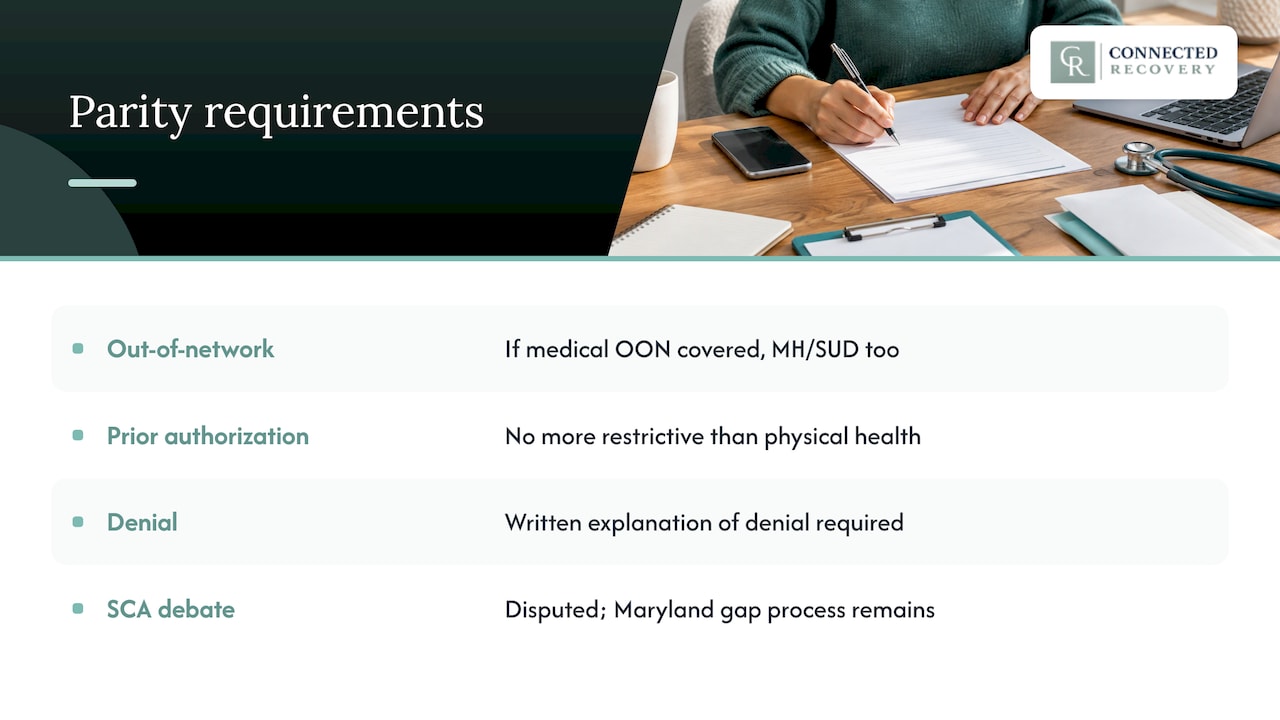
The Mental Health Parity and Addiction Equity Act (MHPAEA) is the federal law that requires plans covering mental health and substance use disorder benefits to treat them no more restrictively than medical and surgical benefits. For out-of-network care, the statute requires a plan that covers out-of-network medical or surgical benefits to cover out-of-network mental health and substance use benefits consistently with parity.
In practice, SAMHSA's guide for families says prior authorization standards for mental health and substance use services must be comparable to or less restrictive than for physical health services, and a plan that denies payment must give a written explanation of the reason. That written explanation is what you need to build an appeal.
Plans do not all treat SCAs the same way under parity. One insurer's regulatory filing objects that SCAs are not a parity-governed limitation at all, while committing to maintain network gap processes that meet Maryland's rule allowing a member to request an out-of-network specialist when no participating provider has the necessary expertise or access would involve unreasonable travel or delay. Whatever the legal debate, your practical lever is the same: a documented network gap.
How long it takes, and what to do if you are denied
There is no single timeline. Some plans move in days and some in weeks, and it depends on how quickly the clinical documents arrive. One insurer's out-of-network guide describes a process where, once an SCA is sent to the provider for signature, there are two automated outreach attempts over 10 calendar days before the plan loads the rates with an unsigned SCA so authorized services can be paid. That shows how administrative the back end is, but it says nothing about how fast your approval will be. Ask your plan for its expected turnaround at the first call and mark a follow-up date.
If the answer is a delay or a denial:
- Ask for the denial in writing with the specific reason and the criteria used.
- File an internal appeal. For most plans you have 180 days from the denial notice, and your treating physician's letter explaining why the network cannot meet your needs carries weight. HealthCare.gov explains internal appeals and your rights.
- Request an external review. If the internal appeal fails, you can ask an independent reviewer to decide. You must file a written request within 4 months of the denial notice. Standard external reviews are decided within 45 days, and expedited reviews within 72 hours or less depending on medical urgency. The insurer must accept the reviewer's decision.
- Use state resources. Your state insurance department can take complaints about delays and denials.
For someone in withdrawal or at risk, the expedited route matters most. If the situation is an emergency, call 911 or go to the nearest emergency department first. Paperwork comes second to safety.
Questions to ask about any request
When families call insurers and facilities, a few questions save the most time:
- Does my plan use the term single case agreement, network gap exception or letter of agreement?
- Which in-network facilities have you checked, and can any of them admit within the time my doctor says is safe?
- What documents do you need from the facility and from my physician?
- Is prior authorization required before admission, and who must submit it?
- What will my deductible and coinsurance be under the agreement?
- How will the authorization be extended if my clinicians recommend a longer stay?
Plans also publish ways to request an exception when their network lacks an appropriate provider, and some providers lay out their insurance and network questions on their own pages. Whatever you find, the written answer from your own plan is the one that counts.
Why a small facility can be the right clinical fit
An SCA request rests on need, and for many people the need is smaller scale and closer attention. Connected Recovery is an accredited 12-bed facility in Van Nuys, so each client's care plan is built around the individual instead of a large census. It offers Medical Detox with 24/7 medical supervision, Residential Treatment and Medication Assisted Treatment, together with dual diagnosis care for co-occurring mental health disorders. For many readers those specifics are the substance of the request: a particular combination of detox, residential and integrated mental health care that the network does not provide.
Our perspective
We built Connected Recovery around a simple idea: someone going through detox and early recovery should not feel like a bed number. Twelve beds means the people treating you know you, and treatment plans are tailored instead of copied from a template.
That is also why we encourage families to start with the clinical picture instead of the paperwork. If you are facing both addiction and a mental health condition, the first question is what level of care is safe and what program can treat both together. Our integrated approach, 24/7 medical supervision and planning from detox through aftercare exist for that situation.
Insurance conversations are easier when you have that clarity. Write down what you need, what you have already tried and what the network could not provide. Then bring it to your plan and to us.
Jim
Talk to us about your admission
If you or someone you love needs detox or residential treatment, start with the program that matches the need. Residential Treatment at Connected Recovery covers addiction and co-occurring mental health conditions in a private, boutique setting in Van Nuys, with aftercare and discharge planning built in. Our team can talk through your admission and your insurance or private pay situation, confidentially.

To see everything we treat, from alcohol and opioids to methamphetamine and cocaine, visit our programs page or reach us through connectedrecoverycenter.com.
FAQ
Can I ask for a single case agreement myself?
You can start the conversation by calling your plan and describing the network gap, but the agreement itself is between the plan and the facility. Many plans require the provider to submit the authorization request. Your role is to document what the network could not offer and to ask for the process by name.
Does a single case agreement work with Medicare or Medicaid?
It depends on the program. One behavioral health manager's policy excludes Medicare and Medicaid members from its SCA process, while a Michigan Medicaid-funded system and an Oregon Medicaid plan both describe SCAs for non-contracted providers. Ask your specific plan, because the answer is set by the plan and the state.
How long does an SCA last?
The agreement states its own duration and scope. Authorizations are typically granted for a defined period and are subject to continuing clinical review, so extensions are requested as treatment progresses.
What if my plan says no?
Ask for the denial in writing with the reason, then file an internal appeal. If that fails, you can request an independent external review within 4 months. Expedited external reviews are decided within 72 hours or less when the situation is urgent.
Do I still pay anything under an SCA?
Usually there is some cost share, and the amount depends on the agreement and your plan. Where an exception is approved before treatment, the Maryland process above sets the member's share at the amount that applies to participating providers. Confirm your figure in writing before admission.
Sources
- Aetna MHPAEA Summary Form, Maryland
- CareOregon Behavioral Health Utilization Management Handbook (July 2026)
- CareOregon Behavioral Health Utilization Management (December 2025)
- Carelon Behavioral Health SCA and OON Reimbursement Policy
- Carelon Behavioral Health OON Reimbursement Policy and SCA Negotiation Process
- Carelon Out-of-Network Provider Guide
- Carelon Single Case Agreement Companion Guide, Pennsylvania
- Mid-State Health Network SUD Single-Case Agreement Procedure
- Fidelis Care New Jersey provider training
- MHPAEA statute text (CMS)
- SAMHSA, Understanding Parity
- HealthCare.gov, External Review
- HealthCare.gov, Internal Appeals
- Insurance acceptance and network questions