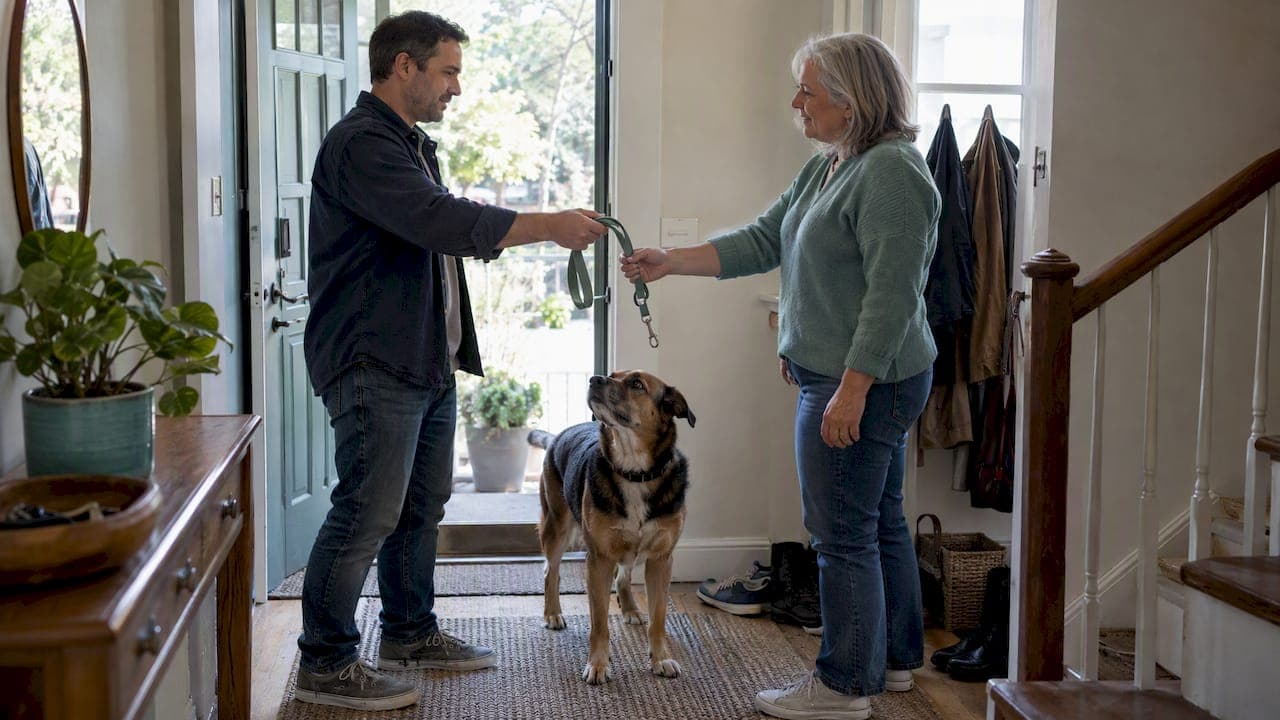
You have three realistic ways to look after a pet while you are in residential treatment: leave them with someone you trust, use a professional sitter or boarding facility, or use a temporary foster program built for people in treatment. Pick one, put it in writing, and settle it before your intake date. Then your attention can go where it needs to go, which is getting well.
We hear this worry often. Many people delay care because they cannot stand the thought of losing an animal who may be the most steady relationship in their life. This guide walks through each option, what to put on paper, how to say goodbye, and how to bring a pet home again.
TL;DR
- Start 2 to 3 weeks before admission if you can. Foster programs have eligibility rules and vaccination requirements, and sitters need time to learn your pet's routine.
- Your main options are family or friends, a professional sitter or boarding facility, and a free temporary foster program for people in treatment. Each has trade-offs in cost, familiarity and supervision.
- Put the plan in writing: who makes veterinary decisions, how bills get paid, and where the records, medications and microchip details are.
- Plan the reunion too. Dogs often need days to weeks to settle after a change of home, and a calm, structured first stretch helps both of you.
- Ask any treatment center about its pet policy and its pre-admission process before you commit, so the plan matches the program.
Table of Contents
- Why the pet question stops people from getting help
- Your options, compared
- Put the plan in writing
- What to expect from treatment while your pet is away
- How to say goodbye without making it harder
- Planning the reunion
- Our perspective on pets and treatment
- When you are ready to talk about treatment
- FAQ
- Sources
Why the pet question stops people from getting help
For many owners, a pet is family. Dogs Matter, a nonprofit that fosters dogs for people entering treatment, reports that over 90% of pet owners consider their pet family, and that the idea of handing an animal over is often the biggest objection to entering inpatient care. If someone has no friend or relative to call, the choice can feel like treatment or the pet.
Researchers see the same pattern. A qualitative study of dog ownership among people with substance use disorder describes the human-animal bond as a real recovery resource, and notes that pet ownership can become an obstacle to care when services are not set up to account for it.
This is not a small detail to push aside. Worrying about an animal at home can pull your focus away from detox and early treatment, so solving it properly is part of preparing for treatment.
Your options, compared
| Option | Best for | Main advantage | Main watch-out |
|---|---|---|---|
| Family or friends | Pets with strong ties to a specific person | Familiar faces, often no cost | Your helper needs to be reliable and sober-supportive for the whole stay |
| Professional pet sitter | Cats and dogs who do better in a home setting | One-on-one attention, stays in familiar surroundings if the sitter comes to you | Cost adds up over a 30-day or longer stay |
| Boarding facility | Dogs who are social and comfortable in kennels | Staff on site, set feeding and exercise schedules | Cost, and stress for anxious or senior animals |
| Temporary foster program | People with limited funds or no support network | Often free, built for treatment timelines | Eligibility rules, limited spots, advance coordination |
No single option is right for everyone. Start with the honest question: who can I count on for the entire length of my stay, with no gaps?
Leaving your pet with family or friends
This is the most common choice, and for many animals the best one. Your pet stays with someone they already know, and the routine changes less.
Before you ask, think about how long the stay might run. Residential treatment length depends on your clinical needs, and it can change. Ask your helper for an open-ended yes, not a fixed two-week yes, and agree in advance on a fallback if their circumstances change.
Be clear about what you are asking: feeding schedule, walks, medications, vet visits, the cost of food and supplies. Offer to cover those costs, or agree on who will, so goodwill does not turn into resentment.

Using a pet sitter or boarding facility
Professional care takes pressure off your personal relationships. Look for a sitter or boarding facility that will give you references, check vaccination records, and tell you plainly how they handle a sick animal or an emergency.
When you tour a boarding facility or interview a sitter, ask:
- Who is on site overnight, and how often are animals checked?
- What happens if my pet gets sick or injured, and which veterinarian do you use?
- Can you give a long-stay rate, and how is payment handled while I am in treatment with limited phone access?
- How do you handle medication, special diets and anxious behavior?
- What do you need from me in writing?
Long stays raise the bill, so get the total in writing before admission. Surprises are hard to resolve from inside a treatment program.
Temporary foster programs for people in treatment
This is the option many people have never heard of. Several nonprofits and public agencies place pets with volunteer fosters while the owner is in inpatient care.
- Dogs Matter offers no-cost temporary foster care for dogs of people in inpatient treatment, and continues until the owner is healthy and stable enough to resume care if needed. It has also announced an expansion to Southern California, Dogs Matter SoCal, which at launch focuses on unhoused pet owners in Los Angeles' Skid Row community who are ready to begin treatment. Check current eligibility before you count on a spot.
- PAWsitive Recovery, run by SPCA International, offers temporary pet foster care for people seeking treatment or in early recovery, and pairs that with support for animals in shelters.
- County programs exist in some places. San Mateo County's Fostering Wellness Program fosters pets while owners are in inpatient behavioral health or substance use treatment. It is a local program, so it serves people in that county and is a model rather than a Los Angeles resource.
Most of these programs work on 30 to 90 day terms, with possible extensions, which lines up with typical residential stays. Eligibility is usually strict. You may need to live in a certain area or be enrolled in an authorized treatment program, and your pet will typically need to be fully vaccinated. That is why you should apply before your intake date, not after.
The relationship also runs both ways. Stephen Knight, who founded Dogs Matter, has said that owners are expected to stay engaged in their recovery and follow through on aftercare so that reunification lasts. Treat the foster as a partner in your recovery plan, not a favor with no strings.
Put the plan in writing
In an emergency, a verbal promise does not help a veterinarian who needs permission to treat your animal. The American Veterinary Medical Association advises owners to write down their plan when they will be away, including a trusted emergency decision-maker, payment arrangements and an emergency kit with medical records, vaccination history and microchip details.
Build one page, or one folder, that covers:
- Who decides. Name the person authorized to approve veterinary care, and tell your regular vet's office in advance.
- Who pays. State a spending limit and how bills will be covered, whether a credit card on file at the clinic or funds left with your helper.
- Who to call. Your vet, an emergency clinic, poison control, and one backup person if your first contact cannot be reached.
- What your pet needs. Feeding amounts, medications and doses, allergies, quirks, favorite toys, walking routine, and what scares them.
- Records. Vaccinations, spay or neuter status, license, microchip number and the registry it is filed with.
- Update your microchip. Make sure the contact details match someone reachable while you are in treatment.
Pack enough of your pet's regular food for the first stretch, plus bowls, leash, bedding and a worn T-shirt that smells like you. Switching foods abruptly on top of a change of home can upset a stomach, so keep things as normal as you can.
What to expect from treatment while your pet is away
Residential detox and treatment ask a lot in the first days. Withdrawal, medical monitoring and the work of getting stable come first. That is exactly the stretch when it helps to know your animal is safe and someone else has the details.
Because of that, ask your treatment team early about:
- Phone and visit policies, so you know when you can check in on your pet's arrangements
- Whether a family member or case manager can relay updates to you
- How to hand off responsibilities if the stay is longer than planned
Do not assume any facility accepts animals. Policies differ widely, and many residential programs do not allow pets on site. Ask directly, and ask what the admissions team does to help patients solve this before arrival.
How to say goodbye without making it harder
People search for how to say goodbye to a dog before treatment, and the honest answer is that animals read your emotion more than your words. A few things help.
- Keep the last day ordinary. A normal walk and meal are more settling than a dramatic farewell.
- Do the handoff in a calm, short visit. Walk through the written plan with the caregiver while your pet is present and relaxed.
- Leave scent and routine. A used blanket and the familiar food keep the transition gentler.
- Let go of guilt. Arranging safe care is not abandoning your pet. It is protecting the relationship over the long run.
It can be hard for the first days. That is normal, and the people supporting you in treatment have heard it before. Bring it to your therapist or group, because grief and worry about an animal are valid things to work through.
Planning the reunion
Coming home is a transition for your pet too, especially if they lived somewhere else for weeks or months. The 3-3-3 rule is a general guide popular with shelters, describing roughly 3 days to decompress, 3 weeks to learn a routine and 3 months to feel fully at home. It was written for newly adopted dogs, but it gives a useful frame. A returning pet may need patience, not instant normal. The San Diego Humane Society notes that stress hormones take about 10 days to settle in dogs after a shelter stay, which shows how much a change of environment can affect them. Your pet's experience will differ, so watch your own animal rather than the calendar.
In practice:
- Keep the first days quiet, with few visitors and a predictable schedule.
- Reintroduce walks, meals and sleep spots on a steady clock.
- Ask your foster or sitter for notes on what worked, so you can keep it going.
- Schedule a vet check if your pet lost weight, scratches, limps or acts differently.
A pet can be part of your recovery routine
There is a reason many people want their animal back as soon as possible. Research on dog ownership and substance use finds that structured activity and responsible caregiving can be a healthy coping tool, while also noting that some pet owners lean on their animals for stress relief the way others lean on substances. The takeaway is balance. Walks, feeding schedules and play give your day structure, but a pet is not a replacement for therapy, peer support or a relapse prevention plan.
Our perspective on pets and treatment
We are a boutique residential program with 12 beds in Van Nuys, so we get to know each person well, and we know that the practical worries outside the building matter as much as the clinical ones inside it. An unresolved question about a dog or cat can keep someone from calling at all.
Our advice is simple. Do not let the pet question be the reason you wait. Tell admissions about it on your first call. A small team can work through logistics with you, from timing your intake to making sure someone is lined up before you arrive. Your care plan covers detox, residential treatment, therapy and aftercare, and your life outside includes the people and animals who depend on you.
Plan for the whole arc, not just the first day. Who will your pet be with at week one, at week four, and the day you come home? If the answer is clear, you can give treatment your full attention.
— Jim
When you are ready to talk about treatment
If you or someone you love needs a safe, medically supervised start, our medical detox program offers 24/7 medical supervision, and our residential treatment program continues care in a small, private setting where co-occurring mental health conditions are treated alongside substance use. You can also see the full list on our programs page or reach out through our website. Mention your pet on the first call, and we will help you think through timing.
Treatment does not end at discharge. Our aftercare planning and family support guidance can help you and your household put the first days home in writing, pet included.
FAQ
What do people do with their pets when they go to rehab?
Most leave them with a trusted friend or relative. Others hire a pet sitter, use a boarding facility, or apply to a foster program for people in treatment. Whichever you pick, arrange it in advance and write down who makes veterinary decisions.
Can you bring a pet to rehab?
Some centers allow it, but many residential and detox programs do not, especially during medical detox. Policies vary by facility, so ask each program directly before admission. If a program does not allow pets, a foster or sitter arrangement is the usual path.
Is there free pet care for people entering rehab?
Sometimes. Nonprofits such as Dogs Matter and PAWsitive Recovery offer temporary foster care at no cost to eligible owners, though spots, locations and requirements vary. Apply early and confirm that your pet's vaccinations are current.
What is the 3-3-3 rule for pets?
It is a general guide for how long a dog may take to adjust to a new home: about three days to decompress, three weeks to learn a routine and three months to feel settled. It is often used for adopted dogs, but it also helps you set expectations when your pet returns home from a stay with someone else.
How far ahead should I plan?
As early as you can, ideally two to three weeks, though do not delay urgent care to finish the plan. If you need to begin treatment now, call admissions, tell them about your pet, and ask a friend or family member to cover the immediate days while longer arrangements fall into place.
Sources
- Temporary Foster Care, Dogs Matter
- Dogs Matter, Southern California expansion
- PAWsitive Recovery, SPCA International
- Fostering Wellness Program, San Mateo County Health
- Ensuring your pet is protected when you're away, American Veterinary Medical Association
- Exploring dog ownership in the lives of people with substance use disorder, PubMed Central
- Dog ownership and coping in recovery, PubMed Central
- Stephen Knight and Dogs Matter, CNN Heroes
- YCSPCA Dog Adoption Guide
- Helping a Dog Adjust to a New Home, San Diego Humane Society