
The family role during detox process is defined as providing informed emotional support, maintaining firm boundaries, and sustaining personal well-being to improve a loved one's recovery outcomes. Research confirms that family involvement aids detox by increasing treatment retention, reducing relapse risk, and strengthening long-term healing. Detox, the clinical term for medically supervised withdrawal stabilization, is only the first step in a longer recovery process. Your role as a family member is not to manage treatment but to create a stable, encouraging environment that makes staying in treatment easier. Connected Recovery's experience with families shows that those who understand their role from the start make a measurable difference in outcomes.
What is the family role during detox process?
The family role during detox is to support without controlling, encourage without enabling, and stay informed without interfering in clinical decisions. That distinction matters more than most families realize when they first walk into this situation.

Educate yourself before detox begins
Preparing yourself emotionally and practically before your loved one enters detox reduces panic and poor decisions later. Learn the basic phases of withdrawal, including the acute phase (typically days 1–5) and the stabilization phase that follows. Knowing that irritability, physical discomfort, and emotional swings are expected symptoms prevents you from misreading them as personal rejection. The detox stabilization phase is a critical window where outside interference can derail progress.
Understand your role as supporter, not fixer
Your job is not to solve the addiction. Families who try to control treatment decisions often create friction with medical staff and add stress to their loved one's experience. Accepting that your role is emotional support, not clinical oversight, protects both of you. This shift in mindset is harder than it sounds, but it is the foundation of effective family support.
Build your own self-care routine now
Caregiver self-care directly affects your ability to show up consistently. Prioritizing 7–8 hours of sleep and at least 15 minutes of daily exercise leads to significant reductions in caregiver stress and anxiety. Set realistic expectations: progress in detox is rarely linear, and setbacks do not erase gains.
Pro Tip: Write down three non-negotiable self-care practices before your loved one's detox begins. Treat them as appointments, not options. You cannot sustain support from an empty reserve.
- Get 7–8 hours of sleep each night
- Exercise for at least 15 minutes daily
- Identify one trusted person you can talk to openly
- Limit news and social media that amplifies anxiety
- Set a daily check-in time with yourself to assess your emotional state
How can families actively support a loved one through detox?
Active support during detox means showing up in specific, healthy ways, not just being available. Family therapy improves treatment retention by addressing communication patterns, relationship dynamics, and shared trauma within the family system. The following steps give you a clear framework.
-
Attend family therapy and educational sessions. Most quality detox programs offer structured family programming. Participating signals commitment and gives you tools to communicate more effectively.
-
Provide encouragement without taking over. Remind your loved one why they chose treatment. Avoid statements that create guilt or pressure. Phrases like "I'm proud of you for being there" carry more weight than "You have to get better for us."
-
Keep calls short, positive, and present-focused. Limiting detox phone calls to brief, upbeat conversations protects your loved one's emotional stability during intense withdrawal phases. Avoid processing past trauma or making promises during these calls.
-
Respect the medical team's authority. Nurses, physicians, and counselors manage the clinical side of detox. Your role is not to second-guess their decisions. If you have concerns, raise them through proper channels, not through your loved one.
-
Set and enforce healthy boundaries. Boundaries are not punishments. They are agreements that protect both parties. If your loved one asks you to bring items that violate treatment rules, saying no is an act of support, not rejection.
Pro Tip: Before each visit or call, write down one positive, present-focused thing to say. It keeps conversations grounded and prevents emotional spiraling on both ends.
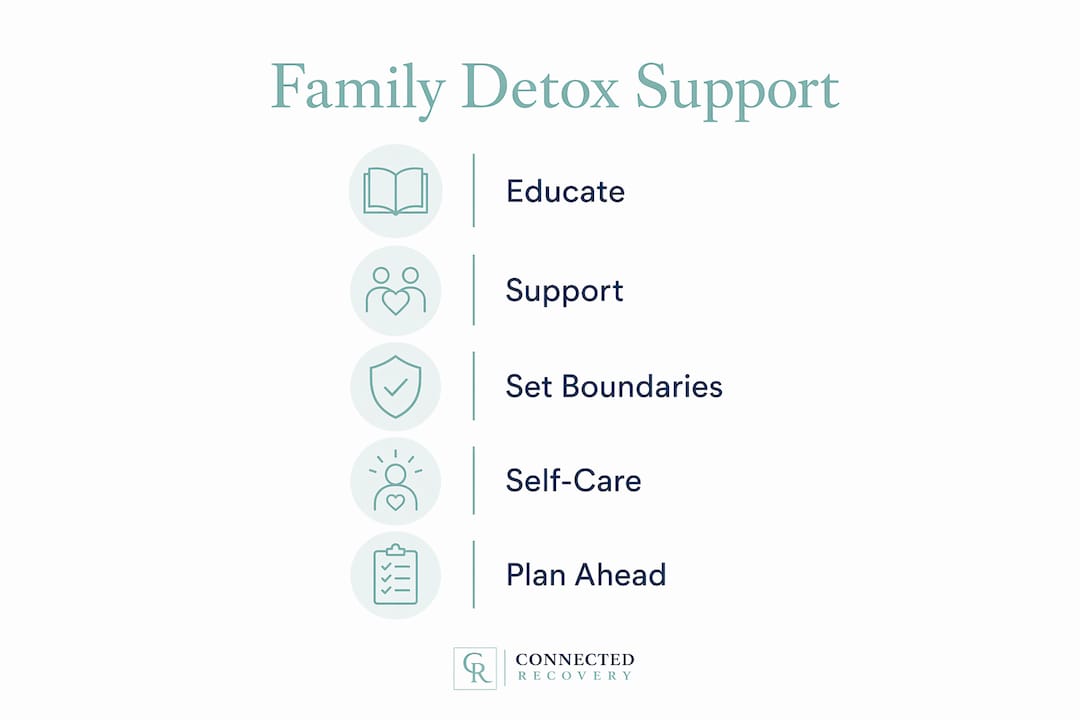
What are the most common family mistakes during detox?
Families make mistakes during detox not from lack of love but from lack of information. Recognizing these patterns early prevents them from undermining the entire process.
- Enabling disguised as support. Bringing contraband, covering up consequences, or making excuses for behavior are all forms of enabling. They feel like kindness but remove the accountability that makes recovery stick.
- Over-involvement in medical decisions. Pressuring staff to change medications or discharge timelines creates conflict and signals to your loved one that the treatment plan is negotiable.
- Breaking promises. If you say you will visit on a specific day, show up. Broken promises during detox amplify feelings of abandonment and distrust.
- Heavy emotional conversations during early detox. The first 3–5 days of detox are the most physically and emotionally intense. This is not the time to discuss finances, relationship grievances, or past events.
- Facilitating early departure. When a loved one calls asking to leave, the instinct to rescue them is powerful. Resist it.
"Refusing to pick up a loved one who wants to leave detox early is one of the most protective things a family member can do. Early discharge in the first 3–5 days significantly increases relapse risk and compromises the stabilization process."
The concept of "detaching with love" captures this balance precisely. You remain emotionally present while refusing to remove the natural consequences of addiction. Detaching with love is a skill, not a personality trait, and it can be learned through structured support groups like Al-Anon.
How do you maintain your own well-being during a loved one's detox?
Caregiver burnout is real, and it arrives faster than most families expect. Burnout manifests as physical exhaustion, irritability, emotional withdrawal, and a creeping sense of hopelessness. When those symptoms appear, your ability to support your loved one drops sharply.
Recognizing burnout early is the first line of defense. The signs include difficulty sleeping even when you have the opportunity, losing interest in activities you normally enjoy, and feeling resentful toward your loved one or the treatment process. None of these feelings make you a bad person. They make you human under sustained stress.
- Join Al-Anon or a comparable peer support group. These groups provide a community of people who understand your specific experience. They also teach the "detach with love" framework in a practical, ongoing way.
- Maintain a daily routine. Structure reduces anxiety. Even simple anchors like a morning walk or a consistent meal time create stability when everything else feels uncertain.
- Separate your identity from the outcome. Your loved one's recovery is not a measure of your worth as a parent, spouse, or sibling. Carrying that weight makes burnout inevitable.
- Schedule time for activities unrelated to caregiving. Hobbies, friendships, and personal goals are not selfish. They are what keep you functional over the long haul.
Pro Tip: Set a weekly check-in with a therapist or trusted friend specifically to process your own emotions. Keep it separate from any conversations about your loved one's progress.
How should families plan for post-detox support?
Detox ends the physical dependence on a substance. It does not end the recovery process. Families who understand this distinction avoid the dangerous assumption that their loved one is "fixed" after detox. Post-detox family involvement directly contributes to sustained sobriety and stronger long-term outcomes.
- Continue family therapy after detox ends. The communication patterns and relationship dynamics that existed before detox do not disappear automatically. Ongoing therapy addresses them systematically.
- Learn about relapse prevention together. Understanding your loved one's triggers, high-risk situations, and coping strategies lets you provide informed support rather than accidental pressure.
- Engage with the aftercare plan. Most quality programs, including Connected Recovery, build aftercare planning into the treatment model. Ask to be included in that conversation.
- Commit to the long view. Recovery is measured in months and years, not days. Families who stay engaged through residential treatment and beyond see the strongest results.
| Post-detox action | Why it matters |
|---|---|
| Attend family therapy sessions | Repairs communication and rebuilds trust over time |
| Learn relapse prevention skills | Helps you recognize warning signs before a crisis develops |
| Participate in aftercare planning | Keeps you aligned with the clinical team's goals |
| Join a peer support group | Sustains your own resilience through the long recovery period |
Key Takeaways
The family role during detox is most effective when it combines informed emotional support, firm boundaries, and consistent self-care throughout the entire treatment process.
| Point | Details |
|---|---|
| Support without controlling | Your role is encouragement and presence, not clinical oversight or decision-making. |
| Keep communication positive | Short, present-focused calls protect your loved one's stability during intense withdrawal. |
| Avoid enabling behaviors | Detaching with love means refusing to remove consequences while staying emotionally present. |
| Prioritize caregiver self-care | Sleep, exercise, and peer support reduce burnout and sustain your ability to help. |
| Plan for post-detox involvement | Family therapy and aftercare participation drive long-term sobriety outcomes. |
What I have learned from watching families navigate detox
Working in addiction recovery long enough teaches you one uncomfortable truth: the families who struggle most are not the ones who care too little. They are the ones who care so much that they cannot stop trying to fix what only their loved one can fix.
I have watched parents drive hours to pick up a child who called from detox in tears, convinced they were "rescuing" them. What they were actually doing was handing that child a reason to never try again. The short-term relief of ending the discomfort always costs more than it saves.
The families who see the best outcomes share a specific quality: they learn to sit with their own discomfort without acting on it. That is genuinely hard. It requires a kind of disciplined patience that goes against every parental or spousal instinct. But when families commit to the family program alongside their loved one's treatment, the results are different. The healing becomes mutual.
My honest advice is this: get your own support before you try to be someone else's support. The oxygen mask principle is not a cliché. It is the most practical thing I can tell you.
— Jim
How Connected Recovery supports families through medical detox
Connected Recovery operates a 12-bed boutique facility in Van Nuys, CA, built specifically for people who need individualized attention during detox and residential treatment. That small scale is intentional. It means your loved one is not a number in a large system, and it means the clinical team has the capacity to include families in a meaningful way.

The medical detox program at Connected Recovery includes 24/7 medical supervision, tailored treatment plans, and built-in support for co-occurring mental health conditions. Families are not an afterthought here. The structure is designed to keep you informed and involved at every appropriate stage. If your loved one is ready to take the first step, Connected Recovery is ready to walk through it with both of you.
FAQ
What is the family role during detox process?
The family role during detox is to provide emotional encouragement, maintain healthy boundaries, and avoid enabling behaviors that undermine treatment. Family members support recovery best by staying informed, attending family therapy, and prioritizing their own well-being.
How should families handle calls from a loved one who wants to leave detox?
Families should not facilitate early departure. Early discharge in the first 3–5 days significantly increases relapse risk, so the most supportive response is to encourage your loved one to stay and speak with their clinical team.
What are the signs of caregiver burnout during a loved one's detox?
Caregiver burnout appears as physical exhaustion, irritability, emotional withdrawal, and persistent hopelessness. Early recognition and structured self-care, including peer support groups like Al-Anon, prevent further decline.
Why does family therapy improve detox outcomes?
Family therapy addresses communication patterns, relationship dynamics, and shared trauma that fuel addiction cycles. Structured family involvement improves treatment retention and long-term recovery results.
What should families do after detox ends?
Families should continue therapy, learn relapse prevention strategies, and engage with the aftercare plan. Post-detox family participation is one of the strongest predictors of sustained sobriety.