
Clinician-led one-on-one therapy speeds and sustains recovery because it delivers care matched to a person's actual clinical picture, coordinated with medical detox and residential support instead of run in isolation. Individual sessions built on modalities like cognitive behavioral therapy (CBT) and motivational interviewing let a clinician adjust pace, address trauma, and manage cravings in real time, something a fixed curriculum can't do. Programs like Connected Recovery build their model around this idea: therapy that bends to the person, not the other way around.
What actually drives the results:
- A trusted, ongoing relationship with one clinician who knows your history
- A treatment plan matched to your specific triggers, diagnosis, and medical needs
Key Takeaways
Recovery outcomes improve when therapy is personalized to the individual, delivered by a skilled clinician, and coordinated directly with medical care rather than run as a separate track.
| Point | Details |
|---|---|
| Alliance drives disclosure | Trust between client and clinician leads to honest disclosure, which makes treatment plans actually work. |
| Modality matching matters more than labels | Clinical skill in fitting CBT, MI, or contingency management to the person outperforms any single framework alone. |
| MOUD plus therapy beats therapy alone | For opioid use disorder, combining medication with behavioral care produces stronger retention than behavioral-only treatment. |
| Therapy starts during detox | Individual sessions typically begin during medical stabilization and increase in frequency through early residential care. |
| Connected Recovery limits caseloads by design | A 12-bed boutique model with 24/7 medical supervision keeps individual therapy central rather than an add-on. |
Table of Contents
- Why One-on-One Therapy Aids Recovery: The Core Mechanisms
- What the Research Says About Individualized, Combined Care
- How Individual Therapy Fits Into Detox and Residential Treatment
- What to Expect in Individual Sessions
- How Connected Recovery Puts This Into Practice
- The Case for Prioritizing Individual Therapy, Not Just Adding It
- Get Individualized Therapy Within Medically Supervised Care
- Frequently Asked Questions
- Sources
Why One-on-One Therapy Aids Recovery: The Core Mechanisms
Individual therapy works because it removes the guesswork from treatment. A clinician sitting across from one patient, session after session, can see patterns a rotating group format simply misses.
The therapeutic alliance is the foundation. When a client trusts their therapist, they disclose the things that actually matter, the relapse two years ago they never mentioned to their family, the shame that keeps them silent in group settings. That honesty is what makes homework assignments stick and treatment plans work. Clinicians who specialize in individualized treatment stress that evidence-based tools like CBT, motivational interviewing, and contingency management aren't interchangeable. They have to be matched to the patient's specific needs and clinical presentation, and that matching depends entirely on clinical judgment built through one-on-one contact.
Here's how that plays out session to session:
- Assessment and formulation. The clinician builds a case history that accounts for co-occurring conditions, trauma, and social context, not just the substance use.
- Skill-building. Sessions target concrete coping tools, emotion regulation, distress tolerance, problem solving, that reduce relapse risk under stress.
- Motivational work. Techniques like motivational interviewing address ambivalence directly, which raises session attendance and engagement.
- Progress tracking. Clinicians monitor retention, sleep quality, mood stability, and functional gains like returning to work or repairing relationships.
Pro Tip: Ask any program you're considering how they measure progress beyond "days sober." Sleep, mood, and functional gains often shift weeks before abstinence outcomes do, and a good clinician tracks all of it.
What the Research Says About Individualized, Combined Care
The evidence base has moved well past "therapy helps." It now points specifically toward personalization as the variable that improves outcomes.
A widely cited psychiatry review argues that treatment should target discrete neurobiological and behavioral processes rather than measuring success by abstinence alone, factoring in sleep, executive function, and social reintegration as legitimate recovery markers. That reframing matters because it gives clinicians permission to build plans around what a specific person needs to function, not a generic checklist.
- Individualized treatment plans increase relevance, empowerment, and engagement compared with standardized programs.
- Ongoing assessment and monitoring help clinicians catch relapse risk early, according to research on individualized treatment planning.
- Social factors, housing, trauma history, support systems, shape adherence as much as the therapy itself.
For opioid use disorder specifically, combining medication for opioid use disorder (MOUD) with behavioral therapy produces meaningfully stronger retention than behavioral treatment alone, with behavioral-only care showing substantially shorter retention by comparison.
The gap in the evidence base is access. Precision approaches, genetic markers, biomarker-guided medication selection, are still emerging in research settings and aren't widely available in standard residential care yet. What is available now, and well-supported, is clinician-led individual therapy paired with medical management.
How Individual Therapy Fits Into Detox and Residential Treatment
Therapy doesn't wait for detox to finish. It usually starts during the medical stabilization phase, when a clinician begins building rapport and gathering the history that shapes the treatment plan to come.
The typical rhythm looks like this:
- During detox: brief, supportive sessions focused on safety, orientation, and initial assessment while the medical team manages withdrawal.
- Early residential phase: near-daily individual sessions as stabilization occurs and the clinical picture becomes clearer.
- Stabilization phase: frequency steps down to several sessions per week, shifting toward skill-building and relapse-prevention planning.
Coordination with the medical team runs underneath all of it. Case conferences, shared notes, and medication management, whether that's buprenorphine, methadone, or naltrexone, let the therapist know what a client is dealing with physically before walking into a session. A person managing intense cravings on medication needs a different conversation than someone three weeks past acute withdrawal.
For clients with co-occurring mental health conditions, individual therapy is often where dual diagnosis work actually happens: processing depression, anxiety, or trauma alongside substance use rather than treating them as separate problems on separate tracks. Connected Recovery's dual diagnosis program is built specifically around that integration.

Discharge planning starts here too. The same clinician who ran individual sessions typically maps out relapse-prevention strategies and outpatient referrals before a client leaves residential care, so aftercare isn't an afterthought.
What to Expect in Individual Sessions
Most individual sessions in residential settings run 50 to 60 minutes, often daily or several times a week depending on where a client is in treatment. Expect a mix of check-in, skill practice, and homework review, not just open-ended talking.
Common goals clients work toward:
- Managing cravings and identifying specific triggers
- Processing trauma at a pace that doesn't destabilize recovery
- Rebuilding communication with family members
- Building a concrete, written relapse-prevention plan
Family involvement is usually optional but valuable. Many programs offer family education sessions or occasional joint meetings, which give relatives a realistic picture of progress instead of guessing from the outside.
Pro Tip: During intake, ask directly what modalities the therapist is trained in, how they handle co-occurring diagnoses, and how often they'll coordinate with the medical team. Vague answers here are a warning sign.
Individual therapy is also usually combined with group sessions rather than replacing them; programs that run both together tend to produce better outcomes than either format alone, since group work builds peer accountability that individual sessions can't replicate.
How Connected Recovery Puts This Into Practice
Connected Recovery operates as a 12-bed boutique facility in Van Nuys, and that small footprint isn't incidental. It's the mechanism that makes individualized care possible in the first place.
- A 12-bed capacity means clinicians carry fewer cases and build a stronger therapeutic alliance with each client.
- 24/7 medical supervision lets therapists coordinate medication management (including MOUD where clinically appropriate) directly with the timing of therapy sessions.
- Integrated dual diagnosis care means mental health conditions get addressed in the same individual sessions as substance use, not in a separate referral.
- Tailored treatment plans carry through from detox into aftercare planning, so the clinician who starts with a client is often still involved at discharge.
If you're evaluating admission, ask about clinician caseloads, how treatment plans get updated, and what documentation your insurance provider requires before intake. Connected Recovery's personalized treatment plan guide breaks down what a plan should actually include.
The Case for Prioritizing Individual Therapy, Not Just Adding It
The conventional advice in this space treats individual therapy as one item on a checklist, alongside group sessions, medication, and detox, as if each piece contributes equally. That undersells it. Individual therapy is where the actual clinical thinking happens: where a therapist figures out which modality fits, catches a co-occurring condition a group format would miss, and adjusts course before a small setback becomes a discharge.
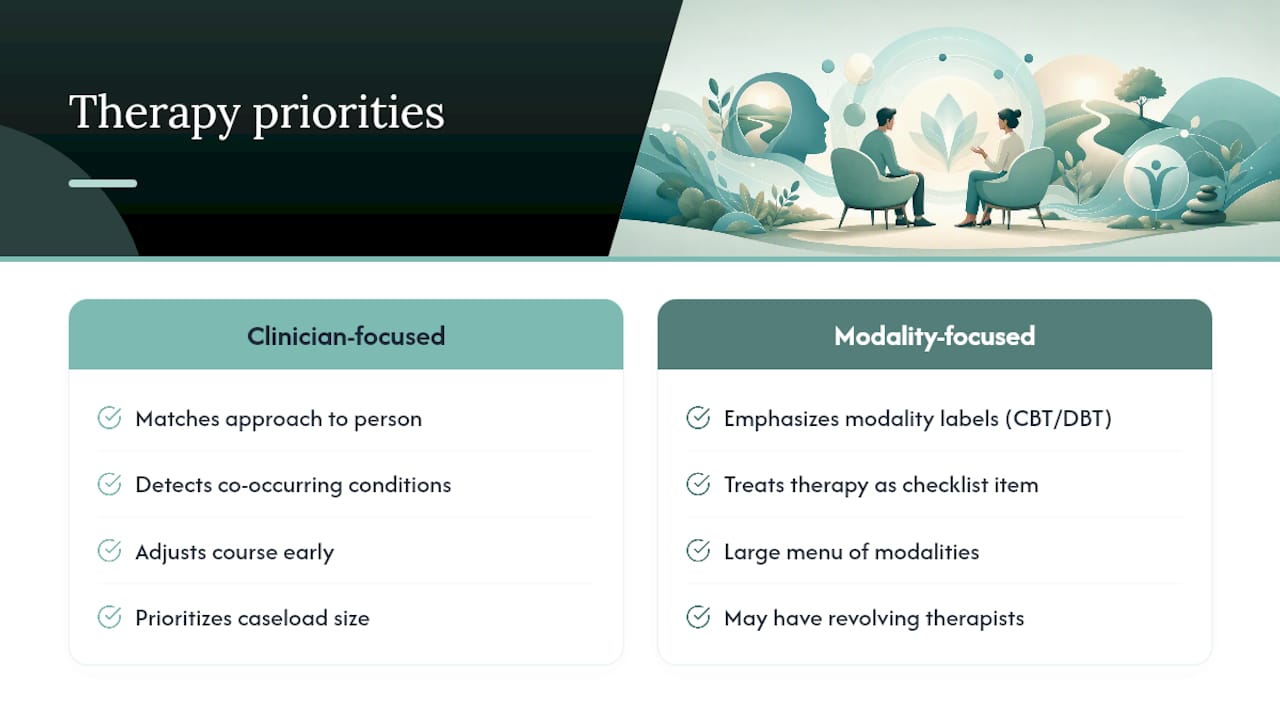
The overrated part of standard treatment marketing is the emphasis on modality names, CBT here, DBT there, as though the label is what matters. The research is clearer than that: clinician skill in matching the approach to the person matters more than which framework gets used. A skilled clinician using "just" motivational interviewing well will outperform a mismatched, checkbox application of a fancier modality.
If you're evaluating a program, prioritize caseload size and clinician continuity over the length of the therapy menu on their website. A facility offering six modalities with a revolving cast of therapists will likely serve you worse than one offering three, delivered consistently by someone who knows your case.
Get Individualized Therapy Within Medically Supervised Care
Reading about clinician-led therapy is one thing. Getting it, paired with round-the-clock medical support, in a setting small enough that your clinician actually knows your case, is another. Connected Recovery is built as a boutique alternative to larger facilities where individual attention gets diluted across dozens of beds: with only 12 clients at a time, therapy stays personal and medical coordination stays tight.
Whether you're coming in for medically supervised detox or moving into residential treatment afterward, the same clinician-led approach carries through, therapy plans built around your history, not a generic protocol. If cravings, medication needs, or a co-occurring diagnosis are part of your situation, that gets addressed in the same individual sessions rather than through a separate referral. Start by checking availability for medical detox in Van Nuys or explore the residential treatment program directly to see how intake works and what to prepare before your first call.
Frequently Asked Questions
Does one-on-one therapy actually help more than group therapy alone? It typically produces different, complementary benefits rather than replacing group work. Individual sessions allow deeper trauma processing and personalized skill-building; programs combining both formats tend to see better outcomes than either alone.
How often will I have individual therapy sessions during residential treatment? Frequency is usually highest early on, often near-daily during initial stabilization, then steps down to several sessions weekly as progress continues, with each session typically running 50 to 60 minutes.
Can individual therapy address both addiction and mental health conditions at the same time? Yes. Clinicians trained in dual diagnosis care address co-occurring conditions like depression, anxiety, or trauma within the same individual sessions rather than through separate treatment tracks.
What if I can't afford one-on-one therapy or my insurance coverage is unclear? Ask any program directly about insurance verification and payment options during intake. Many facilities, including boutique programs, can walk you through what your specific plan covers before you commit.
How do I find a therapist qualified in addiction-specific individual counseling? Look for credentials in addiction counseling specifically, ask about experience with modalities like CBT and motivational interviewing, and confirm they coordinate directly with any medical team managing detox or medication.
This article is general information, not a substitute for advice from a qualified doctor. Consult a qualified healthcare professional about your own circumstances before acting on anything here.
Sources
- Personalizing the Treatment of Substance Use Disorders
- Toward Individualized Treatment for Substance Abuse
- Tailored Therapies in Addiction Medicine: Redefining Opioid Use Disorder Treatment with Precision Medicine
- A Personalized Plan Is Key to Overcoming Substance Use | Psychology Today