
Sustainable recovery is defined as the ongoing process through which individuals improve their health, build self-directed lives, and develop the resilience needed to manage addiction or mental health challenges long term. SAMHSA defines this process as one focused on positive change, not just symptom reduction. 50.2 million American adults currently identify as being in recovery from substance use or mental health challenges. That number proves recovery is not a rare outcome. It is a lived reality for tens of millions of people, and understanding what makes it last is the most useful question you can ask.
What is sustainable recovery and why does it matter?
Sustainable recovery is not a destination. It is a continuous process of growth, adaptation, and self-care that extends well beyond the end of any formal treatment program. Recovery sustainability is systemic, meaning that lacking stability in housing or community support can undermine progress even when symptoms are under control.
The importance of sustainable recovery lies in what it protects against. Short programs can reduce substance use or stabilize a mental health crisis. Without a plan for what comes after, those gains erode. Sustainable recovery strategies create the structure that keeps progress intact when life gets difficult.
This approach matters because addiction and mental health challenges rarely resolve in a straight line. The goal is not perfection. The goal is building enough support, skill, and purpose that setbacks do not become permanent reversals.

What are the core dimensions of sustainable recovery?
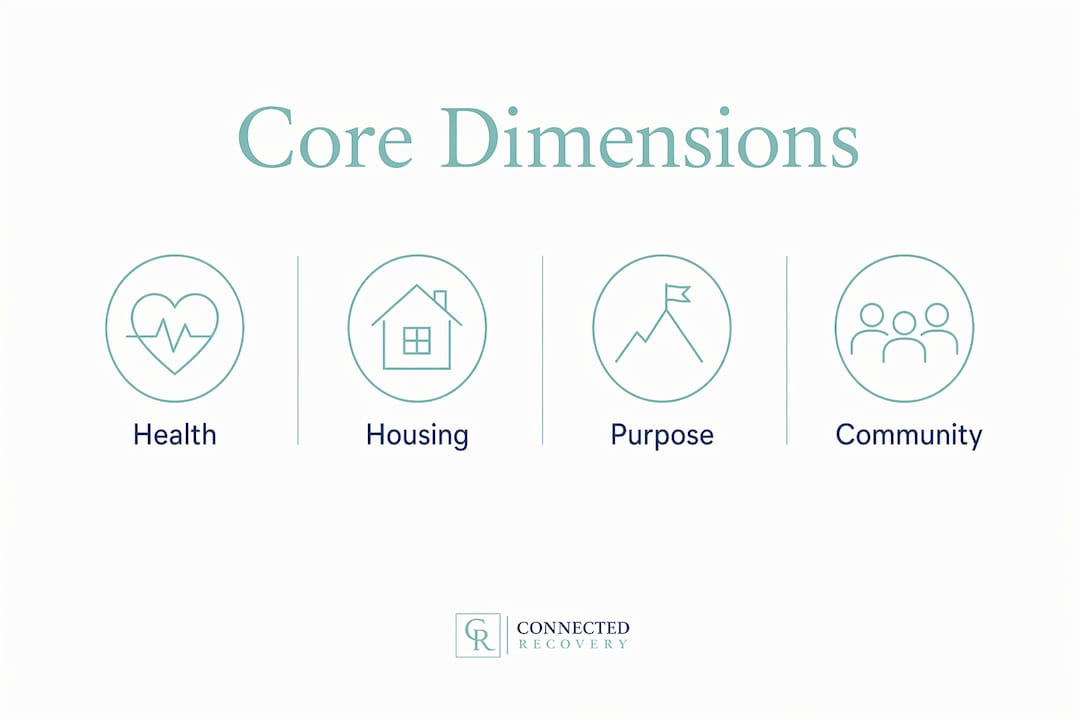
NAMI’s 2026 framework identifies four dimensions that work together to create lasting wellness. Each one addresses a different area of life that recovery must touch to hold.
-
Health: Physical and emotional wellbeing, including managing symptoms, making healthy choices, and accessing ongoing medical or mental health care.
-
Home: Stable, safe housing that provides a foundation for daily functioning. Without it, every other dimension becomes harder to maintain.
-
Purpose: Meaningful daily activities such as work, school, volunteering, or caregiving that give structure and direction to life.
-
Community: Supportive relationships with family, friends, peers in recovery, and professionals who provide connection and accountability.
These four dimensions do not operate in isolation. A person who achieves sobriety but lacks stable housing faces a recovery that is fragile by design. A person with strong community ties but no sense of purpose often struggles with motivation over time. The framework works because it treats recovery as a whole-life challenge, not a single-issue problem.
| Dimension | What It Covers | Why It Matters |
|---|---|---|
| Health | Physical and mental wellbeing | Manages symptoms and builds daily coping capacity |
| Home | Safe, stable living situation | Provides the foundation for all other progress |
| Purpose | Work, school, or meaningful activity | Creates structure and reduces idle time that triggers relapse |
| Community | Relationships and peer support | Sustains motivation and reduces isolation |
Pro Tip: Map your own status across all four dimensions. Identifying your weakest area gives you a clear starting point for where to focus your energy first.
How does sustainable recovery differ from short-term programs?
Short-term recovery programs focus primarily on stopping substance use or stabilizing a mental health crisis. Sustainable recovery methods go further by addressing the root causes and building the skills needed to stay well without constant clinical support.
Ongoing mental healthcare addressing root causes is critical to long-term success. A 30-day detox program can clear substances from the body. It cannot, on its own, rewire the thought patterns, trauma responses, or emotional regulation deficits that drove the addiction in the first place.
Here is what distinguishes a sustainable approach from a short-term one:
-
Mental health integration. Sustainable recovery treats co-occurring conditions like depression, anxiety, or PTSD alongside addiction. Addressing only one condition leaves the other as an active relapse trigger.
-
Coping skills development. Short programs introduce coping tools. Sustainable recovery builds those tools into daily habits through repeated practice and ongoing therapy.
-
Continuity of care. Sustainable recovery plans include aftercare planning that bridges the gap between formal treatment and independent living.
-
Adaptability. Life changes. A sustainable recovery strategy adjusts to new stressors, life transitions, and evolving mental health needs rather than relying on a fixed protocol.
Pro Tip: When evaluating any treatment program, ask specifically what the aftercare plan looks like. A program with no structured post-treatment support is a short-term solution dressed up as a long-term one.
What challenges occur in recovery and how can you manage them?
Recovery is a non-linear process. Resilience-building helps individuals manage setbacks and continue growing over time, but that resilience must be built before a crisis hits, not during one.
Relapse is the most discussed challenge, and the most misunderstood. A relapse does not mean recovery has failed. It means the current plan needs adjustment. Treating relapse as a learning event rather than a moral failure changes how quickly a person can restart progress.
“Recovery is not a straight line. It is a process that requires patience, planning, and the willingness to get back up every single time.”
The most effective way to manage setbacks is to plan for them in advance. Pre-written responses for setbacks that specify what to do and who to contact reduce the time spent in crisis and the risk of extended relapse. Think of it as a fire drill. You practice the response before the emergency so the steps are automatic when stress is high.
Key strategies for managing challenges include:
-
Identify personal warning signs. Know the specific thoughts, behaviors, and situations that precede a setback for you specifically.
-
Build a contact list before you need it. Include a therapist, a peer support person, a family member, and a crisis line.
-
Use relapse prevention tools actively. Skills like urge surfing, cognitive restructuring, and grounding techniques work best when practiced regularly, not just in a crisis.
-
Stay connected. Disengagement is a major driver of relapse. Sustained community connection is one of the most reliable interventions available.
What sustainable recovery methods actually work?
Practical sustainable recovery strategies combine clinical care, peer support, and daily self-care into a system that holds up under real-world pressure. No single method works for everyone. The most effective plans layer multiple approaches.
-
Ongoing therapy and mental healthcare. Regular sessions with a therapist or counselor address root causes and build coping capacity over time. Dual diagnosis treatment is particularly effective for individuals managing both addiction and a co-occurring mental health condition.
-
Peer recovery support. Peer support reduces relapse risk through shared understanding, mutual respect, and a sense of belonging. Programs like SMART Recovery and 12-step groups provide structured peer connection.
-
Case management and aftercare. Case management services coordinate housing, employment, healthcare, and legal needs so that practical life stressors do not derail recovery progress.
-
Purposeful daily structure. Meaningful activity fills the time and mental space that substances or crisis once occupied. Work, volunteering, creative pursuits, and education all serve this function.
-
Physical self-care. Sleep, nutrition, and exercise directly affect mood stability and stress tolerance. These are not optional wellness extras. They are clinical tools.
| Approach | Best For | Key Benefit |
|---|---|---|
| Ongoing therapy | Root cause and mental health work | Builds lasting coping skills |
| Peer support groups | Social connection and accountability | Reduces isolation and relapse risk |
| Case management | Practical life stabilization | Removes barriers to sustained progress |
| Daily structure and purpose | Motivation and identity rebuilding | Replaces harmful patterns with meaningful ones |
Pro Tip: Treat your recovery plan like a living document. Review it every 90 days and adjust based on what is working and what has changed in your life.
Key takeaways
Sustainable recovery succeeds when it addresses health, housing, purpose, and community together, not as separate problems but as one interconnected system.
| Point | Details |
|---|---|
| Recovery is ongoing, not a finish line | Sustainable recovery requires continuous growth, not a single endpoint after treatment. |
| Four dimensions must align | Health, Home, Purpose, and Community all need attention for recovery to hold long term. |
| Mental health integration is non-negotiable | Treating addiction without addressing co-occurring conditions leaves the root cause active. |
| Pre-plan for setbacks | Writing down responses to potential crises before they happen reduces relapse duration and risk. |
| Peer support is a clinical tool | Sustained social connection through peer programs directly lowers relapse likelihood. |
Recovery is not something you finish
I have spent years reading about recovery frameworks and talking with people who have lived them. The single biggest misconception I keep encountering is the idea that recovery has an end date. People complete a program, feel stable, and quietly assume the work is done. That assumption is where most setbacks begin.
What actually works is treating recovery the way athletes treat fitness. You do not get in shape and then stop exercising. You build habits, track your progress, and adjust when something stops working. The NAMI four-dimension framework resonates with me precisely because it refuses to let you ignore any part of your life. You cannot white-knuckle your way through sobriety while your housing is unstable and your social world is empty. The system catches up with you.
The other thing most articles skip over is how much peer support matters beyond the clinical setting. Motivation spikes during treatment. Engagement and peer connection are what sustain that motivation when the structure of a program is gone. The people who stay well are almost always the people who stay connected.
Recovery is not something you finish. It is something you practice.
— Jim
How Connectedrecoverycenter supports your long-term recovery
Connectedrecoverycenter is a boutique 12-bed facility in Van Nuys, CA, built specifically for individuals who need personalized, ongoing support rather than a one-size-fits-all program.
Every client receives 24/7 medical supervision, a tailored treatment plan, and a clear path from medical detox through residential care and into structured aftercare. Connectedrecoverycenter treats both substance use and co-occurring mental health conditions through an integrated approach, which means the root causes of addiction get addressed alongside the addiction itself. If you are ready to build a recovery plan that actually lasts, explore the full range of addiction treatment programs at Connectedrecoverycenter and take the first step toward a life that holds.
FAQ
What is sustainable recovery in simple terms?
Sustainable recovery is the long-term process of maintaining health, purpose, and community support after addiction or mental health treatment. It goes beyond stopping substance use to building a full life that supports continued wellness.
How long does sustainable recovery take?
Sustainable recovery is an ongoing process with no fixed endpoint. SAMHSA describes it as a lifelong process of change focused on health and self-directed living rather than a time-limited program.
What are the most effective sustainable recovery methods?
The most effective methods combine ongoing therapy, peer support groups, case management, stable housing, and purposeful daily activity. No single method works alone. Layering these approaches creates a system that holds under real-world pressure.
Is relapse a sign that recovery has failed?
Relapse is a potential part of the non-linear recovery process, not evidence of failure. Pre-written setback plans that specify who to contact and what steps to take help individuals restart progress quickly after a setback.
How does dual diagnosis treatment support sustainable recovery?
Dual diagnosis treatment addresses both addiction and co-occurring mental health conditions at the same time. Treating only one condition leaves the other as an active trigger, which is why integrated care produces more durable outcomes than single-focus programs.