
Integrated mental health treatment is defined as a coordinated care model that addresses mental health disorders and substance use disorders simultaneously within a single, unified treatment setting. The standard industry term for this approach is "integrated behavioral health," a framework endorsed by SAMHSA, the American Psychological Association, and the Agency for Healthcare Research and Quality. Integrated treatment is the gold standard for co-occurring disorders, producing better sustained recovery and symptom improvement than sequential care models. If you or someone you care about is dealing with both a mental health condition and a substance use disorder, understanding this model is the first step toward finding care that actually works.
What is integrated mental health treatment, and how does it differ from traditional care?
Traditional care treats mental health and substance use disorders in separate silos. A person might see a psychiatrist on Tuesdays and an addiction counselor across town on Thursdays, with neither provider reading the other's notes. Fragmentation is the primary failure cause in conventional mental health systems, according to the APA and AHRQ. That gap forces patients to repeat their histories at every appointment and leaves critical information out of each provider's hands.
Integrated behavioral health removes that gap entirely. One interdisciplinary team, one shared treatment plan, and one unified record replace the disconnected handoffs. The result is care that treats the whole person rather than a list of separate diagnoses. This shift represents a fundamental change in how healthcare systems think about mental illness and addiction.

The distinction matters most for people with co-occurring disorders, which describes having both a mental health condition (such as depression, anxiety, or PTSD) and a substance use disorder at the same time. These conditions reinforce each other. Treating only one while ignoring the other produces predictable relapse. Integrated mental health care addresses both conditions together, which is why outcomes consistently improve under this model.
What are the main components of integrated mental health treatment?
True integration rests on three structural elements: interdisciplinary teams, shared electronic health records, and coordinated treatment planning. Each element depends on the others.
Interdisciplinary teams bring together primary care physicians, psychiatrists, licensed counselors, Behavioral Health Consultants, and case managers. They meet regularly in structured "huddles" to review patient progress, adjust medications, and coordinate next steps. Programs that hold regular interdisciplinary huddles show better medication management and higher treatment adherence than those without formal coordination.
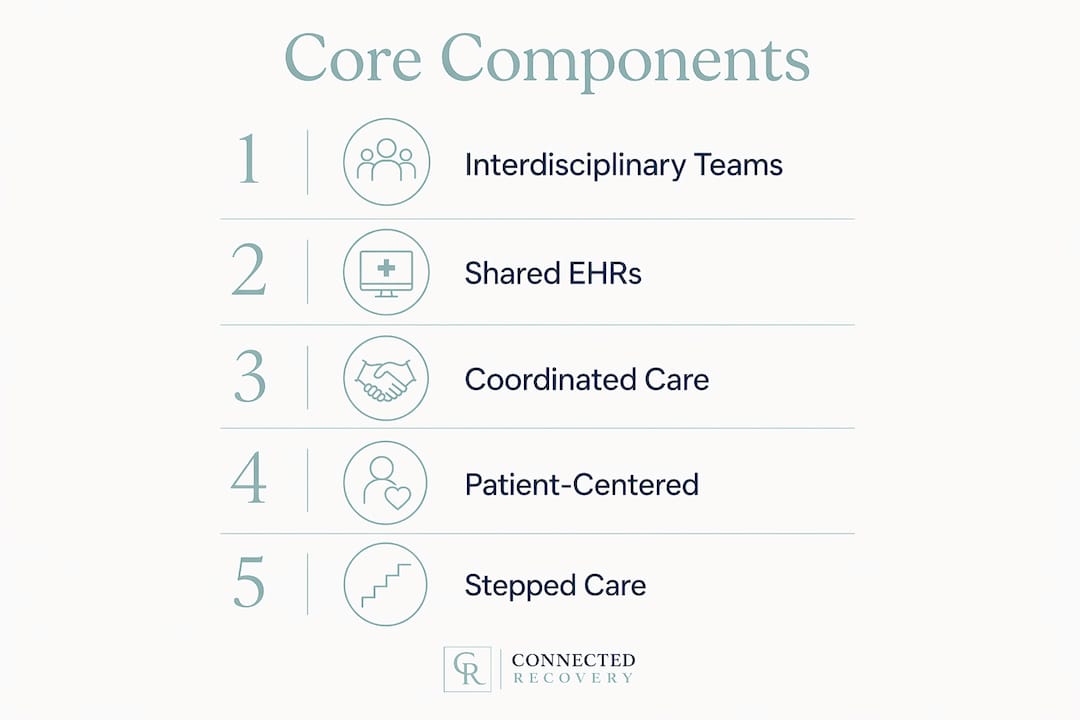
Shared electronic health records allow every team member to update and read the same patient file in real time. Without shared EHR systems, patients must repeat their histories at every visit and coordination breaks down. This single data layer is what separates genuine integration from simple colocation, where providers share a building but not a workflow.
Coordinated treatment plans set shared goals across all disciplines. Rather than a psychiatrist writing one plan and an addiction counselor writing another, the team produces one document with unified targets, timelines, and accountability.
Three widely studied models show how these components come together in practice:
- The Collaborative Care Model embeds a care manager within primary care to coordinate between the patient, the primary care physician, and a consulting psychiatrist.
- The Cherokee Model places Behavioral Health Consultants directly inside primary care visits, enabling real-time warm hand-offs without referral delays.
- The Colorado Integrated Behavioral Health Plus (CIBH+) model uses a stepped care approach that adjusts treatment intensity based on patient context rather than fixed diagnostic categories.
Pro Tip: When evaluating any program, ask specifically whether providers share a single EHR system. Shared records are the clearest sign of true integration versus simple colocation.
What are the key benefits of integrated mental health treatment?
The clinical case for integrated behavioral health is strong and growing. Mental health summary scores improve by 0.05 per integration point in standardized practice profiles, based on 2025 research validated across multiple settings. That number reflects a measurable, consistent gain tied directly to how deeply a practice integrates its behavioral health services.
The benefits extend well beyond test scores:
- Faster, more accurate diagnosis. Embedded behavioral health support results in faster diagnosis for anxiety and panic disorders in primary care settings, according to 2025 evaluations.
- Higher patient satisfaction. Patients report better experiences when they receive coordinated care from a team that communicates openly, rather than navigating multiple disconnected providers.
- Reduced stigma. Receiving behavioral health support within a primary care visit normalizes mental health treatment. Patients who might never walk into a standalone psychiatric clinic will accept a brief conversation with a Behavioral Health Consultant during a routine checkup.
- Lower total healthcare costs. Value-based care frameworks drive integration by reducing total healthcare costs and improving early intervention for comorbid conditions. Integration is a financial imperative, not just a clinical preference.
- Better long-term recovery. For people with co-occurring disorders, integrated treatment produces higher rates of discontinued substance use and improved psychiatric symptoms compared to sequential care.
The cost argument deserves special attention. Untreated co-occurring disorders drive repeated emergency room visits, hospitalizations, and lost productivity. Integrated care catches problems earlier and manages them more efficiently, which reduces downstream costs for patients and health systems alike.
How does integrated mental health treatment work in practice?
The day-to-day experience of integrated care looks different from traditional treatment in several concrete ways.
-
The initial visit combines physical and behavioral health screening. A primary care physician conducts a standard exam while a Behavioral Health Consultant reviews mental health and substance use history in the same appointment block. No separate intake, no second waiting room.
-
Brief behavioral health interventions happen inside primary care visits. Behavioral Health Consultants conduct focused interventions lasting 15–20 minutes within primary care visits, contrasting with traditional longer therapy sessions. This format fits naturally into a medical workflow and reduces the friction that keeps people from seeking mental health support.
-
The team huddles before and after patient appointments. Clinicians share updates, flag concerns, and adjust treatment plans in real time. This is where the Cherokee Model's warm hand-off approach shines: a physician can introduce a patient directly to the Behavioral Health Consultant in the same room, eliminating the referral gap entirely.
-
Care intensity adjusts as the patient's needs change. The CIBH+ stepped care approach combines in-person visits, digital outreach, and team-based case review to match treatment intensity to patient context. Someone in early recovery gets more frequent contact; someone who is stable gets lighter touchpoints.
-
Digital tools extend reach between appointments. Video conferencing, secure messaging, and digital screening tools keep the care team connected to patients who face transportation barriers or live in underserved areas.
Pro Tip: Ask your provider whether they use a stepped care model. Programs that adjust treatment intensity over time produce better long-term outcomes than those with a fixed, one-size-fits-all schedule.
What should you look for when choosing an integrated treatment program?
Not every program that calls itself "integrated" delivers true integration. Knowing what to look for protects you from paying for colocation dressed up as coordination.
Signs of genuine integration include:
- Shared records across all providers. Every clinician on your team reads and writes to the same patient file. If providers fax notes to each other, that is not integration.
- Regular team coordination meetings. Interdisciplinary teams that coordinate with shared data improve both patient and provider satisfaction. Ask how often the team meets and who attends.
- A single, unified treatment plan. Your mental health goals and your substance use recovery goals appear in one document, not two separate plans from two separate providers.
- Flexible scheduling and modalities. A quality program offers both in-person and digital appointment options. Rigid scheduling is a sign of a system built around provider convenience, not patient need.
- Dual diagnosis expertise. Programs that specialize in individualized addiction treatment alongside mental health care produce better outcomes for people with co-occurring disorders than generalist programs that add behavioral health as an afterthought.
Pro Tip: Before enrolling, ask the program directly: "Do your primary care and behavioral health providers share a single electronic health record?" A confident "yes" is a strong signal of real integration.
Key takeaways
Integrated mental health treatment is the most effective approach for co-occurring disorders because it eliminates care fragmentation, unifies treatment planning, and coordinates interdisciplinary teams around a single patient record.
| Point | Details |
|---|---|
| Core definition | Integrated care addresses mental health and substance use disorders simultaneously in one unified setting. |
| True integration vs. colocation | Shared EHR systems and joint treatment plans separate real integration from providers who merely share a building. |
| Clinical outcomes | Mental health scores improve measurably with each increase in integration depth, based on 2025 validated research. |
| Practical delivery | Brief 15–20 minute behavioral health visits inside primary care appointments reduce barriers and speed diagnosis. |
| Choosing a program | Ask about shared records, team huddle frequency, and whether a single unified treatment plan covers all conditions. |
Why I think integrated care is the most important shift in addiction treatment
I have watched the traditional model fail people in ways that are entirely preventable. A person leaves detox with a referral slip and a two-week wait for a psychiatrist. By the time that appointment arrives, they have relapsed. The system did not fail them because of bad intentions. It failed them because the design assumed that mental health and addiction are separate problems with separate solutions.
The research now confirms what experienced clinicians have known for years. Treating co-occurring disorders sequentially, one after the other, produces worse outcomes than treating them together. The Cherokee Model and CIBH+ are not theoretical frameworks. They are working systems that produce faster diagnoses, fewer referral drop-offs, and better long-term recovery.
The piece I find most underappreciated is the stigma reduction effect. When a Behavioral Health Consultant walks into a primary care exam room, mental health support stops feeling like a separate, scary thing. It becomes part of routine medical care. That shift in perception keeps people engaged in treatment longer, and engagement is the single biggest predictor of sustained recovery.
Digital tools are making this model accessible to people who could never reach it before. Video-based behavioral health visits, digital screening tools, and remote care coordination are extending integrated care into rural and underserved communities. The future of addiction treatment is not a bigger facility. It is a better-connected team.
— Jim
Connected Recovery's approach to integrated mental health care
Connected Recovery operates as a 12-bed boutique facility in Van Nuys, CA, built specifically around the integrated care model. Every client receives a personalized treatment plan that addresses both substance use and co-occurring mental health disorders from day one, with 24/7 medical supervision throughout the process.
The facility's dual diagnosis treatment program combines psychiatric support, addiction medicine, and behavioral health counseling within a single coordinated team. That structure eliminates the referral gaps and communication breakdowns that derail recovery in fragmented systems. Connected Recovery also provides case management services that extend coordination from initial detox through aftercare planning, keeping the treatment team aligned at every stage of recovery.
FAQ
What is integrated behavioral health?
Integrated behavioral health is a care model that embeds mental health and substance use disorder treatment within a coordinated, interdisciplinary team, typically anchored in primary care. It uses shared records, unified treatment plans, and real-time communication to eliminate gaps between providers.
How does integrated treatment work for co-occurring disorders?
Integrated treatment addresses both a mental health condition and a substance use disorder at the same time, using one team and one treatment plan. SAMHSA confirms this approach produces higher rates of discontinued substance use and better psychiatric symptom improvement than sequential care.
What is the difference between integrated care and colocation?
Colocation means providers share a physical space but operate independently with separate records and plans. True integration requires shared electronic health records, joint treatment planning, and regular team coordination meetings across all disciplines.
How long does integrated mental health treatment take?
Treatment length varies based on the individual's conditions, severity, and response to care. Stepped care models like CIBH+ adjust treatment intensity over time, meaning some patients receive intensive support early and transition to lighter touchpoints as they stabilize.
What questions should I ask before entering an integrated treatment program?
Ask whether all providers share a single electronic health record, how often the interdisciplinary team meets, and whether your mental health and substance use goals appear in one unified treatment plan. These three questions reliably distinguish genuine integration from colocation.