
A detox evaluation process is a structured clinical assessment that determines your physical, psychological, and social needs before detoxification begins. Clinicians use this assessment to build a personalized, medically safe withdrawal plan rather than applying a one-size-fits-all protocol. The American Society of Addiction Medicine (ASAM) sets the gold standard for this process through its six-dimension criteria, which guides level-of-care decisions across the country. Understanding what happens during a detox assessment process removes the fear of the unknown and helps you walk in prepared, not anxious.
What are the key steps in the detox evaluation process?
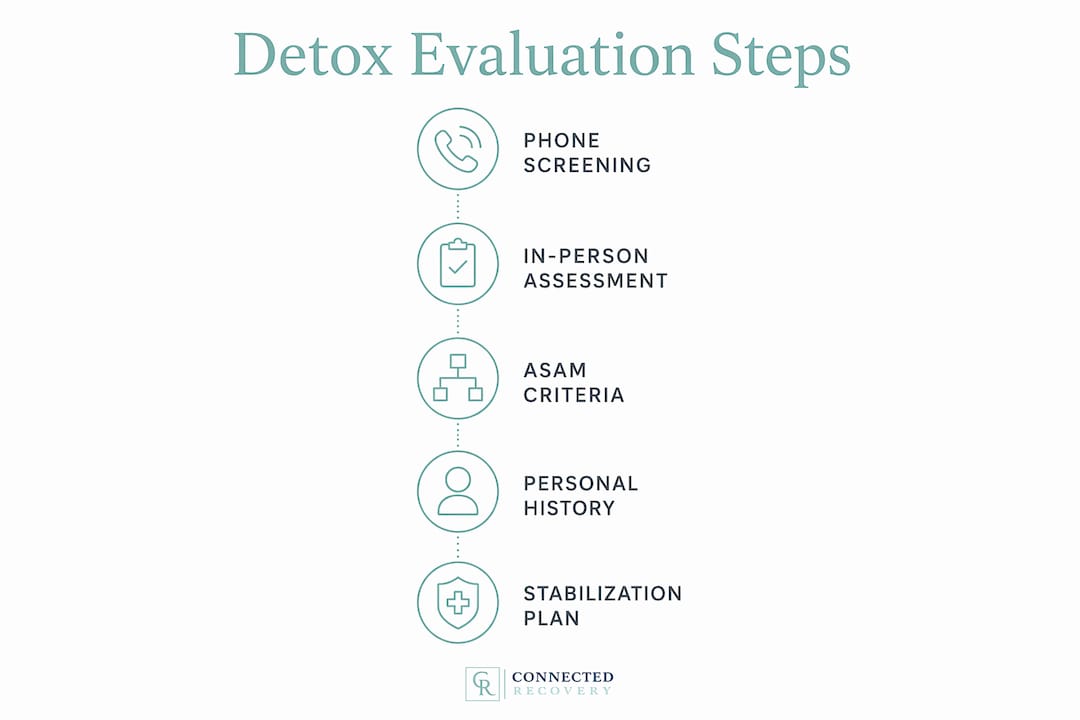
The detox evaluation process follows a clear sequence, starting before you ever arrive at a facility. Each step builds on the last, so clinicians have a complete picture by the time medical stabilization begins.
-
Phone screening. The process starts with a call. Staff collect your substance use history, the date and amount of your last use, your insurance information, and basic financial details. This call also confirms whether the facility is in-network, which prevents billing surprises later. Insurance verification happens at this stage, not after admission.
-
In-person bio-psychosocial assessment. On arrival, a clinician conducts a full physical exam, draws blood for lab work, and records baseline vital signs including blood pressure, heart rate, respiratory rate, temperature, and oxygen saturation. A mental health evaluation follows, covering mood, cognition, trauma history, and any co-occurring psychiatric conditions. Social factors like housing stability, family support, and employment status are also documented.
-
Withdrawal risk scoring. Clinicians use validated tools like the Clinical Institute Withdrawal Assessment for Alcohol, Revised (CIWA-Ar) to score withdrawal severity. The CIWA-Ar measures symptoms including nausea, tremors, anxiety, agitation, and perceptual disturbances. That score directly determines which medications you receive and how quickly.
-
Medication and care plan development. All data collected feeds into a personalized medication protocol. Clinicians decide on dosing, monitoring frequency, and which specialists to involve based on your specific profile.
-
Ongoing monitoring. For high-risk patients, vital signs are checked repeatedly during the first 72 hours. Frequent monitoring allows staff to catch complications like seizures or cardiac events before they escalate.
Pro Tip: Write down your full substance use history before your phone screening, including all substances, approximate daily amounts, and your last use date. Clinicians need this detail to assess your withdrawal risk accurately. Vague answers lead to generic protocols.
How does the ASAM criteria guide the detox evaluation process?

The ASAM criteria are the most widely used clinical framework for addiction treatment placement in the United States. They require clinicians to assess patients across six distinct dimensions rather than relying on a single factor like substance type or frequency of use. This multi-dimensional approach is what separates a thorough detox program evaluation from a superficial intake form.
| ASAM Dimension | What It Assesses |
|---|---|
| 1. Acute intoxication and withdrawal risk | Current intoxication level and predicted withdrawal severity |
| 2. Biomedical conditions | Physical health problems that complicate detox, such as liver disease or diabetes |
| 3. Emotional and behavioral conditions | Mental health diagnoses, trauma history, and current psychiatric symptoms |
| 4. Treatment acceptance and resistance | Motivation to engage in treatment and any ambivalence or barriers |
| 5. Relapse potential | History of prior treatment attempts, triggers, and coping skills |
| 6. Recovery environment | Housing stability, social support, and exposure to substance-using peers |
Each dimension produces a score that informs the recommended level of care. A person with severe withdrawal risk and unstable housing scores differently from someone with mild withdrawal and a strong support network. That difference matters because placing someone in a level of care that is too low increases relapse risk, while placing them too high wastes resources and can feel punitive.
Adherence to ASAM criteria is a marker of clinical quality. Facilities that follow this framework build individualized treatment plans rather than defaulting to whatever bed is available. The criteria also create a documented clinical rationale, which insurers require for coverage approval.
Pro Tip: Ask any facility you are considering whether their intake team uses ASAM criteria. If the answer is vague or negative, that is a signal to look elsewhere. The criteria exist to protect you, not to create paperwork.
What should you have ready before your detox evaluation?
Preparation directly affects how quickly and safely your care begins. Clinicians need accurate information to verify benefits and build your medication plan before your condition or motivation changes. Delays caused by missing documents can push back admission by hours or days, which is a serious risk during active withdrawal.
Gather the following before your evaluation appointment:
- Insurance card and policy number. Staff need this to verify in-network status and benefits before you arrive.
- Photo ID and emergency contact information. Required for admission paperwork and medical consent.
- Complete medication list. Include dosages and prescribing physicians for every medication you currently take.
- Substance use history. Be specific: substances used, approximate daily amounts, last use date, and any prior withdrawal episodes.
- Mental health records or diagnoses. If you have a psychiatric diagnosis or take psychotropic medications, bring documentation.
- Prior treatment records. Previous detox or rehab history helps clinicians anticipate complications and avoid repeating ineffective approaches.
Transparency is the single most important thing you can bring. Clinicians are not there to judge your use history. They need accurate data to keep you safe. Understating your use or omitting substances can result in under-medication during withdrawal, which increases the risk of seizures and severe discomfort.
Out-of-pocket costs vary widely depending on insurance coverage and facility type. Verifying your benefits during the phone screening prevents unexpected charges after admission. Ask specifically about deductibles, copays, and whether the facility is in-network for your plan.
What happens after the detox evaluation?
The evaluation findings translate directly into a medical stabilization protocol. Clinicians use your ASAM scores, CIWA-Ar results, and lab work to select medications, set monitoring schedules, and identify which specialists need to be involved from day one. This is not a waiting period. Medical stabilization begins the moment your plan is confirmed.
Withdrawal symptom monitoring continues throughout the stabilization phase. Staff track vital signs, reassess CIWA-Ar scores at regular intervals, and adjust medications as your withdrawal trajectory becomes clearer. The goal is to keep symptoms manageable without over-sedating you, which requires real-time clinical judgment rather than a fixed protocol.
Discharge and transition planning starts early, not at the end of your stay. A 2014 analysis published in the Journal of Substance Abuse Treatment found that seamless transfer to residential or outpatient treatment reduces relapse rates at both 30 and 90 days compared to discharges without follow-up planning. That finding reframes discharge planning as a clinical priority, not an administrative afterthought.
Your transition plan may include residential treatment, intensive outpatient programming, medication-assisted treatment, or a combination. The evaluation data you provided on day one shapes every one of those recommendations. A well-executed aftercare plan is the bridge between completing detox and sustaining recovery.
Pro Tip: Ask your care team about your discharge plan within the first 48 hours of admission. Knowing the next step reduces anxiety and gives you something concrete to work toward while you are still in detox.
Key Takeaways
A thorough detox evaluation process is the clinical foundation that makes safe, personalized withdrawal management possible.
| Point | Details |
|---|---|
| Evaluation precedes treatment | Clinicians assess physical, psychological, and social factors before any medication protocol begins. |
| ASAM criteria set the standard | Six dimensions guide level-of-care decisions and protect patients from mismatched treatment placements. |
| Preparation speeds admission | Bringing insurance info, medication lists, and an honest use history prevents delays and improves care accuracy. |
| CIWA-Ar guides withdrawal management | Validated scoring tools translate symptom severity into specific medication and monitoring decisions. |
| Discharge planning starts early | Seamless transition to the next level of care significantly reduces relapse risk at 30 and 90 days. |
Why the evaluation is the most underestimated part of recovery
Most people focus their anxiety on detox itself, the physical discomfort, the unknown timeline, the fear of withdrawal. The evaluation rarely gets the same attention. That is a mistake, and I have seen it play out in real consequences.
When someone walks into an evaluation unprepared or withholds information, clinicians are forced to make conservative guesses. Conservative guesses mean under-medication or over-medication, neither of which serves the patient. The evaluation is not a formality. It is the moment where your entire care plan gets built. Treating it casually is like giving an architect incomplete blueprints and expecting a solid structure.
The other thing I want people to understand is that the ASAM criteria exist to protect you from being placed in the wrong level of care. Facilities that skip or rush this framework are cutting corners on your safety. Asking a facility whether they use ASAM criteria is not an aggressive question. It is a reasonable one, and any quality program will answer it without hesitation.
Viewing the evaluation as a collaboration rather than an interrogation changes everything. You are not being screened out. You are being set up for the safest possible withdrawal. The more you give, the better your plan becomes.
— Jim
Connected Recovery's approach to medical detox evaluation

Connected Recovery, located in Van Nuys, CA, builds every medical detox plan on a thorough clinical evaluation using ASAM criteria and comprehensive bio-psychosocial assessments. With a 12-bed capacity, the facility provides the kind of individualized attention that larger centers cannot replicate. Every person admitted receives 24/7 medical supervision, a personalized withdrawal management protocol, and a discharge plan that connects detox to the next phase of care. If you are ready to take the first step, Connected Recovery offers a free, confidential initial screening. Contact the team directly or learn more about the medical detox program to understand what your evaluation and care plan would look like.
FAQ
What is a detox evaluation process?
A detox evaluation process is a clinical assessment conducted before detoxification begins. It covers physical health, mental health, substance use history, and social factors to build a safe, personalized withdrawal plan.
How long does a detox evaluation take?
The phone screening typically takes 15–30 minutes. The full in-person bio-psychosocial assessment, including physical exam, lab work, and mental health evaluation, generally takes several hours on the day of admission.
What is the ASAM criteria used in detox assessment?
The ASAM criteria are a six-dimension clinical framework used to assess withdrawal risk, physical health, mental health, treatment readiness, relapse potential, and recovery environment. Scores across all six dimensions determine the appropriate level of care.
Why is honesty important during a detox evaluation?
Clinicians use your substance use history to calculate withdrawal risk and select medications. Understating your use can result in under-medication, which increases the risk of severe withdrawal complications including seizures.
What happens right after the detox evaluation is complete?
Clinicians finalize your medication protocol and begin medical stabilization immediately. Vital signs and withdrawal symptoms are monitored frequently, and discharge planning to the next level of care begins within the first 48 hours.