
Urgent detox admission steps are the specific actions you take to secure medically supervised withdrawal treatment as fast as possible, often within hours of your first call. The clinical term for this process is emergency detoxification intake, and it follows a defined sequence: phone screening, insurance verification, bed confirmation, and travel to the facility. Same-day admission is possible when you arrive at that first call prepared, honest, and ready to move. This guide walks you through every step so nothing slows you down when time matters most.
What are the urgent detox admission steps?
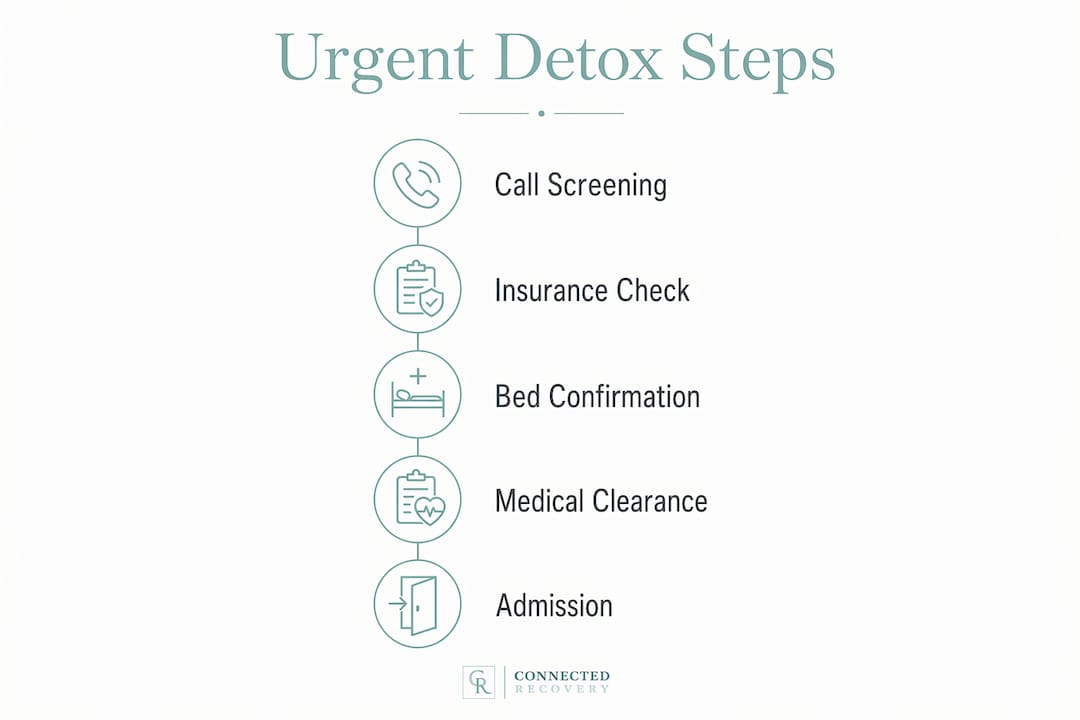
The detox program admission process moves faster than most people expect. Urgent detox admission steps include an initial phone screening, insurance verification, facility acceptance, and travel to the site, with travel often being the longest segment for people in rural or cross-state situations. Understanding this sequence before you call removes the anxiety of not knowing what comes next.
The phone screening is a clinical safety conversation, not an interrogation. The intake counselor asks about the substances you use, how much, and when you last used. They also ask about your medical history, any mental health conditions, and whether you have a support person nearby. Your answers directly determine which level of care is right for you, so accuracy matters more than anything else at this stage.

Insurance verification runs parallel to or immediately after the screening. Many facilities have dedicated benefits specialists who check your coverage in real time while you are still on the phone. Once coverage is confirmed and a bed is available, you receive arrival instructions and the admission is set.
Pro Tip: Write down the name of the intake counselor you speak with, the time of your call, and any reference number given. This protects you if there is any confusion when you arrive.
How do you prepare for the fastest residential detox intake?
Preparation is the single biggest factor separating a same-day admission from a multi-day delay. Full honesty about your substance use is the most critical requirement. Intake teams are not there to judge you. They need accurate information to place you in a setting that can safely manage your withdrawal.
Before you pick up the phone, gather the following:
- Insurance card or a photo of it. Having insurance information ready speeds the verification step significantly. If you do not have insurance, say so immediately. Many programs offer self-pay rates or payment plans, and waiting to "get insurance figured out" is one of the most avoidable delays in the process.
- A list of all substances used, amounts, and the date and time of your last use. Include alcohol, prescription medications, and any over-the-counter drugs.
- Your medical history summary. Note any chronic conditions, current prescriptions, known allergies, and prior withdrawal episodes.
- A valid photo ID. Most facilities require this for admission paperwork.
- Emergency contact information. A name and phone number for someone who knows you are seeking treatment.
- Clarity on your travel availability. Know whether you can leave today, whether you have a ride, and how far you can realistically travel.
Communicating your logistical constraints upfront lets intake staff filter options quickly and avoids wasting time on facilities you cannot reach or afford. If you need a program within 30 miles, say that immediately. If you require a private room for medical reasons, state it. The more specific you are, the faster the match.
Pro Tip: If you have a dual diagnosis, meaning a mental health condition alongside addiction, mention it in the first two minutes of the call. This changes which programs are appropriate and prevents a placement that cannot meet your full clinical needs. Connected Recovery's dual diagnosis program is built specifically for this situation.
How to execute the detox admission process step by step
The step-by-step process for emergency detox intake follows a consistent sequence across most accredited facilities. Here is exactly what happens from your first call to your first night in care:
- Call the admissions line. State clearly that you need detox and that you are ready to come today. Saying "I'm ready to come today" signals urgency to the intake team and moves you to a priority scheduling track. Hesitation or vague timelines result in slower placement.
- Complete the phone screening. Answer every question about substance use, medical history, and mental health honestly and completely. This call typically takes 20–45 minutes.
- Insurance verification. Provide your insurance ID number, group number, and the name of the policyholder. The benefits team checks your coverage, confirms in-network status, and identifies any prior authorization requirements.
- Receive facility acceptance. Once clinical criteria are met and a bed is confirmed, the intake coordinator tells you the facility address, what to bring, and what to leave behind.
- Arrange travel. Drive yourself, ask a family member, or request transportation assistance from the facility. Some programs coordinate transport directly.
- Arrive and complete in-person intake. You sign consent forms, receive a medical evaluation from a physician or nurse practitioner, and begin your individualized treatment plan.
The table below shows typical timeframes for each step under normal conditions:
| Step | Typical Duration |
|---|---|
| Phone screening | 20–45 minutes |
| Insurance verification | 15–30 minutes |
| Bed confirmation | 5–15 minutes |
| Travel to facility | 30 minutes to several hours |
| In-person intake and medical evaluation | 1–2 hours |
Facilities vary significantly in their medical capabilities, which affects how quickly they can accept you and what conditions they can safely treat. Knowing this helps you ask the right questions when you call.
What mistakes delay or block same-day detox admission?
Several common errors add hours or days to the admission process. Recognizing them now prevents them from slowing you down.
- Waiting until insurance is "sorted." Insurance complications such as inactive policies, prior authorization requirements, or out-of-network providers do not eliminate your options. Multiple pathways exist, including self-pay and sliding-scale fees. Call first and let the facility's benefits team work the insurance problem while your screening proceeds.
- Understating your substance use. Telling the intake counselor you drink "a few beers a day" when the reality is a fifth of liquor can result in placement at a facility that cannot safely manage your withdrawal. This is a safety risk, not just an administrative one.
- Expressing uncertainty about readiness. Uncertainty about readiness moves you to a slower scheduling track. If you are calling, you are ready. Say it plainly.
- Ignoring travel logistics. Not having a ride or a plan to get to the facility stalls admission even after a bed is confirmed. Solve the transportation question before or during the call.
- Choosing speed over clinical fit. Accepting the first available bed at a facility that cannot manage your specific withdrawal type is dangerous. A fast placement must also be a matched placement that accounts for your clinical needs.
Pro Tip: If the first facility you call does not have an available bed, ask them for a referral. Experienced intake counselors maintain relationships with other programs and can often point you to an open bed faster than a cold search.
Which clinical factors determine your detox placement?
Not every detox program is equipped for every type of withdrawal. The clinical criteria that shape your placement decision are just as important as the logistical ones.
The table below compares hospital-based detox and residential detox by key clinical factors:
| Factor | Hospital-Based Detox | Residential Detox |
|---|---|---|
| Withdrawal severity | High risk, life-threatening | Mild to moderate |
| Substances | Alcohol, benzodiazepines | Opioids, stimulants, cannabis |
| Medical monitoring | Continuous, physician-led | 24/7 nursing, physician on call |
| Co-occurring disorders | Complex dual diagnosis | Stable mental health conditions |
| Length of stay | 3–7 days average | 5–14 days average |
Alcohol and benzodiazepine withdrawal carry the highest medical risk of any substance. Seizures and delirium tremens can be fatal without proper intervention. Emergency detox programs differentiate specifically by their ability to manage these high-risk withdrawals, with hospital-level care required for severe cases and residential programs appropriate for milder presentations.
Co-occurring mental health conditions, such as major depression, bipolar disorder, or PTSD, also affect placement. A facility without a licensed mental health team cannot safely stabilize someone experiencing both acute withdrawal and a psychiatric crisis. Connected Recovery's residential treatment program addresses this through an integrated care model that treats both conditions simultaneously.
Medical clearance is sometimes required before admission. If you arrive at an emergency room due to active withdrawal complications, the ER team stabilizes you first. The detox facility then accepts you once you are medically cleared. This is not a setback. It is the system working correctly to protect your safety.
Key takeaways
Urgent detox admission succeeds when you call prepared, speak honestly, and confirm that the facility's clinical capabilities match your specific withdrawal needs.
| Point | Details |
|---|---|
| Call ready to commit | Saying "I'm ready to come today" moves you to a priority admission track immediately. |
| Honesty speeds placement | Full disclosure of substances, amounts, and medical history prevents dangerous clinical mismatches. |
| Insurance is not a barrier | Call before insurance is resolved; facilities have benefits teams to handle verification in parallel. |
| Clinical fit matters as much as speed | Alcohol and benzodiazepine withdrawal require hospital-level care, not just the nearest open bed. |
| Travel is often the longest step | Solve transportation logistics during the call to avoid delays after bed confirmation. |
What i've learned about urgent detox admissions after years in this field
After working in and around addiction treatment for a long time, the pattern I see most often is this: people wait too long to call because they are afraid the call itself will be overwhelming. The intake process is actually the least overwhelming part of the whole experience. It is a structured conversation with a trained professional whose only job is to help you get safe.
The biggest mistake I see is people editing their story during the intake call. They say "I drink socially" or "I only use on weekends" because they are embarrassed or afraid of judgment. Intake counselors have heard everything. What they need from you is accuracy, not a polished version of events. Understating your use does not protect you. It puts you at risk of landing in a program that cannot handle what your body is actually going through.
The second thing I want you to know is that insurance confusion is almost never a dead end. I have seen people with lapsed coverage, no coverage, and complicated out-of-network situations get admitted the same day because they called and let the facility's team work the problem. The call is always the right first move.
If you are reading this right now and wondering whether you should pick up the phone, the answer is yes. The admissions process at a good facility is designed to meet you where you are, not where you think you should be.
— Jim
Start your detox admission at connected recovery today
Connected Recovery operates a 12-bed boutique detox and residential treatment facility in Van Nuys, CA, with 24/7 medical supervision and individualized care plans from day one. The small size is intentional. You get direct attention from clinical staff, not a number in a queue.
If you are ready to start, Connected Recovery's medical detox program accepts same-day inquiries and walks you through insurance verification on the first call. The team also handles dual diagnosis cases and can discuss self-pay and payment plan options if insurance is a concern. Call today and tell them you are ready to come in. That one sentence starts everything.
FAQ
What happens during the first detox intake call?
The intake counselor asks about your substance use, last use date, medical history, and mental health background. This clinical screening typically takes 20–45 minutes and determines which level of care is appropriate for you.
Can i get admitted to detox the same day i call?
Same-day admission is possible when you complete the phone screening, pass insurance verification, and are ready to travel immediately. Clear answers and immediate availability are the two factors that make it happen.
What if i don't have insurance for detox admission?
Lack of insurance does not prevent you from starting the intake process. Many programs offer self-pay rates, sliding-scale fees, or payment plans, and the facility's benefits team can explore all options during your first call.
Do i need a doctor's referral to enter a detox program?
Most detox facilities do not require a physician referral for admission. You can call directly, complete the phone screening, and be admitted based on clinical need alone.
How is alcohol withdrawal detox different from opioid detox?
Alcohol and benzodiazepine withdrawal carry a risk of life-threatening seizures and require hospital-level medical supervision. Opioid withdrawal is rarely fatal but is intensely uncomfortable and is safely managed in most residential detox settings.