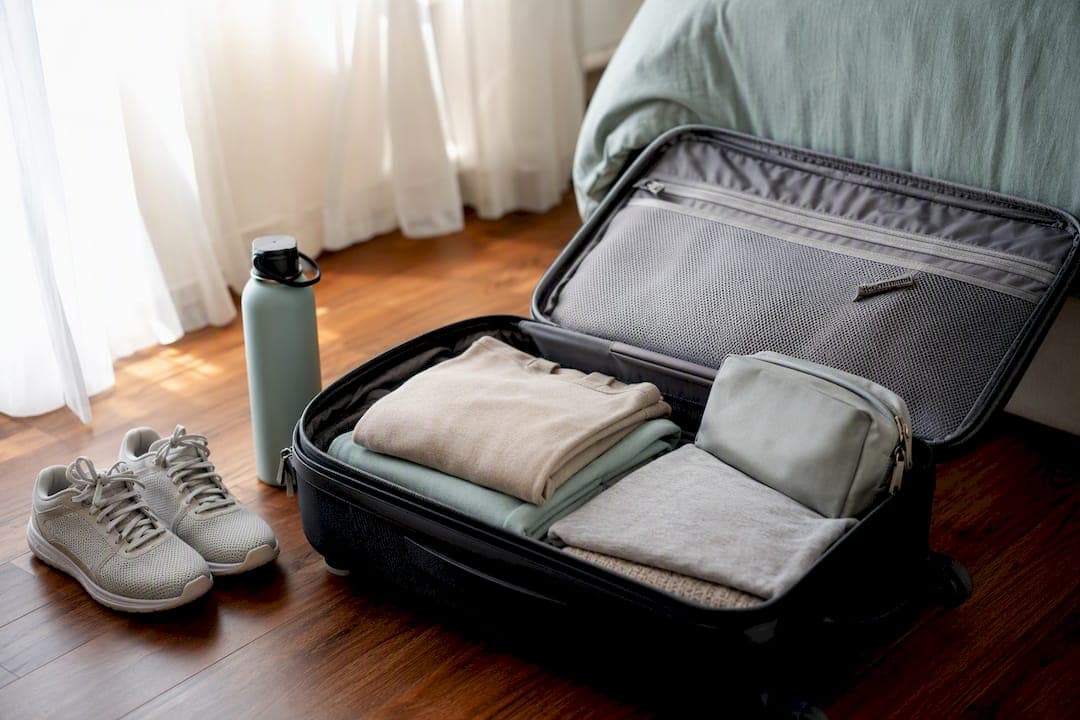
Travel for rehab makes sense for a specific set of people: those who need clinical services their local market doesn't offer, those whose home environment actively undermines recovery, and those for whom privacy is a genuine safety or career concern. If none of those apply, a strong local program is usually the faster, cheaper path. The single test to apply is this: can a program within driving distance match your actual level of care, or would you be settling? If the answer is no, start researching travel now.
- Need specialized care (detox, dual diagnosis, trauma-specific therapy) not available nearby
- Home environment includes active triggers, unsafe relationships, or constant relapse cues
- Privacy or professional reputation concerns make a local admission risky
- A facility like Connected Recovery can help coordinate admissions and transport once you decide
Call an admissions line or your insurer today and ask directly whether they can match your clinical needs. That one conversation tells you more than a week of research.
Key Takeaways
Travel for rehab is justified when a local program cannot match your clinical needs, but it requires verified insurance, documented transport, and a written aftercare plan to actually pay off.
| Point | Details |
|---|---|
| Apply the level-of-care test | Travel only when local programs can't match your specialized clinical needs. |
| Verify insurance before booking | Call your insurer and the facility to confirm benefits and prior authorization first. |
| Document the aftercare handoff | Insist on named local providers and scheduled follow-ups before you leave. |
| Check international legal rules | Visa, licensing, and privacy protections vary abroad and rarely match U.S. standards. |
| Connected Recovery supports travel logistics | Its 12-bed model coordinates transport, admissions, and aftercare for out-of-area patients. |
Table of Contents
- What Are the Clinical Benefits of Traveling for Rehab?
- What Are the Downsides of Traveling for Rehab?
- How Do You Get to a Rehab Facility Out of State?
- Which Facilities Arrange Transportation for Patients?
- Should You Stay Local or Travel for Treatment? A Decision Checklist
- How Do You Verify Insurance and Payment Before Booking Travel?
- What Should You Pack for Residential Rehab?
- How Do You Plan Your Trip Home After Rehab?
- How Does a Boutique Facility Support Travel and Admissions?
- Is It Legal to Travel Internationally for Rehab?
- How Do You Choose the Right Rehab Location?
- Does Travel Affect How Ready You Are for Rehab?
- Sources
What Are the Clinical Benefits of Traveling for Rehab?
Distance from triggers is not a soft benefit. It's the mechanism behind one of the more consistent findings in residential treatment research: patients removed from familiar people, places, and substances tend to complete programs at higher rates than those who stay close to home. The research on residential treatment completion points to environmental removal and treatment fit as two of the strongest predictors of whether someone finishes the program they started.
Travel also opens access to services your zip code simply doesn't have. Not every community has a facility equipped for medically supervised detox, dual diagnosis care, or specialty modalities for trauma and co-occurring disorders. The National Institute on Drug Abuse frames this as a core principle of effective treatment: match the level of care to the person's actual needs, not to whatever happens to be closest.
Fewer than 20 percent of people who need substance use treatment in a given year actually receive it, and access gaps are a major reason why. If your nearest options have long waitlists or lack the right program, traveling can shrink the time between deciding to get help and actually starting.
- Reduced exposure to people, places, and routines tied to substance use
- Access to detox, dual diagnosis, or specialty therapy programs unavailable locally
- Anonymity that protects careers, licenses, and family reputation
- A documented boost in completion odds when the environment and program fit are right
What Are the Downsides of Traveling for Rehab?
Traveling for treatment isn't free of trade-offs, and pretending otherwise does readers a disservice. Family involvement gets harder. Weekly family therapy sessions that would be routine for a local program become video calls or occasional flights, and some programs simply can't include out-of-state family the way an in-person model can.

Money is the next issue. Flights, lodging for visiting family, and time off work add up fast, and insurance networks often complicate out-of-area care. A plan that covers you at home may treat a distant facility as out-of-network, which means higher out-of-pocket costs unless the facility negotiates or the plan has an exception process.
Aftercare handoffs are the risk people underestimate most. Coming home means transferring your care to local providers who never met you during treatment. If that handoff isn't documented and scheduled before you leave, the gap between discharge and your first local appointment is exactly where relapse risk spikes.
- Weaker in-person family therapy access and slower family reintegration
- Travel, lodging, and time-off costs stacked on top of treatment fees
- Insurance network limits that can turn a covered stay into a partial out-of-pocket one
- Aftercare gaps if discharge planning doesn't include local follow-up
Pro Tip: If you're still in active withdrawal, don't drive yourself or book a red-eye flight alone. Ask the facility whether they offer a medically supervised pickup, since traveling while withdrawing can be genuinely dangerous depending on the substance.
How Do You Get to a Rehab Facility Out of State?
Getting there safely takes more planning than booking a flight. The right transport choice depends on your medical stability, distance, and whether the facility offers pickup.
- Drive yourself or have a sober companion drive if you're medically stable and the distance is reasonable, ideally under six hours.
- Use a facility-arranged pickup for airport or ground transfers when you're not stable enough to travel alone.
- Book a direct flight when distance makes driving impractical, and coordinate arrival timing with admissions so you land during intake hours.
- Take a bus or train only if you're medically cleared and want a lower-cost option with no time pressure.
Facilities that handle intake regularly often build same-day admission around your arrival window, but that only works if you or your insurer completed benefit verification and any required pre-authorization in advance. Addressing transportation barriers before they become a crisis is one of the best practices identified by HHS for keeping people engaged with treatment instead of falling through the cracks.
- Carry medications in original containers with your name and dosage clearly visible
- Bring a printed medication list in case a phone dies or gets left behind
- Understand that HIPAA and 42 CFR Part 2 privacy rules govern who a third-party driver or transport service can share your information with
A same-day arrival health check, covering vitals and current withdrawal symptoms, is standard at most accredited programs and helps staff catch anything that changed in transit.
Which Facilities Arrange Transportation for Patients?
Many residential programs offer some level of transport help, but the details vary a lot. Some cover airport pickup for free within a set radius. Others charge a flat transfer fee or only provide medically escorted transport for patients in active withdrawal.
- Airport or train station pickup, sometimes with a clinical staff escort
- Shuttle service from a designated meeting point rather than door-to-door
- Medically supervised transfers for people who aren't stable enough to travel unaccompanied
Ask admissions directly: Do you provide pickup, and from where? Is a medical escort included if I'm still withdrawing? Is transport bundled into my treatment cost or billed separately? These questions should come up during insurance verification, since some transport arrangements require your consent to share travel and health information with a driver or escort.
Pro Tip: Get the transport answer in writing, even a confirmation email. Verbal promises about "we'll pick you up" fall apart fast when nobody documented the pickup time.

Should You Stay Local or Travel for Treatment? A Decision Checklist
Run through this before you commit to either path:
- Clinical level of care. Does a local program actually offer detox, dual diagnosis treatment, or the specialty therapy you need, or would you be settling for a partial fit?
- Accreditation. Is the program accredited and licensed, and can they show you proof without hesitation?
- Bed availability and timing. Can you get in this week, or are you looking at a multi-week wait either way?
- Insurance coverage. Is the facility in-network, and if not, what will out-of-pocket costs look like?
- Family involvement. How much do you need in-person family sessions, and would travel make that harder?
If you flag two or more clinical gaps, meaning the local option can't match your level of care needs, travel is usually justified even with the added cost and logistics. If your only concerns are cost and family convenience, a strong local program is probably the better call.
How Do You Verify Insurance and Payment Before Booking Travel?
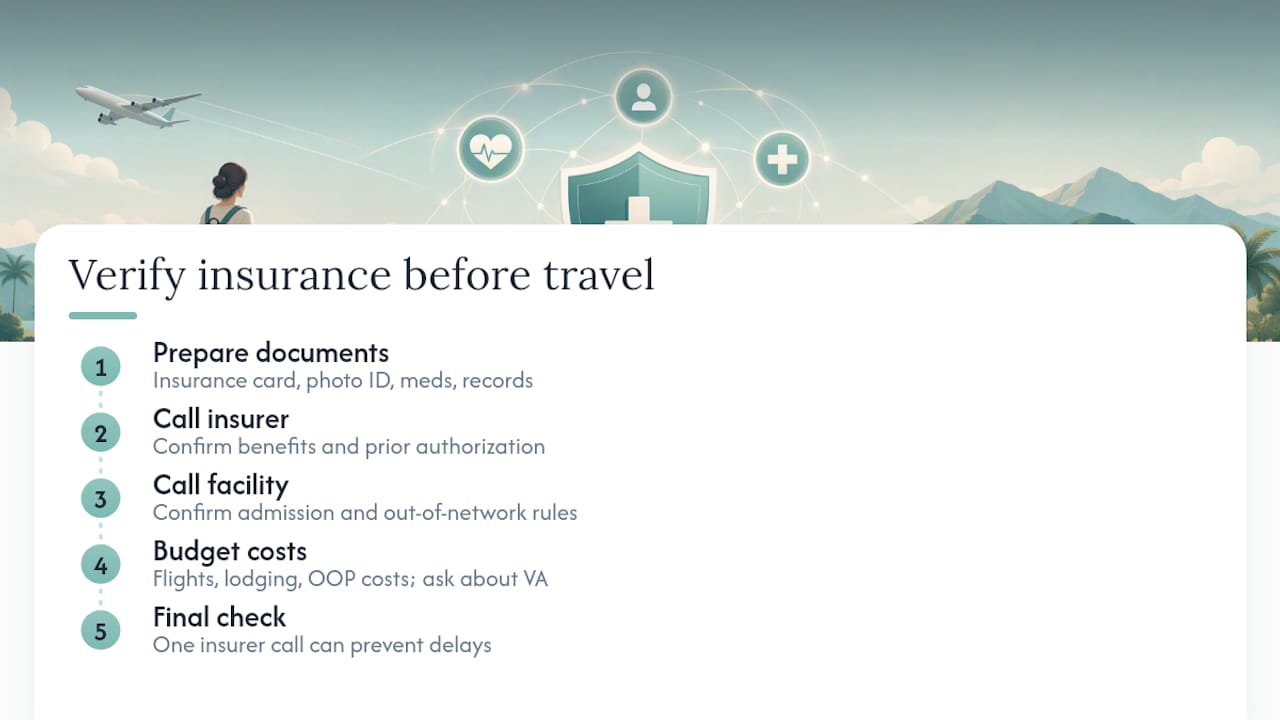
Call your insurer and the facility before you buy a single plane ticket. Confirm your actual benefits, ask specifically about prior authorization requirements, and find out how the plan handles out-of-network care if the facility isn't in their directory. Ask about emergency exceptions too. Some plans will authorize out-of-network treatment when no in-network bed is available within a reasonable timeframe.
Have these ready before you call: insurance card, photo ID, a current medication list, and recent medical or psychiatric records if you have them. Missing paperwork is one of the most common reasons same-day admissions get delayed.
Budget beyond the treatment cost itself. Flights, a hotel for a visiting spouse or parent, and any out-of-pocket treatment costs can add up to several thousand dollars depending on distance and length of stay. Veterans should ask specifically about VA travel reimbursement for approved treatment, since some federal programs cover travel costs when treatment is medically necessary.
A single phone call to your insurer confirming benefits and prior authorization can save days of delay once you're standing at admissions ready to check in.
What Should You Pack for Residential Rehab?
Pack light, but pack right. Bring your insurance card, photo ID, a written medication list, and any recent medical records. Disclose every medication to admissions before you arrive. Most facilities allow prescribed medications but require them to be checked in and dispensed by staff rather than kept in your room.
- Comfortable, weather-appropriate clothing without drawstrings, per most facility policies
- Toiletries without alcohol content, since many programs restrict alcohol-based products
- Leave jewelry, cash, and valuables at home or with family
Before you leave, notify your employer if job protection applies, set an emergency contact list, and pause auto-pay bills or mail delivery that could pile up while you're away.
How Do You Plan Your Trip Home After Rehab?
Don't leave a program without a documented discharge and aftercare plan in hand. That means specific referrals to local providers, scheduled follow-up appointments, and any medication prescriptions you'll need before your first local visit.
- Confirm your aftercare paperwork is complete, including provider names, phone numbers, and appointment dates, not just a generic recommendation to "find a therapist."
- Arrange transport home with timing in mind. Arriving back late at night with no one to meet you is a preventable risk, especially in the first 72 hours after discharge.
- Connect with local supports before you leave, whether that's an outpatient program, a peer support group, sober living, or a telehealth follow-up already on the calendar.
- Double check prescriptions and referral contacts one more time the morning you leave, since this is the paperwork most likely to get lost in the shuffle of packing.
How Does a Boutique Facility Support Travel and Admissions?
A 12-bed facility handles travel logistics differently than a 200-bed campus, mostly because staff can actually track individual arrivals instead of processing a queue. Connected Recovery's model pairs 24/7 medical supervision with integrated care for co-occurring mental health disorders, which matters most in the first hours after a long flight or drive when withdrawal symptoms can shift quickly.
A capable admissions navigator should document three things before you ever board a plane: a confirmed transport plan, completed insurance verification, and a medical escort arrangement if you're not stable enough to travel alone.
The gap between "we'll figure out your discharge plan" and a written aftercare plan with named providers and scheduled dates is the difference between a program that talks about continuity and one that practices it. Boutique settings, with fewer patients to track, tend to close that gap more reliably than larger facilities juggling higher patient loads.
- Small census means staff can coordinate pickup timing around your actual flight or drive
- Dual diagnosis care addresses mental health and substance use together instead of treating them separately
- Discharge planning typically starts well before your last day, not the morning you leave
Is It Legal to Travel Internationally for Rehab?
International rehab travel adds a layer most domestic guides skip entirely: visas, medical licensing, and legal protections that don't cross borders the way people assume. A facility operating overseas isn't bound by U.S. federal privacy protections like 42 CFR Part 2, even if the marketing sounds identical to a domestic program. That matters if you care about who can access your treatment records later.
Visa requirements vary by destination and by how long you plan to stay. Some countries issue medical tourism visas for treatment stays; others expect you to enter on a standard tourist visa, which can create problems if your treatment runs longer than the visa allows. Check entry requirements directly with the destination country's embassy rather than relying on a facility's website, since immigration rules change and a program has no authority over visa approval.
Licensing and accreditation are harder to verify from a distance. U.S. accreditation bodies don't oversee facilities abroad, so a program's claimed credentials may not mean what a domestic equivalent means. Medication laws differ too. A prescription that's routine in the U.S. can be restricted or require special documentation elsewhere, and bringing controlled substances across a border without the right paperwork can create legal problems that have nothing to do with your recovery.
For most readers, a legally straightforward option inside the U.S. carries far less risk than an international placement, unless there's a specific medical or personal reason driving that choice. If international treatment is genuinely the right fit, loop in an immigration attorney or the relevant embassy before booking anything.
How Do You Choose the Right Rehab Location?
Climate, culture, and legal environment shape your day-to-day experience during treatment more than most people expect going in. A humid coastal setting versus a dry mountain town isn't just aesthetic. Weather affects mood, sleep, and physical comfort during a period when your body is already under stress from withdrawal or early recovery.
Culture matters in a subtler way. Some patients do better in a facility that matches their background, language, or faith tradition, since feeling understood by staff and peers reduces the isolation that often drives relapse. Others specifically want distance from anything that reminds them of home, including cultural familiarity. Neither preference is wrong, but knowing which one applies to you should shape where you look.
Legal environment is the piece people forget to research. States differ on things like medication-assisted treatment access, involuntary commitment laws, and how a facility can legally handle a psychiatric crisis. If you have a co-occurring mental health condition, ask directly how the facility's state handles psychiatric holds or emergency stabilization, since answers vary significantly.
Practical logistics deserve equal weight alongside atmosphere. How far is the facility from an airport? Is there a nearby hospital for medical emergencies? Does the surrounding area support family visits if that matters to your treatment plan? A beautiful location with a two-hour drive from the nearest airport creates its own kind of logistical stress, and that stress lands on exactly the people who can least afford more of it.

Does Travel Affect How Ready You Are for Rehab?
Travel itself is a stressor, and pretending it isn't sets people up for a rough first day. Long flights, time zone changes, and the general disorientation of arriving somewhere unfamiliar all tax a body that may already be managing withdrawal symptoms or psychiatric medication adjustments.
Physically, dehydration and disrupted sleep from travel can worsen withdrawal symptoms that were already manageable at home. This is part of why medically supervised intake matters so much for anyone traveling any real distance for detox. The neurobiology of addiction research underscores why some substances require close medical monitoring during withdrawal, and travel fatigue can complicate that monitoring if staff don't know what to watch for.
Emotionally, the adrenaline of finally taking action can carry someone through the trip itself, only to crash once they're sitting in an unfamiliar room on day one. That's normal, not a sign anything went wrong. Facilities that do intake well build in a buffer, checking vitals and mental state on arrival rather than diving straight into group sessions, precisely because they expect new arrivals to need a beat before diving in.
If you're traveling a significant distance, build in rest before you go if possible. Arriving already exhausted from work stress and packing at 2 a.m. stacks poorly on top of travel fatigue and whatever brought you to treatment in the first place. A short buffer day, even just sleeping normally the night before departure, measurably changes how someone shows up for their first 24 hours.
Author's quick note: the one call that actually moves things forward
Pick up the phone and call an admissions navigator today. A facility like Connected Recovery can often help arrange private transport or expedite intake. Leaving home for treatment is genuinely hard. That doesn't mean it's the wrong move.
— Jim
How Connected Recovery Can Help You Get There
Connected Recovery is a boutique alternative to sprawling treatment campuses: 12 beds, 24/7 medical supervision, and integrated care for substance use and co-occurring mental health disorders under one roof in Van Nuys. That size means admissions can actually coordinate your specific arrival, not just process you into a queue.
Connected Recovery offers medical detox, residential treatment, and dual diagnosis care with a documented aftercare plan built in before you ever leave. If travel logistics or transport coordination is the piece holding you back, call admissions today and ask what a same-day intake would look like for your situation.
Sources
NIDA, ASPE/HHS, HHS Part 2 privacy, SAMHSA, treatment completion research.
This article is general information, not a substitute for advice from a qualified doctor. Consult a qualified healthcare professional about your own circumstances before acting on anything here.
- NIDA — Addiction treatment: Effective principles
- Recovery Research — What predicts residential treatment completion?
- ASPE — Best practices and barriers to engaging people with SUD
- HHS — HIPAA and 42 CFR Part 2 guidance
Recommended
- What Is a Private Residence Rehab? Your Clear Guide | Connected Recovery Inc.
- Steps to Emergency Rehab Admission: Act Fast, Get Help | Connected Recovery Inc.
- How Rehab Protects Your Professional Reputation | Connected Recovery Inc.
- What Is a Recovery Treatment Plan? Your 2026 Guide | Connected Recovery Inc.