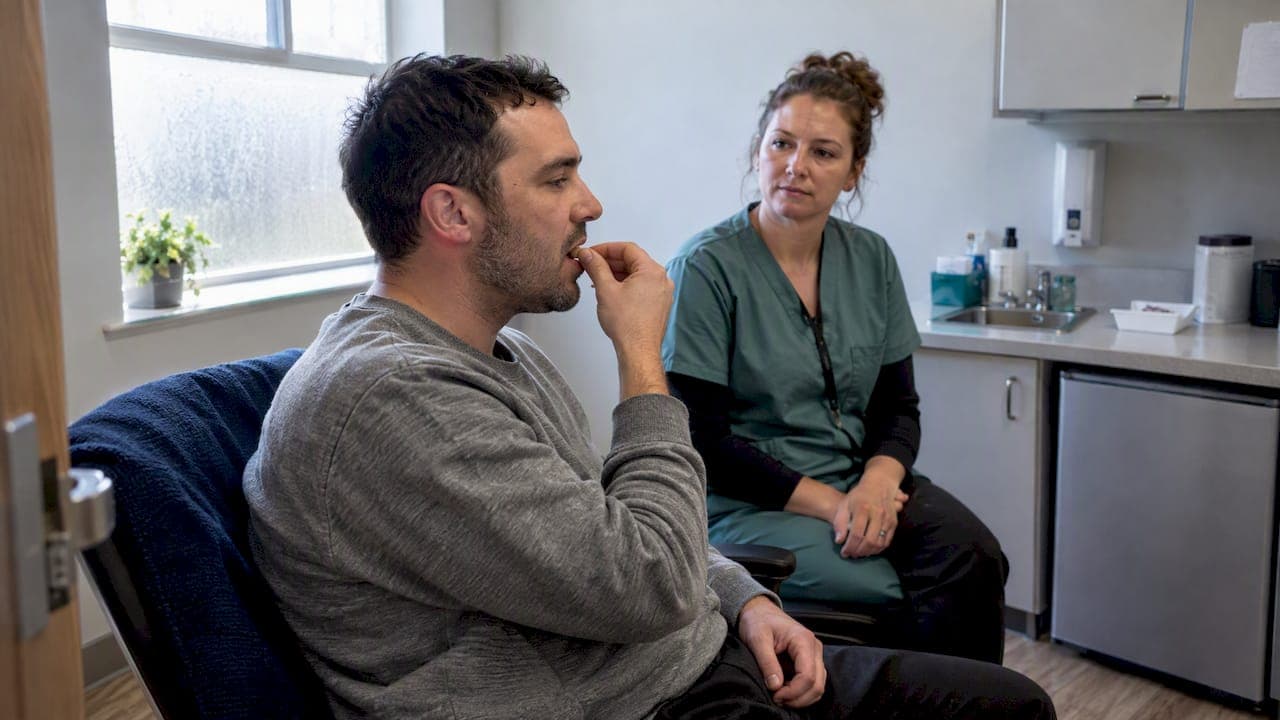
Suboxone induction is the first 1 to 3 days of buprenorphine-based medication-assisted treatment, and the single most important rule is timing: you begin only once you are in moderate opioid withdrawal, confirmed by symptoms or a clinical scale, because dosing too soon causes precipitated withdrawal. Plan for sublingual dosing, naloxone on hand, and a clinician you can reach by phone.
TL;DR:
- The key to successful induction is starting only after confirming moderate withdrawal symptoms, especially in cases involving fentanyl or long-acting opioids.
- Outpatient induction typically lasts 1 to 3 days, with doses gradually increasing under strict guidance to avoid precipitated withdrawal.
- Microdosing protocols develop as safer alternatives for fentanyl users, allowing continuation of opioids while gradually introducing buprenorphine over several days.
- Recognizing sudden, severe withdrawal symptoms within 15 to 45 minutes indicates precipitated withdrawal, which requires immediate medical attention or stopping further doses.
- Supervised, clinical-based induction is recommended for complex cases or unsuccessful outpatient attempts, providing immediate response to emergencies and better safety outcomes.
Table of Contents
- What induction is and the three phases of MAT
- Preparing for induction: medical review, what to stop, and a safety checklist
- Assessing withdrawal readiness (COWS/SOWS and common symptoms)
- Step-by-step traditional induction: Day 1 to 3 dosing and technique
- Low-dose and cross-taper options for fentanyl exposure
- How to recognize and respond to precipitated withdrawal
- Choosing home induction vs observed in-clinic induction
- What happens after induction: follow-up and stabilization
- Clinical perspective: teach-back priorities and when residential induction matters
- What the research actually supports
- Medically supervised induction and MAT support when you need it
- FAQ
- Sources
What induction is and the three phases of MAT
Medication-assisted treatment for opioid use disorder moves through three phases, and understanding where induction fits helps explain why the first few days feel different from everything that follows. Induction is the short window, typically 1 to 3 days, where you and your prescriber find a buprenorphine dose that controls withdrawal and cravings without causing oversedation. Stabilization follows over the next several days to weeks as the dose is fine-tuned. Maintenance is the longer-term phase, often lasting months or years, where a stable dose supports day-to-day functioning.

Induction matters because getting the dose right early reduces the chance of early dropout, something ASAM and SAMHSA guidance treats as a core goal of the process, since moderate withdrawal before the first dose lowers the risk of a bad first experience that drives people away from treatment entirely. A rushed or poorly managed induction can color how someone feels about the medication for months.
MAT is never just the medication. Counseling and psychosocial support, delivered alongside buprenorphine, are part of what makes the treatment work over time.
- Induction (days 1 to 3): finding a dose that controls withdrawal without oversedation
- Stabilization (days to weeks): adjusting the dose as cravings and side effects settle
- Maintenance (months to years): holding a steady dose while building recovery skills and support
Preparing for induction: medical review, what to stop, and a safety checklist
Most successful inductions start well before the first dose, during what many clinics call an MAT Procedure Review Appointment. This visit covers your opioid use history, other medications, allergies, co-occurring mental health conditions, and who to call if something goes wrong. It is also when you get a written plan instead of a vague verbal one.
Stopping the right opioids at the right time matters more than almost anything else. Short-acting opioids like heroin or oxycodone generally need 12 to 24 hours of abstinence before the first buprenorphine dose, while long-acting opioids, methadone, and fentanyl require longer waits, sometimes 24 hours or more, to reduce the risk of precipitated withdrawal. Document the time of your last dose so you and your clinician can calculate the safe window together.
- Schedule a medical review appointment to cover history, allergies, and co-occurring conditions before picking an induction date.
- Confirm your last opioid use time and type, then calculate the required waiting period with your clinician.
- Fill a naloxone prescription and keep it accessible at home before induction day.
- Arrange a support person, transportation, and a quiet space for the first 24 to 48 hours.
- Review your current medications with your prescriber to flag any interactions, especially sedatives or other central nervous system depressants.
Pro Tip: Write down the exact time of your last opioid dose on your phone or a notecard the moment you take it. You will need that number later, and withdrawal makes it hard to recall details accurately.
Fentanyl and other long-acting opioids complicate this timeline considerably, a point covered in more detail later in this guide. If your use history includes fentanyl, tell your clinician explicitly, since the standard waiting window may not be enough.
Assessing withdrawal readiness (COWS/SOWS and common symptoms)
Clinicians rarely rely on the clock alone to decide when induction can start safely. Most use the Clinical Opiate Withdrawal Scale (COWS), a clinician-administered tool, or the Subjective Opiate Withdrawal Scale (SOWS), which you can complete yourself, to confirm you have reached moderate withdrawal before the first dose.
Moderate withdrawal typically includes a cluster of symptoms rather than one isolated complaint. Watch for these signs as you approach your induction window.
- Restlessness, anxiety, and difficulty sitting still
- Muscle aches, especially in the back and legs
- Yawning, runny nose, and watery eyes
- Goosebumps, chills, or sweating
- Nausea, stomach cramping, or diarrhea
- Dilated pupils and a faster heart rate
A detailed withdrawal timeline can help you recognize where you are in the process and what to expect hour by hour. If you are unsure whether your symptoms count as mild or moderate, call your clinician rather than guessing, and never take the first dose based on anxiety alone without physical symptoms present.
Step-by-step traditional induction: Day 1 to 3 dosing and technique
Standard induction follows a structured dosing pattern that most prescribers adapt only slightly from one patient to the next. The goal on Day 1 is to find a dose that controls withdrawal without overshooting into sedation.
- Once moderate withdrawal is confirmed, take an initial dose, often 2 mg/0.5 mg or 4 mg/1 mg, placed sublingually.
- Wait and reassess. If withdrawal symptoms persist after roughly two hours, your clinician may have you take an additional dose.
- Continue titrating through Day 1 as needed, staying within the day's maximum.
- On Day 2, take a single consolidated dose rather than divided doses, adjusted based on how Day 1 went.
- Continue adjusting over Day 3 and beyond, moving toward a stable maintenance dose.
The FDA prescribing information for Suboxone sets Day 1 dosing at up to 8 mg/2 mg in divided doses and Day 2 dosing at up to 16 mg/4 mg as a single dose, figures that function as safety ceilings rather than targets everyone needs to reach.
Day 1 ceiling: up to 8 mg/2 mg (divided doses). This limit exists because higher Day 1 doses increase sedation risk before your clinician has confirmed how your body responds to buprenorphine.
Administration technique affects how well the medication works. Place the film or tablet under your tongue and let it dissolve completely, which typically takes 20 to 45 minutes; swallowing it or moving it to your cheek reduces absorption and effectiveness. The AHRQ patient guide to starting buprenorphine recommends watching for symptom improvement within that same 20 to 45 minute window before deciding whether another dose is needed.
Across Days 1 through 3, dose increases are generally capped at no more than 4 mg per day without direct clinician guidance, and the overall daily maximum for buprenorphine/naloxone combination products is 32 mg. Going beyond either limit on your own, even if withdrawal feels unresolved, is a conversation to have with your prescriber rather than a decision to make alone.

Low-dose and cross-taper options for fentanyl exposure
Fentanyl has changed how clinicians approach induction. Because fentanyl is a potent synthetic opioid that accumulates in fat tissue, standard waiting windows sometimes are not enough to avoid precipitated withdrawal, even after 24 or more hours of abstinence.
Clinical reviews on buprenorphine induction in the fentanyl era describe microdosing, also called low-dose induction, as an approach developed partly in response to this problem. Instead of stopping the opioid and waiting, microdosing introduces small amounts of buprenorphine gradually, often over 3 to 7 days, while a person continues their current opioid at a low dose or tapers it slowly in parallel.
- Microdosing avoids the abrupt stop-and-wait pattern that can trigger precipitated withdrawal in fentanyl-exposed patients.
- Protocols vary by clinic and are not yet standardized, so the evidence base, while growing, is still limited.
- Candidates are usually people with confirmed or suspected fentanyl use, or those transitioning from long-acting opioids like methadone.
- This approach requires direct clinician supervision rather than self-directed attempts at home.
For patients with complex opioid use histories, fentanyl-specific withdrawal patterns often justify inpatient or residential induction, where staff can monitor symptoms and adjust the plan in real time rather than relying on scheduled check-ins alone.
How to recognize and respond to precipitated withdrawal
Precipitated withdrawal is different from the expected discomfort of opioid withdrawal itself. It happens when buprenorphine, which binds tightly to opioid receptors, displaces a full opioid agonist still in your system, triggering a sudden and often severe withdrawal reaction within minutes of dosing rather than the gradual course you would otherwise expect.
- Expected withdrawal builds gradually and was likely already present before your first dose.
- Precipitated withdrawal appears suddenly and intensely, often within 15 to 45 minutes of taking buprenorphine.
- Symptoms can include severe nausea, vomiting, diarrhea, agitation, and a racing heart rate well beyond your baseline withdrawal.
- If this happens, stop further dosing immediately and call your clinician or treatment team.
Most precipitated withdrawal resolves with supportive care and time, though it is miserable while it lasts. Clinical management options include adjusted buprenorphine dosing once the reaction has calmed, symptomatic medications for nausea or diarrhea, or moving to a supervised inpatient setting for a restart. Severe or prolonged symptoms, especially with vomiting that prevents fluid intake, warrant an emergency department visit.
Pro Tip: Keep your clinician's after-hours number saved in your phone under a name you will recognize even if you are distressed, something like "Addiction Doc: Call First."
Naloxone belongs in every induction plan regardless of how the process goes, since opioid use disorder itself carries overdose risk independent of the induction attempt.
Choosing home induction vs observed in-clinic induction
Home, or unobserved, induction and in-clinic, or observed, induction both work, but they fit different circumstances. Observed induction gives you direct clinical supervision and immediate response if something goes wrong, which matters most for people with limited support at home or complex medical histories. Home induction offers more comfort and flexibility, and research on home versus observed induction outcomes has found it feasible and safe in many outpatient settings when paired with solid pre-induction education and a scheduled follow-up visit.
- Observed induction suits pregnancy, unstable housing, transfers from methadone, or significant co-occurring medical or psychiatric conditions.
- Home induction works best for people with a clear understanding of the dosing plan, a support person present, and reliable phone access to their clinician.
- Either setting requires the same core safety elements: naloxone, a written titration plan, and a known emergency contact.
- A failed or frightening home induction attempt is a reasonable trigger to move to a supervised setting for a restart.
If your clinician approves home induction, confirm you have the written dosing schedule, naloxone, a support person physically present for at least the first several hours, and a same-week follow-up appointment already on the calendar before you take your first dose.
What happens after induction: follow-up and stabilization
Follow-up should happen within about a week of starting induction, sooner if anything felt off. This visit checks whether your current dose controls cravings and withdrawal symptoms without causing oversedation, and it is the point where many people need a modest dose adjustment.
- Expect dose changes in small increments during the first few weeks as your clinician fine-tunes your maintenance level.
- Report any lingering withdrawal symptoms, sedation, or cravings honestly, since these guide dose adjustments more than anything else.
- Counseling and psychosocial support, started during or shortly after induction, meaningfully improve long-term outcomes alongside the medication.
- Overdose prevention planning, including naloxone renewal, should continue well past the induction window.
- Repeated failed outpatient attempts, unstable living situations, or serious co-occurring conditions are reasons to consider residential or medically supervised programs instead of continuing to try outpatient induction alone.
The first 90 days of recovery tend to set the tone for everything after, so treat early follow-up visits as something to protect, not skip.
Clinical perspective: teach-back priorities and when residential induction matters
We operate a facility with medical supervision, suited for patients whose induction carries higher risk: fentanyl exposure, methadone transfers, or significant co-occurring mental health conditions. In a residential setting, staff can respond to precipitated withdrawal or dosing complications within minutes rather than over a phone call.
Teach-back is a core part of how we confirm a patient actually understands their plan, not just that they heard it. Before any first dose, we check that a patient can state, in their own words, when to take the next dose, how to administer it, and who to call if something feels wrong. That three-part check catches gaps that a quick "any questions?" misses.
When outpatient induction has failed once already, or when a patient's situation involves significant withdrawal and anxiety that outpatient support cannot adequately address, moving to a supervised setting is often the safer next attempt rather than a third try at home.
What the research actually supports
The most overrated part of induction advice is the exact starting dose. Whether someone begins at 2 mg or 4 mg matters far less than whether they waited long enough since their last opioid use and whether someone is reachable if things go sideways. Most of the guidance circulating online fixates on dosing charts while glossing over the waiting period, which is the actual point of failure in most precipitated withdrawal cases.
The underrated piece is teach-back. A patient who can repeat back their own plan, in their own words, before the first dose is dramatically less likely to panic or improvise if symptoms spike. Fentanyl has made this more urgent, not less, because the old 24-hour rule of thumb no longer guarantees safety the way it once did.
If you take one thing from this guide, let it be this: treat the waiting period and the readiness check as the real decision points, and treat the dosing chart as a safety ceiling, not a target to chase.
— Jim
Medically supervised induction and MAT support when you need it
Standard outpatient induction works for many people, but it is not the right fit for everyone, particularly those with fentanyl exposure, a methadone transfer, or a co-occurring mental health condition that makes unsupervised dosing riskier. For those situations, a medically supervised setting removes the guesswork around precipitated withdrawal because staff are present to respond immediately rather than over the phone.

Our residential facility offers Medical Detox, Medication Assisted Treatment, and Residential Treatment, built around close, round-the-clock supervision that outpatient induction cannot provide. An assessment covers your opioid use history, co-occurring conditions, and prior induction attempts, then the clinical team builds a dosing plan suited to your specific exposure history, including microdosing protocols when fentanyl is involved.
- Medical Detox provides supervision through the highest-risk early days of induction.
- Medication Assisted Treatment integrates buprenorphine dosing with counseling.
- Residential Treatment extends support past induction into stabilization and longer-term recovery planning.
If outpatient induction has already failed once, or your situation feels too complex to manage at home, reach out through our Medication Assisted Treatment program to talk through whether a supervised setting fits your next step.
This article is general information, not a substitute for advice from a qualified doctor. Consult a qualified healthcare professional about your own circumstances before acting on anything here.
FAQ
How long does Suboxone induction take?
Induction typically lasts 1 to 3 days as you and your clinician find a dose that controls withdrawal without causing oversedation. Stabilization follows over the next days to weeks before settling into a steady maintenance dose.
What happens when a baby is born on Suboxone?
Babies exposed to buprenorphine in the womb can experience neonatal withdrawal symptoms after birth, which medical staff monitor closely and treat as needed. Pregnant patients on MAT are generally managed through observed induction and close obstetric and addiction medicine coordination rather than home induction.
What is the 3-day rule for Suboxone?
There is no single universal "3-day rule," but induction is commonly described as a 3-day window where dosing moves from an initial Day 1 dose, up to 8 mg/2 mg divided, to a consolidated Day 2 dose of up to 16 mg/4 mg, with further adjustment on Day 3. Exact timing and doses depend on your clinician's plan and how your body responds.
What to expect when starting Suboxone?
Expect to wait until you are in moderate withdrawal before your first dose, since dosing too early risks precipitated withdrawal. After the first sublingual dose, most people notice symptom improvement within 20 to 45 minutes, followed by dose adjustments over the next couple of days as your clinician finds your stable level.
Sources
- A practical guide for buprenorphine initiation in the primary care setting (PMC)
- SUBOXONE (buprenorphine and naloxone) prescribing information (FDA label)
- Patient Guide to Starting Buprenorphine (AHRQ / compendium)
Always talk with your own clinician before starting or adjusting any induction plan.