
Most U.S. health plans cover medically necessary residential treatment for substance use and mental health disorders, largely because of the Affordable Care Act and federal parity law. What you actually pay depends on your plan type, whether the facility is in-network, and whether the insurer's prior authorization team agrees the level of care is necessary. The real first move isn't researching benefits online. It's calling your insurer and the treatment facility together and getting the answer in writing.
TL;DR:
- Most plans cover residential treatment for substance use and mental health disorders, but costs depend heavily on network status, plan type, and prior authorization outcomes.
- Federal laws ensure coverage without caps and require parity in treatment limits and authorization procedures, with recent enforcement tightening in 2024 and 2025.
- Out-of-pocket costs vary from a few hundred dollars to tens of thousands, depending on network, deductible status, and out-of-network care, with accreditation affecting expenses.
- Success largely hinges on thorough documentation, written authorization, and timely appeals, rather than just initial benefits checks or diagnosis confirmation.
- Verifying coverage should involve direct calls to insurers with detailed questions and written records, especially when seeking out-of-state or exceptions, to prevent unexpected expenses.
Table of Contents
- Federal Rules Behind Residential Rehab Insurance Coverage
- How Coverage Differs by Plan Type
- What Residential Rehab Actually Costs With Insurance
- Prior Authorization, Medical Necessity, and the Appeals Process
- The Exact Script to Verify Your Benefits Before Admission
- Out-of-State Care and Network Exceptions
- What Insurance Typically Won't Cover
- How Connected Recovery Handles Insurance and Privacy
- Why the Real Barrier Isn't Coverage, It's Navigation
- Start an Insurance-Verified Admission at Connected Recovery
- Where to Verify Coverage and Find Treatment
- Sources
Federal Rules Behind Residential Rehab Insurance Coverage
Two federal laws do the heavy lifting here, and knowing both changes how you talk to your insurer.
The Affordable Care Act classifies mental health and substance use disorder treatment as an essential health benefit on every Marketplace plan. That includes inpatient and residential levels of care, and it means pre-existing addiction or psychiatric diagnoses can't get you excluded or capped.
The Mental Health Parity and Addiction Equity Act forces insurers to treat behavioral health limits the same way they treat medical and surgical limits, covering copays, visit caps, and the sneakier "nonquantitative" limits like prior authorization rules.
- No annual or lifetime dollar caps on essential health benefits
- Financial requirements (deductibles, copays) must match those for medical/surgical coverage
- Prior authorization and utilization review standards can't be stricter for behavioral health than for comparable physical health care
CMS tightened parity enforcement in 2024 and 2025, requiring insurers to document and correct unequal authorization practices. Early results show fewer mid-stay denials and faster turnaround on urgent reviews.
How Coverage Differs by Plan Type
Your plan type dictates almost everything about access, network flexibility, and what you'll owe.
- Private/employer plans: PPOs generally allow out-of-network care at a higher cost; HMOs usually require in-network providers and a referral, with narrower exceptions.
- Marketplace plans: Bronze through Platinum tiers all cover residential SUD and mental health treatment as an essential health benefit, though higher-tier plans carry lower out-of-pocket costs.
- Medicare: Part A covers inpatient hospital-based treatment, Part B covers outpatient and some intensive outpatient services, and Part D covers medications used in medication-assisted treatment. Medicare Advantage plans add their own network rules on top.
- TRICARE: Covers residential treatment through its own network of approved facilities, with referral requirements similar to an HMO.
In-network care almost always means a lower deductible and coinsurance rate than the same treatment out-of-network.
What Residential Rehab Actually Costs With Insurance
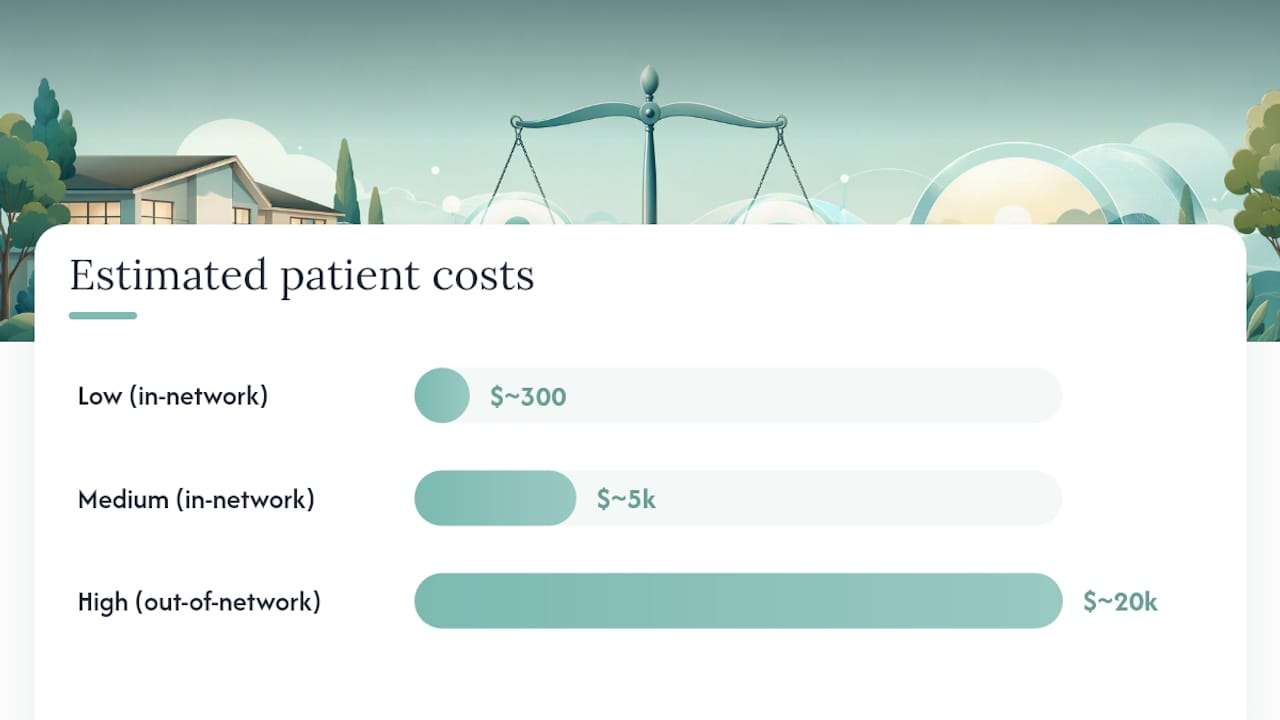
Insurance doesn't eliminate cost, it restructures it. Four terms determine your bill: the deductible (what you pay before insurance starts contributing), the copay (a flat fee per service), coinsurance (your percentage share after the deductible), and the out-of-pocket maximum (the ceiling on what you'll pay in a plan year).
Industry-reported ranges put a 30-day residential program's sticker price well into the thousands per week before insurance, with medical detox billed separately on a per-day basis. What you actually owe looks more like this:
- Low out-of-pocket scenario: In-network facility, deductible already met, 10% coinsurance. You might owe a few hundred dollars total.
- Medium scenario: In-network but deductible unmet. You could pay several thousand dollars before coinsurance kicks in.
- High scenario: Out-of-network care with no single-case agreement. You could owe thousands, sometimes tens of thousands.
Choosing a facility accredited by The Joint Commission or CARF, and confirming in-network status before admission, are the two biggest levers you have on that final number.
Prior Authorization, Medical Necessity, and the Appeals Process
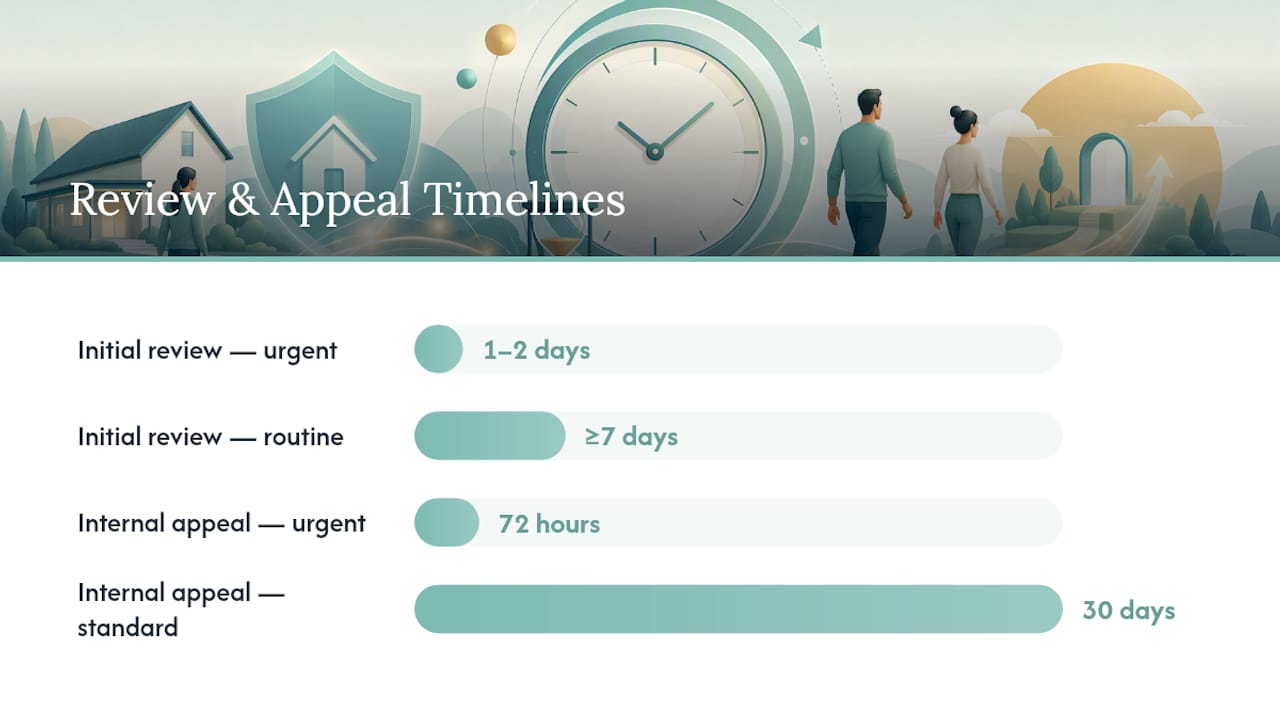
Almost every denial traces back to one of two things: missing documentation of medical necessity, or an out-of-network facility. Insurers use utilization review, often measured against ASAM criteria, to decide whether residential care is justified versus a lower level of care. Urgent requests are typically reviewed within a day or two; routine requests can take a week or more.
If you're denied, here's the path:
- Internal appeal — the insurer reviews its own decision, usually within 30 days for standard cases or 72 hours for urgent ones.
- External independent review — a third party outside the insurance company makes a binding decision if the internal appeal fails.
- Federal complaint — if you suspect a parity violation, you can escalate through CMS oversight channels.
Pro Tip: Ask the facility's clinical team to submit continuous progress notes during your stay, not just at admission. Insurers reviewing extensions respond better to ongoing evidence than a single intake assessment.
The Exact Script to Verify Your Benefits Before Admission
Call your insurer before you call anywhere else, and ask these questions in this order:
- "Is [facility name] in-network for residential substance use or mental health treatment?"
- "What's my remaining deductible and out-of-pocket maximum this year?"
- "Does this admission require prior authorization, and what's the typical turnaround?"
- "Is there a day limit on residential coverage, and how are extensions requested?"
- "Is medication-assisted treatment covered under my formulary?"
Write down the representative's name, the call date, and a reference number for every call. Request written pre-authorization once approved, not just a verbal confirmation. Coordinating with the facility's admissions team on submitting the same documentation avoids contradictory paperwork that slows down approval.
Pro Tip: Ask the insurer to email a summary of the call. A written record settles disputes faster than a phone log ever will.
Out-of-State Care and Network Exceptions
PPOs generally allow you to travel for treatment at a higher cost; HMOs and EPOs restrict you to their contracted network almost entirely, with narrow exceptions.
- Request a single-case agreement when no in-network facility can meet your clinical needs, especially for dual-diagnosis or specialized care.
- Document network adequacy failures (no available bed, no qualified in-network provider within a reasonable distance) to strengthen that request.
- If you paid out-of-pocket or received partial approval, submit a retroactive reimbursement claim with an itemized bill and proof of medical necessity.
What Insurance Typically Won't Cover
Sober living homes are usually classified as room and board, not treatment, so most plans exclude them entirely. That distinction catches a lot of families off guard mid-stay.
Other common exclusions:
- Private-room upgrades beyond semi-private accommodations
- Certain alternative or holistic therapies without documented clinical evidence
- Non-FDA-approved treatment protocols
Sliding-scale programs, state-funded treatment grants, and Medicaid where eligible can offset these gaps for readers without room in their budget.
How Connected Recovery Handles Insurance and Privacy
A 12-bed facility can move faster on benefits verification than a 200-bed hospital system, mostly because fewer patients means more hands-on attention to each case. Connected Recovery's admissions team verifies benefits directly with insurers, prepares ASAM-based documentation for prior authorization, and follows through on appeals when a claim is denied or underpaid.
Services include:
- Medically supervised detox
- Residential treatment
- Dual diagnosis care for co-occurring conditions
- Aftercare planning
Pro Tip: Ask any facility, including Connected Recovery, for an on-site benefits verification before you commit. A same-day answer beats days of insurer phone tag.
Why the Real Barrier Isn't Coverage, It's Navigation
Federal law already answers the big question: medically necessary residential treatment is a covered benefit almost everywhere. The gap isn't legal, it's procedural. Most denials trace back to a documentation error or a network mismatch, not an actual exclusion in the policy.
Where conventional advice falls short is treating "check your benefits" as a single phone call. It's not. It's a paper trail: names, reference numbers, written pre-authorization, and continuous clinical notes if the stay runs long. The 2024 to 2025 parity enforcement changes make insurers more accountable, but that accountability only helps you if you can point to a specific violation, not a vague complaint.
If you take one thing from this, prioritize the documentation over the diagnosis. Plenty of people qualify for coverage and still get denied because nobody wrote anything down. A boutique provider that treats benefits verification as part of clinical care, not an afterthought handled by a separate billing office, tends to catch these gaps before they become bills.
— Jim
Start an Insurance-Verified Admission at Connected Recovery
Connected Recovery runs a 12-bed residential program in Van Nuys built around the idea that fewer patients means faster, more personal attention, including on the insurance side. The clinical team handles benefits verification, prior authorization paperwork, and appeals in-house rather than routing you through a separate billing department.

Call admissions, use the verification script above when you check your own benefits, and ask for on-site confirmation of your coverage before you commit to anything. If detox is your first step, start with medical detox admissions; if you're ready for the full residential program, review residential treatment options and request a same-day benefits check.
Where to Verify Coverage and Find Treatment
Confirm Marketplace rules and enrollment options at HealthCare.gov. Check Medicare Part A, B, and D rules at Medicare. Contact your state program through Medicaid for expansion-specific rules. Locate in-network or state-funded providers through Findtreatment, and review parity enforcement actions on CMS's oversight page.
This article is general information, not a substitute for advice from a qualified doctor. Consult a qualified healthcare professional about your own circumstances before acting on anything here.