
Rehab accreditation is an independent review of a treatment program against published quality standards. In the United States, two organizations do most of it for addiction treatment: CARF and The Joint Commission. A third credential, ASAM level of care certification, tells you which level of care a program is set up to deliver. None of these replaces a valid state license, and the most useful question is not "is it accredited?" but "what exactly was reviewed, and does it match the care my family member needs?" At Connected Recovery, a boutique 12-bed accredited detox and residential facility in Van Nuys, Los Angeles, those are the questions we want families to ask of any program they consider.
TL;DR
- Accreditation is a voluntary, independent review of quality. A state license is the legal minimum every program must hold, and the two are not the same thing.
- The two most common accreditors for addiction treatment are The Joint Commission and CARF.
- ASAM level of care certification is separate again: it shows a program can deliver a specific level of care, not that its overall practices are sound.
- Always confirm which services and which location the accreditation covers, and check the license alongside it.
Table of Contents
- What accreditation actually means
- The main rehab accreditation types
- CARF vs. Joint Commission: how to think about the difference
- What is new in accreditation
- Which level of care does your situation call for?
- How to confirm an accreditation applies
- Accreditation is one signal, not the whole decision
- Why a small, accredited program can serve you better
- What we offer in Van Nuys
- FAQ
- Sources
What accreditation actually means
Three words get mixed up in rehab marketing: license, accreditation and certification. They answer different questions.
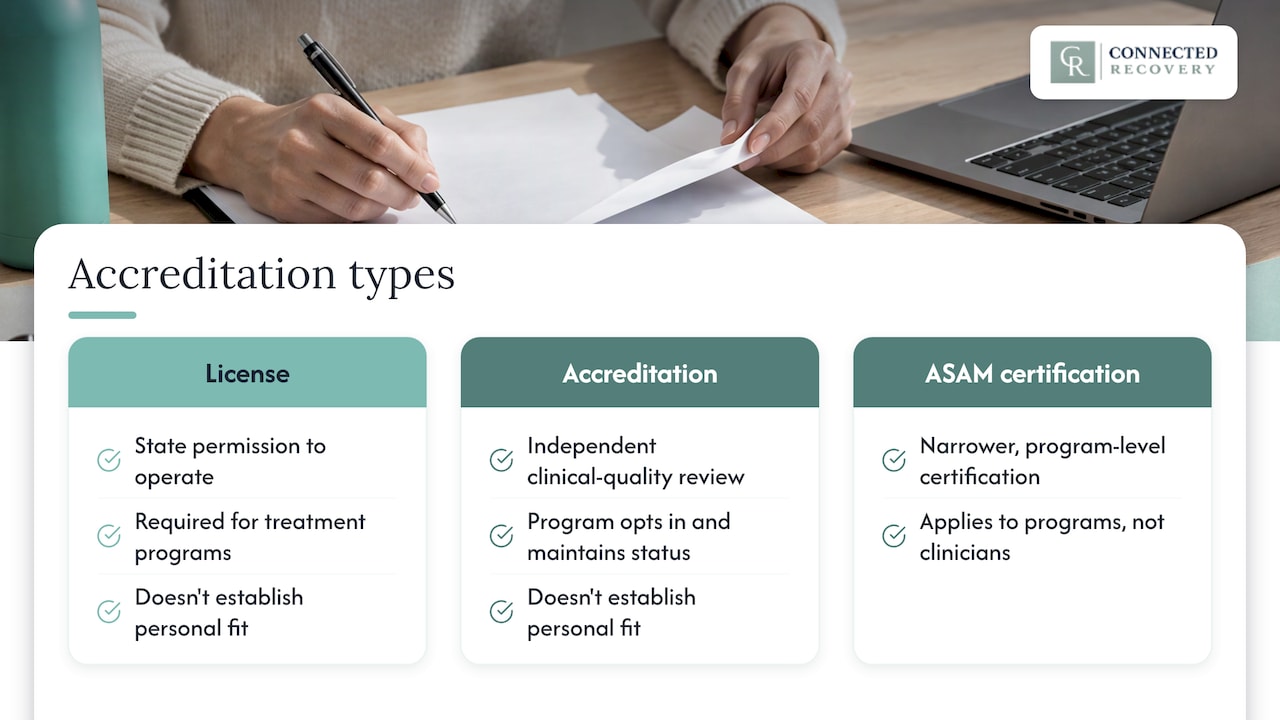
A license is permission from the state to operate. The National Institute on Alcohol Abuse and Alcoholism (NIAAA), part of the National Institutes of Health, says all treatment programs are required to have a state license, and that this is distinct from accreditation. A license is the floor. It is not a mark of distinction.
Accreditation is a review by an outside body. NIAAA describes it as a rigorous review by an independent review board against widely accepted clinical-quality standards. The Joint Commission puts it similarly: an independent evaluation meant to help organizations assess and improve performance so care is safe and high quality. The program chooses to go through it, pays for it and has to keep meeting the standards to keep the status.
Certification, in this field, usually refers to something narrower. ASAM level of care certification, for example, applies to programs rather than individual clinicians. It is covered below.
The practical meaning for you: a license tells you the program is legally allowed to treat patients. Accreditation tells you someone independent has examined how it runs. Neither tells you whether the program will fit the person you are worried about. That takes a conversation, and we come back to it at the end.
The main rehab accreditation types
CARF
CARF is an international accreditor of health and human services. Its Behavioral Health program lists a wide range of services it accredits: outpatient, intensive outpatient, partial hospitalization, residential, inpatient, withdrawal management, crisis, office-based opioid treatment and other behavioral health services.
Its standards are a person-centered framework. They cover substance use treatment, mental health, integrated behavioral health, psychosocial rehabilitation and family services. "Person-centered" means the standards look at whether care is organized around the individual's own needs and goals, not just whether paperwork exists.
For families, the integrated behavioral health piece matters most. If someone is dealing with both addiction and depression, anxiety, trauma or another mental health condition, you want a framework that expects both to be treated together.
The Joint Commission
The Joint Commission is best known for hospitals, but it also runs a Behavioral Health Care and Human Services accreditation. Per its own description, that program accredits addiction, mental health, eating disorder, developmental disability and human service organizations across community settings and levels of care.
The scope includes residential treatment, outpatient care, intensive outpatient, partial hospitalization, opioid treatment programs, office-based opioid treatment, medication-assisted therapy, crisis stabilization and tele-behavioral health, among other services.
How it works: accreditation is awarded after an onsite survey, in which surveyors assess the organization's compliance with the standards in the applicable manual. To be eligible, an organization must hold a license or registration where the law requires one, and offer services that can be evaluated under the standards and are consistent with state and federal requirements. In other words, you cannot use accreditation to skip licensing. It sits on top of it.
ASAM level of care certification
The American Society of Addiction Medicine (ASAM) publishes the criteria most programs and insurers use to describe levels of care, such as residential treatment or withdrawal management in a residential setting. ASAM explains that its level of care certification applies to programs, not individual clinicians, and that it demonstrates capacity to deliver a specified level of care rather than overall service quality or organizational practices.
ASAM also states that CARF assesses and certifies programs against specified residential ASAM Criteria levels, and that this certification is separate from both accreditation and state licensure. So you may see a program with a license, an accreditation and a level of care certification. Each says something different.
A quick side-by-side
| State license | CARF or Joint Commission accreditation | ASAM level of care certification | |
|---|---|---|---|
| What it is | Legal permission to operate | Independent review against quality standards | Confirmation a program can deliver a defined level of care |
| Required? | Yes, for treatment programs | Voluntary | Voluntary |
| What it tells you | The program meets state rules | An outside body surveyed how the program runs | The program is set up for a specific level, such as residential |
| What it does not tell you | How rigorous the state review was | Whether the treatment fits your situation | Overall quality of services |
CARF vs. Joint Commission: how to think about the difference
Both review programs against published standards, both cover addiction and mental health, and both include residential treatment, withdrawal management and medication-assisted care in their scope. For a family choosing a facility, the differences matter less than you might expect from the amount of online debate.
What matters more:
- Does it cover the level of care you need? Detox, residential treatment and outpatient are different services. An accreditation listing for outpatient care does not automatically cover a residential unit.
- Does it cover the address? An organization can run several sites. Accreditation is tied to what was surveyed.
- Does the framework fit the person? If there is a co-occurring mental health condition, look for integrated treatment, not an addiction program that refers the mental health piece elsewhere.
The National Association of Addiction Treatment Providers (NAATP) describes accreditation as independent recognition that a behavioral health provider meets predetermined standards. Its quality assurance guidance recommends that providers be transparent about the services and locations included. That is the right lens. The meaningful question is not merely whether a provider says it is accredited, but which services and locations were reviewed.
What is new in accreditation
Standards are revised over time, so the programs listed on an accreditor's page change. CARF's Behavioral Health page identifies Sobering Center and Integrated Primary Care as new offerings in 2026.
In its January 13, 2026 announcement, CARF said the new sobering center standards address low-barrier access, streamlined intake, multidisciplinary monitoring, referrals, safe facilities, community partnerships, staff competency training and data collection. Its stated rationale is that sobering centers can offer a safer, lower-barrier alternative during acute intoxication and connect people to treatment and community services.
A sobering center is a short-term setting for someone who is acutely intoxicated. It is a front door, not a treatment program. If a person then needs medically supervised withdrawal and residential care, that is a different level of care with its own standards.
Which level of care does your situation call for?
Accreditation only helps once you know what you are shopping for. A simple way to sort it:
- Medically supervised detox (withdrawal management). For people whose withdrawal could be physically risky, such as alcohol, opioids or benzodiazepines, or who have tried and failed to stop alone. Round-the-clock medical supervision is the point.
- Residential treatment. A live-in program for people who need structure, daily therapy and distance from the environment where use happens.
- Intensive outpatient or partial hospitalization. Several hours of treatment a day or week while living at home. Good as a step down.
- Aftercare. Ongoing support, relapse prevention and case management after discharge.
Our article on what continuum of care means in addiction treatment walks through how these stages connect. When you read an accreditation listing, match it to the stage you need. A program accredited for outpatient care is not necessarily reviewed for detox.
How to confirm an accreditation applies
NIAAA advises checking that a program's state license is valid and asking whether it is also accredited. It also points out that state licensing rigor varies, and frames accreditation as one useful independent quality signal alongside valid licensure and staff credentials, not a substitute for judging whether treatment fits an individual's needs.
Here is a routine that takes about fifteen minutes:
- Check the license. In California, the state licenses and certifies residential alcohol and drug treatment facilities, and your first step is to confirm the license is current and covers the type of service offered.
- Identify the accreditor. The program should name it plainly: CARF, The Joint Commission or another recognized body.
- Ask what was reviewed. Which services (detox, residential, outpatient) and which address are covered?
- Ask about level of care. Does the program describe its services in terms of recognized levels, and does that match the medical needs of the person entering?
- Ask about staffing. Who is on site overnight? Is there medical supervision around the clock, and who prescribes medication?
- Ask about mental health. If there is a co-occurring condition, how is it assessed and treated during the stay?
- Ask about the plan after discharge. Accreditation standards focus on care processes, and a strong program should be able to describe aftercare and discharge planning concretely.
When the program is a good fit, these answers come easily and in specifics. Our guide on choosing a rehab goes deeper on the human side of the decision.
Accreditation is one signal, not the whole decision
NIAAA is candid that nonaccredited programs can also be high quality, for instance where state licensing standards are comparable or smaller programs cannot bear the cost of accreditation. That is why accreditation belongs next to other signals: a valid license, credentialed clinicians, a clear clinical approach, and a size and setting that suit the person.
Fit also reaches beyond the clinical. Recovery usually involves the people closest to the person in treatment, and relationships often need attention too. Families sometimes explore evidence-based couples therapy alongside treatment to rebuild communication once the acute crisis has passed.
Two practical points for families acting under pressure:
- Urgency changes the order of questions. If someone is in active withdrawal or in danger, get them to medical care first. Alcohol and benzodiazepine withdrawal in particular can be dangerous without supervision. In an emergency, call 911. For emotional crisis or substance use support, you can call or text 988, the Suicide and Crisis Lifeline.
- Privacy is a legitimate criterion. Many people want an admission that stays discreet. Our article on how addiction treatment stays off your record explains what that looks like.
Why a small, accredited program can serve you better
It is easy to assume that bigger means safer. In residential treatment, scale often works the other way. In a large facility, a person can move through the program as one of dozens of names on a schedule. In a small one, staff know each client's story, medication, triggers and progress every day.
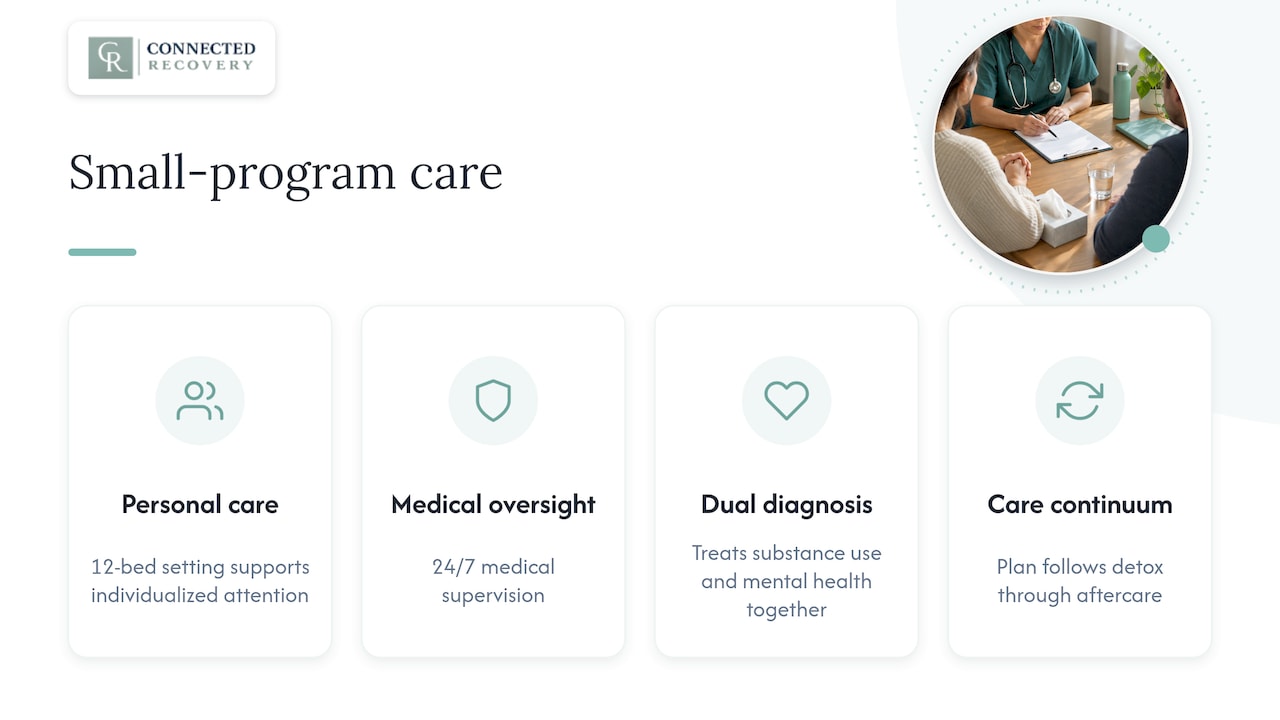
Accreditation standards ask a program to show it plans care around the person. Size determines whether that plan is lived or merely documented. At Connected Recovery we operate a deliberately small 12-bed facility, so each client receives individualized attention, with 24/7 medical supervision and a treatment plan built around them. The setting is designed to feel like a private retreat rather than an institution.
That structure is also well suited to dual diagnosis. We treat substance use and co-occurring mental health disorders through an integrated approach, so the person is not split between an addiction track and a separate mental health referral. If this is your situation, our dual diagnosis rehab guide explains how to choose care that treats both.
What we think about accreditation
When families call us, the first question is rarely about accreditation. It is "can you take him today?" or "will she be safe?" But accreditation is the right thing to learn about, because it makes you look at how a program is run rather than how it is described.
Our view is simple. Look for three things together: a valid license, an independent accreditation that covers the service and the address you are considering, and a setting where the clinical team actually knows each client. We built Connected Recovery around the third one. With 12 beds, medical supervision around the clock and a plan that follows each person from detox through aftercare, the standards on paper are things we can practice every day.
Use accreditation as a filter, then use a conversation as the decision. Ask what the days look like, who is in the building at night and how mental health is treated alongside addiction. Those answers tell you what a certificate cannot.
Jim
What we offer in Van Nuys
Connected Recovery provides care for adults in Van Nuys, Los Angeles, from the first hours of withdrawal through discharge. Our medical detox offers medically supervised withdrawal management. Residential treatment continues with individual and group therapy and a family program. Medication-assisted treatment is available, and aftercare planning and discharge planning are part of the care model, so the plan for life after treatment starts early.
If you are comparing programs and want to talk through level of care, privacy and insurance or private pay options, you can see everything we treat on our programs page or reach us through connectedrecoverycenter.com.
FAQ
What is the difference between CARF and Joint Commission accreditation?
Both are independent accreditors that review behavioral health and addiction programs against published standards, and both cover services such as residential treatment, withdrawal management and medication-assisted care. CARF's behavioral health framework is person-centered and spans substance use, mental health and family services. The Joint Commission awards accreditation after an onsite survey against the standards in its applicable manual. For a family, the key is that the accreditation covers the service and location you need.
Is a rehab without accreditation unsafe?
Not automatically. Every treatment program must hold a state license, and NIAAA notes that nonaccredited programs can be high quality. Accreditation is one additional independent signal. Weigh it with the license, staff credentials and how well the program fits the individual.
Does ASAM level of care certification replace accreditation?
No. ASAM says its level of care certification shows a program can deliver a specified level of care, not overall service quality or organizational practices. It is separate from both accreditation and state licensure, so each credential answers a different question.
How do I check that an accreditation covers a specific facility?
Ask the program which accreditor reviewed it, which services were included and which address was surveyed. NAATP's guidance stresses that the meaningful question is which services and locations were reviewed, not just whether a provider says it is accredited. Also confirm the state license is valid.
Sources
- NIAAA: Ten Questions for Alcohol Treatment Programs
- The Joint Commission: What is Accreditation?
- The Joint Commission: Behavioral Health Care and Human Services Accreditation
- CARF International: Behavioral Health
- CARF: Accreditation standards for sobering centers
- ASAM: The ASAM Criteria and Level-of-Care Assessment
- NAATP: Quality Assurance Guidebook
- Evidence-Based Couples Therapy: What Works and How to Choose