
What are the top alternatives to Rayville Recovery for addiction treatment?
If you're searching for rayvillerecovery.com alternatives, the clearest answer is this: several CARF-accredited facilities across the United States offer residential detox, dual diagnosis care, and personalized aftercare that match or exceed what Rayville Recovery provides. The difference is that most of them accept insurance and serve patients beyond Louisiana's low-income population.
| Facility | Accreditation | Treatment Services | Program Duration | Medical Supervision | Personalized Care | Aftercare Support | Capacity |
|---|---|---|---|---|---|---|---|
| Connected Recovery Inc. | CARF | Detox, residential, dual diagnosis | Individualized | 24/7 | a small boutique-sized program | Yes, comprehensive | a dozen beds |
| Rayville Recovery | CARF | Detox, residential, IOP | residential | Not publicly listed | Moderate | Discharge planning | Not listed |
| Palmetto Addiction Recovery Center | Insurance accepted | Residential | Not listed | Not listed | Adults | Not listed | Not listed |
| General CARF-accredited centers | CARF | Detox, IOP, residential | 14–90 days | Varies | Varies | Varies | Varies |
Connected Recovery Inc. operates out of Van Nuys, California, with a a small residential program that keeps caseloads small enough for real one-on-one attention. That capacity is the single biggest structural difference from most alternatives.

Table of Contents
- How does Rayville Recovery compare to its key alternatives?
- How do you choose the right addiction recovery center?
- What makes Rayville Recovery different from other centers?
- Connected Recovery is a boutique alternative worth knowing about
- Key Takeaways
How does Rayville Recovery compare to its key alternatives?
The most useful way to compare recovery centers is not by geography but by what they actually deliver on the criteria that predict outcomes: accreditation, medical oversight, program breadth, and aftercare.
Key differentiators to evaluate:
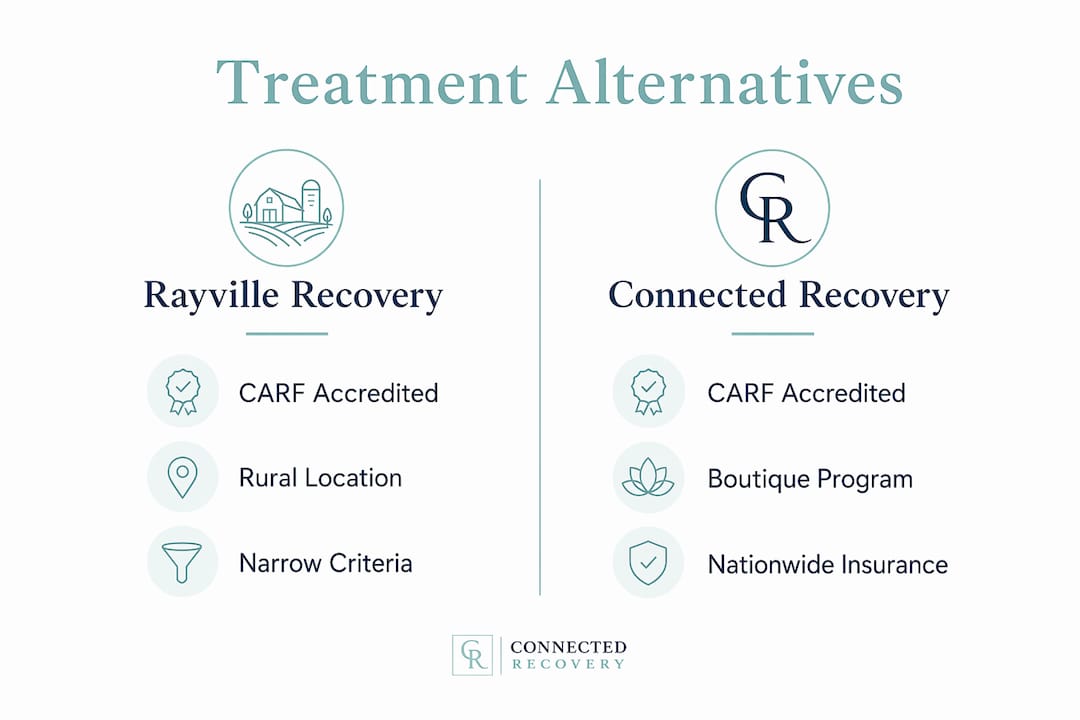
- CARF accreditation: Both Rayville Recovery and Connected Recovery Inc. carry CARF accreditation, the primary quality benchmark for U.S. addiction treatment facilities. Not every center on a directory listing holds it.
- 24/7 medical supervision: Connected Recovery provides around-the-clock medical oversight during detox and residential treatment. This matters most during withdrawal, when complications can escalate quickly.
- Dual diagnosis integration: Treating addiction alongside co-occurring mental health conditions within the same care plan improves long-term outcomes. Connected Recovery's integrated dual diagnosis model addresses both simultaneously rather than sequentially.
- Program length: Residential programs typically run 14–90 days, with a common duration baseline. Rayville Recovery's residential track runs a typical program duration; Connected Recovery tailors duration to the individual.
- Cost and insurance: Rayville Recovery is a no-cost facility for low-income Louisiana residents, which is a rare and vital access point. Most alternatives, including Connected Recovery, work with insurance providers and private payment.
- Aftercare planning: Discharge planning is where many facilities fall short. Connected Recovery builds aftercare into the treatment plan from day one, not as an add-on at the end.
| Criteria | Rayville Recovery | Connected Recovery Inc. |
|---|---|---|
| CARF accredited | Yes | Yes |
| 24/7 medical supervision | Not publicly listed | Yes |
| Dual diagnosis care | Yes | Yes |
| Inpatient / residential | Yes | Yes |
| IOP available | Yes | Contact for details |
| Aftercare planning | Yes | Yes, comprehensive |
| Insurance accepted | No (no-cost model) | Yes |
| Facility size | Not listed | a dozen beds |
Cognitive behavioral therapy, often called CBT, is one of the evidence-based modalities that quality residential programs incorporate alongside medical detox. Facilities that combine CBT with medication-assisted treatment tend to produce stronger outcomes for patients with co-occurring anxiety or depression.
How do you choose the right addiction recovery center?
The right facility is the one that fits your clinical picture, not just your zip code. Start with accreditation and work outward from there.
What to verify before you commit:
- CARF or Joint Commission accreditation confirms the facility meets independent quality standards.
- Ask directly whether the center offers individualized treatment or runs everyone through the same protocol.
- Confirm 24/7 medical staffing, especially if detox is part of the plan.
- Check whether the facility treats co-occurring mental health conditions in-house or refers out.
- Review the admission criteria carefully. Some centers, like Rayville Recovery, restrict eligibility by income and state residency.
- Ask about insurance acceptance upfront. A facility that cannot verify your coverage before admission creates financial risk.
Program length is another variable worth scrutinizing. NIDA guidance supports longer residential stays for more complex cases, and a center that pushes everyone toward a 30-day discharge regardless of progress is prioritizing throughput over outcomes.
Pro Tip: Ask every facility you consider: "What does your discharge plan look like, and who creates it?" A vague answer is a red flag. The best centers build tailored recovery plans that include housing, outpatient follow-up, and relapse prevention before you leave residential care.
Location matters more than people admit. A rural setting like Rayville Recovery's can reduce environmental triggers during early recovery. Urban or suburban facilities may offer easier family access and more outpatient resources post-discharge. Neither is universally better; the right call depends on your support network and what you're recovering from.
What makes Rayville Recovery different from other centers?
Rayville Recovery occupies a specific and underserved niche. It is a no-cost residential facility for low-income Louisiana residents, which means it removes the financial barrier that stops many people from seeking treatment at all. That access model is genuinely rare.
Rayville Recovery's defining features:
- No-cost residential treatment for qualifying Louisiana residents
- CARF accreditation confirming adherence to quality and person-centered care standards
- Medically assisted detoxification on-site
- 12-Step meetings integrated into the program
- Family education and support services
- Comprehensive discharge planning
- Intensive outpatient program (IOP) available
- Free meals and laundry provided on-site
- Rural setting in Rayville, Louisiana, conducive to focused recovery
The tradeoff is that Rayville Recovery's eligibility criteria are narrow. If you live outside Louisiana, have insurance, or do not meet the income threshold, you will need to look elsewhere. That is not a criticism; it is just the reality of a model built around a specific population.
For patients who need a broader range of services, insurance-based options, or treatment outside Louisiana, the alternatives covered in this article offer comparable accreditation with more flexible admission criteria.
Connected Recovery is a boutique alternative worth knowing about
Most addiction treatment facilities are built for volume. Connected Recovery is built for the opposite.
The small capacity at Connected Recovery's Van Nuys, California facility means your counselor actually knows your case. You get 24/7 medical supervision during detox, an integrated approach to co-occurring mental health conditions, and an aftercare plan that is written for you specifically, not pulled from a template. The medical detox program is supervised around the clock, which is the standard you want when withdrawal carries real medical risk.
Connected Recovery accepts insurance and serves patients nationwide, so the geographic and financial restrictions that apply to Rayville Recovery do not apply here. If you are weighing recovery websites like Rayville and want a CARF-quality program with more flexibility, Connected Recovery is worth a direct conversation. Contact the admissions team to verify your insurance and get a clear picture of what the program looks like for your situation.
Key Takeaways
Connected Recovery Inc. offers a CARF-quality, a small boutique-sized program alternative to Rayville Recovery, with 24/7 medical supervision, dual diagnosis care, and individualized aftercare planning for patients nationwide.
| Point | Details |
|---|---|
| CARF accreditation matters | Both Rayville Recovery and Connected Recovery hold CARF accreditation, the primary U.S. quality standard for addiction treatment. |
| Program length varies | Residential programs typically vary in length; the right duration depends on clinical complexity, not a standard calendar. |
| Aftercare is non-optional | Comprehensive discharge planning from day one, not a last-minute checklist, is what separates facilities with strong outcomes. |
| Eligibility differs widely | Rayville Recovery serves low-income Louisiana residents at no cost; Connected Recovery accepts insurance and admits patients from across the country. |
| Connected Recovery | A 12-bed Van Nuys facility offering 24/7 medical supervision, dual diagnosis treatment, and personalized aftercare for sustainable recovery. |