
Anesthesia-assisted rapid opioid detox carries a documented risk of death and serious hospitalization, and no major guideline body recommends it as routine care. The CDC and reviews summarized on NCBI Bookshelf advise against it outside controlled research. Safer, evidence-backed paths exist: medication-assisted treatment and medically supervised detox.
TL;DR:
- The procedure causes a sudden surge of stress hormones that can lead to life-threatening heart and lung complications, especially in vulnerable patients.
- There is no evidence that rapid detox improves long-term recovery rates compared to slower, medically supervised detox approaches.
- Safer options like medication-assisted treatment and gradual detox with continuous monitoring significantly reduce risks and improve engagement in recovery.
- Choosing a detox program should focus on verified medical oversight, emergency preparedness, and individualized care, not speed or unverified claims.
Table of Contents
- Is Rapid Detox Safe? What the Evidence Shows
- How Rapid Detox Works: The Procedure Behind the Risk
- Why Rapid Detox Can Trigger Life-Threatening Complications
- Does Rapid Detox Actually Work Long-Term?
- Medical Detox and MAT vs. Rapid Detox
- What to Ask Before Choosing a Detox Program
- What Safer Detox Programs Actually Do Differently
- The Bottom Line on Rapid Detox Risk
- Why We Emphasize Medically Supervised Care Over Speed
- How Connected Recovery Approaches Medically Supervised Detox
- Sources
Is Rapid Detox Safe? What the Evidence Shows
The short answer is no, not in the way most clinics market it. Anesthesia-assisted rapid opioid detoxification (AAROD), sometimes called ultra-rapid detox (UROD), pushes a patient through opioid withdrawal in a matter of hours while they're under sedation or general anesthesia. It sounds efficient. The data on what actually happens to patients tells a much less reassuring story.
The clearest evidence comes from a CDC investigation into a New York City clinic. Out of 75 patients who underwent the procedure, two died and five more suffered serious adverse events that required hospitalization.
A high serious adverse event rate — nearly one in ten patients in the CDC-investigated cohort died or was hospitalized after anesthesia-assisted rapid detox.
That single cluster isn't an isolated anecdote. Other case series and clinic-cluster reports have raised similar red flags about mortality tied to AAROD, prompting the public-health scrutiny that led to the CDC's original inquiry.
Reading these numbers requires some caution, though, and it's worth being honest about the limits of the data:
- The findings come from case series and clinic investigations, not large randomized trials, so they can't establish a precise population-wide death rate.
- Underreporting is a real possibility. Complications that occur after discharge, or at facilities never flagged for review, may not make it into any dataset.
- Clinics vary enormously in staffing, monitoring, and protocol, so outcomes at one facility don't necessarily predict outcomes at another.
Even with those caveats, the direction of the evidence is consistent. Whenever researchers have looked closely at AAROD outcomes, they've found a pattern of severe, sometimes fatal, complications that standard detox methods rarely produce.
How Rapid Detox Works: The Procedure Behind the Risk
Rapid detox is built on a blunt idea: instead of letting opioids clear the body gradually, clinicians flood the system with an opioid antagonist, usually naloxone or naltrexone, to force withdrawal to happen immediately. Because that withdrawal is brutal when experienced consciously, patients are sedated or placed under general anesthesia so they're unconscious while it unfolds.
The procedure reported in clinical investigations generally follows a sequence like this:
- Sedation or general anesthesia is induced, often with intubation to protect the airway.
- An opioid antagonist is infused intravenously to trigger withdrawal while the patient is unconscious.
- Anesthesia is maintained for several hours while withdrawal symptoms peak internally.
- The patient is extubated once the acute antagonist-induced phase has passed.
- Overnight monitoring follows, sometimes in a step-down unit, sometimes on a general floor.
Dosing ranges and exact sedation protocols differ from clinic to clinic. That's the part that should give any prospective patient pause: there's no standardized AAROD protocol recognized across the field. One facility's version of "rapid detox" can look pharmacologically different from another's, with different antagonist doses, different anesthesia depth, and different monitoring standards. That variability itself becomes a risk factor, since outcomes are harder to predict when the underlying procedure isn't consistent.
Why Rapid Detox Can Trigger Life-Threatening Complications
The physiology here matters, because it explains why this procedure has produced so many serious outcomes. Precipitating withdrawal all at once, under anesthesia, doesn't just accelerate an unpleasant process. It sets off a cascade the cardiovascular system isn't built to absorb quickly.
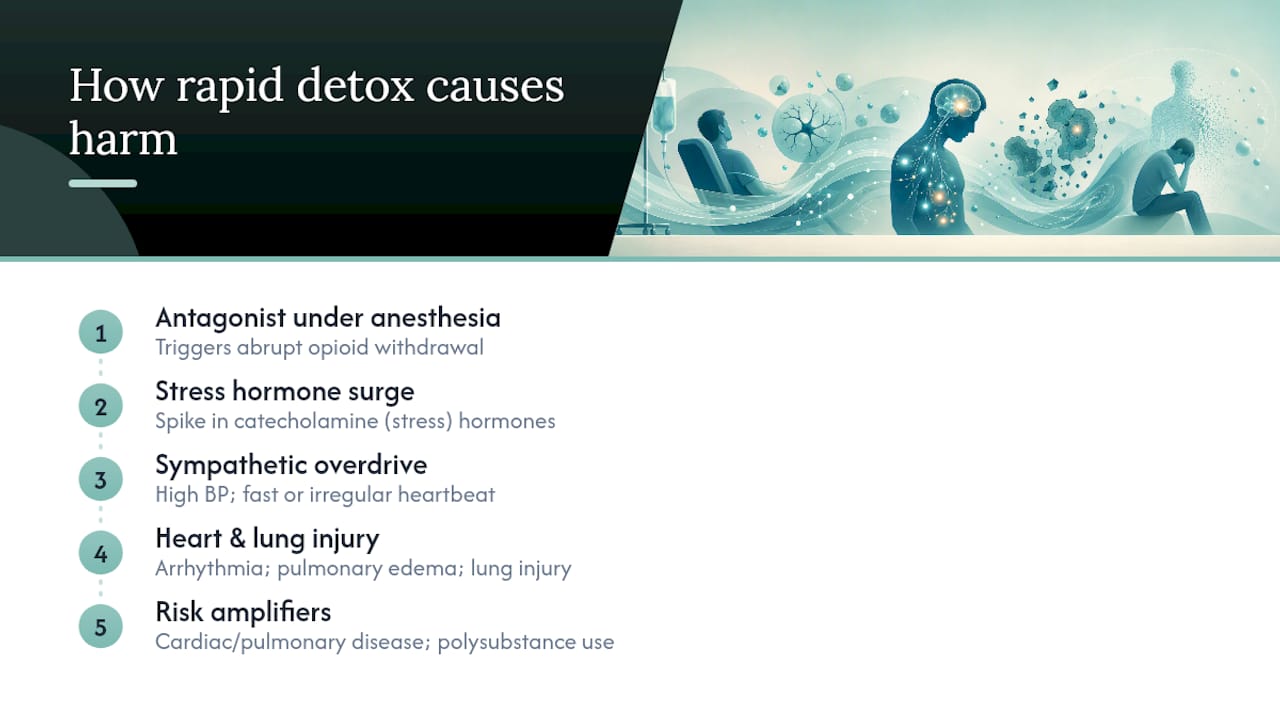
Opioid withdrawal is driven largely by a surge of catecholamines, the stress hormones that flood the body when opioid receptors are suddenly blocked. Under normal, gradual withdrawal, that surge is spread out and the body has time to compensate. Compress the same surge into a few hours, and the result is sympathetic overdrive: spiking blood pressure, racing or irregular heartbeat, and a heart working far harder than it should.
Antagonist-precipitated withdrawal produces an intense sympathetic response with catecholamine release that plausibly explains many of the cardiopulmonary events reported after anesthesia-assisted rapid detox.
That surge is directly implicated in the complications case reports keep flagging: cardiac arrhythmia, pulmonary edema, and acute lung injury among them. Vomiting and diarrhea, both common features of opioid withdrawal, add another layer of danger by driving electrolyte disturbances at the exact moment the heart is already under strain from the catecholamine surge. Sodium, potassium, and magnesium shifts can independently trigger arrhythmias, and when they stack on top of sympathetic overdrive, the decline can happen fast.
Not every patient carries the same risk. People with existing cardiac or pulmonary disease face amplified danger. So do patients with psychiatric comorbidities or polysubstance use, since the anesthesia and antagonist load interact unpredictably with other substances already in their system. A patient who might tolerate a slow, monitored taper without incident can decompensate rapidly under the compressed physiologic stress of AAROD.
Does Rapid Detox Actually Work Long-Term?
Speed is the entire selling point of rapid detox. Faster withdrawal, though, isn't the same as better recovery, and the evidence doesn't support the idea that AAROD produces superior long-term results.
- Observational and controlled comparisons haven't shown higher long-term abstinence rates with AAROD or UROD compared to standard detox approaches.
- Withdrawal under rapid detox is compressed but more physiologically intense, not gentler. Patients experience the same withdrawal biology, just concentrated into hours instead of days.
- Guideline reviews summarized on NCBI Bookshelf conclude that the added risk and expense of AAROD aren't justified by any measurable improvement in outcomes.
The most honest way to frame it: rapid detox may shorten how long a patient consciously experiences withdrawal symptoms, since they're sedated through the worst of it. It does not shorten the road to sustained recovery, and it introduces risks that a slower, supervised approach simply doesn't carry. Even when the antagonist induction shaves time off reaching a naltrexone-maintenance dose, that time saved doesn't translate into a meaningfully better shot at staying opioid-free.
Medical Detox and MAT vs. Rapid Detox
Put standard medically supervised detox next to AAROD, and the safety gap is stark. Reports on tapering approaches and symptomatic supportive care point to a serious adverse event rate under 1%, compared with the 9.3% figure documented in the CDC's New York City investigation.
- Standard detox and medication-assisted treatment (MAT) using methadone or buprenorphine carry a far lower documented risk of death or hospitalization than AAROD.
- MAT is the approach public-health authorities point to for reducing mortality and keeping patients engaged in treatment over time, largely because it manages withdrawal gradually while treating the underlying dependence.
- AAROD requires anesthesia staff, airway management, and often ICU-level backup, resources that drive up cost without a matching improvement in outcomes.
For anyone comparing options, a detox timeline overview makes clear how gradual, monitored withdrawal is designed to work with the body's own pace rather than against it.
What to Ask Before Choosing a Detox Program
Choosing a program shouldn't come down to which clinic promises the fastest turnaround. It should come down to which one can prove it manages risk properly.
- Ask whether a physician provides direct, ongoing oversight throughout detox, not just at intake.
- Confirm the facility offers 24/7 medical monitoring, including vital signs and electrolyte checks.
- Ask what the ICU or emergency-transfer plan looks like if a patient decompensates.
- Confirm the program can start MAT (buprenorphine or methadone) as part of continuing care, not just detox in isolation.
- Ask about aftercare linkage, since detox without a follow-up plan is where most relapse risk hides.
A facility questionnaire guide can help structure these conversations before you commit to a program.
Pro Tip: If a facility can't clearly answer how they'd handle a cardiac or respiratory emergency mid-detox, that's your answer about whether they're equipped for it.
Know the warning signs that need immediate emergency care after any detox: shortness of breath, chest pain, severe confusion, a high fever, or seizures. None of those are "wait and see" symptoms. They mean calling 911 or getting to an emergency room right away.
What Safer Detox Programs Actually Do Differently
Programs that manage opioid withdrawal safely share a set of practices that have nothing to do with speed. Continuous monitoring of vitals and electrolytes, individualized medication tapering rather than one-size-fits-all dosing, a clear airway management plan, and integrated behavioral health support for co-occurring conditions all show up repeatedly in accounts of well-run detox care.
- Continuous vitals and electrolyte monitoring throughout the withdrawal period
- Individualized tapering or MAT dosing rather than fixed protocols applied to every patient
- A documented airway and emergency-transfer plan before detox even begins
- Integrated mental health care for co-occurring disorders, not detox handled in isolation
A boutique, small-capacity model with 24/7 medical supervision reflects this same logic: smaller patient loads make individualized monitoring realistic instead of aspirational. Before committing to any program, ask to see how they document credentials, published outcomes, and emergency-transfer agreements.
The Bottom Line on Rapid Detox Risk
Avoid anesthesia-assisted rapid detox outside a formal research setting. The documented death and hospitalization rates, combined with no proven long-term advantage, make it a poor trade against safer options like MAT and medically supervised detox. If you or a family member need help, look for an accredited program offering 24/7 medical care and MAT access. And if severe symptoms appear during or after any detox, treat it as a medical emergency, not something to monitor at home.
Why We Emphasize Medically Supervised Care Over Speed
Rapid detox sells urgency, and urgency is understandable when someone you love is suffering. But the evidence points toward patience paired with supervision, not speed for its own sake. That's why Connected Recovery built its model around 24/7 medical oversight in a 12-bed setting where staff can actually watch for the complications this article describes, rather than promising a shortcut the data doesn't support. If you're weighing options, we're glad to talk through what a monitored, individualized approach could look like.
— Jim
How Connected Recovery Approaches Medically Supervised Detox
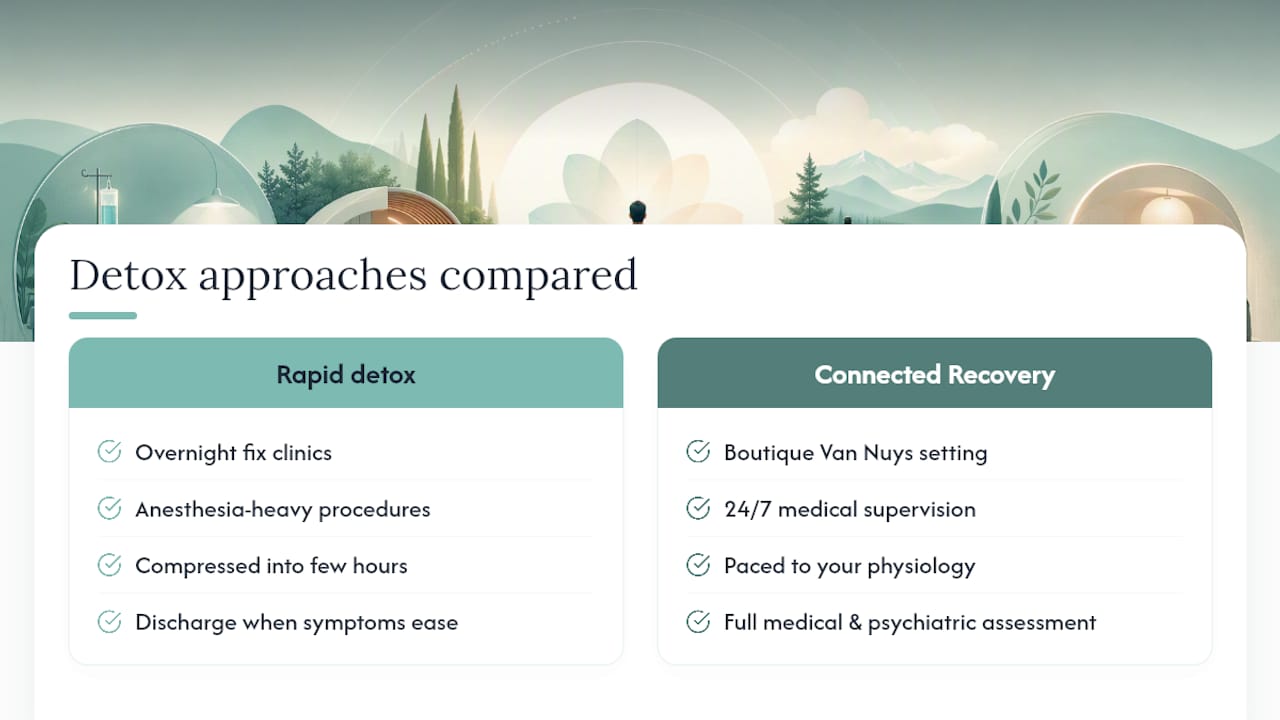
If the alternatives you've just read about, rapid detox clinics promising an overnight fix, sound risky, that's because they are. Connected Recovery offers a different route: a boutique setting in Van Nuys with 24/7 medical supervision, where detox is paced to your physiology instead of compressed into a few anesthesia-heavy hours.

Intake starts with a full medical and psychiatric assessment, since co-occurring conditions change how withdrawal should be managed. From there, the team builds an individualized plan that can include MAT, and continues straight into residential care rather than discharging you the moment withdrawal symptoms ease. That continuity matters: a residential detox model reduces the gap where relapse risk spikes right after detox ends.
For readers also managing psychiatric medications during this process, resources like this guide to tapering an SSRI safely cover a related but distinct piece of the puzzle.
If you're ready to explore medical detox in Van Nuys, the next step is simple: call to verify your insurance and schedule an intake assessment. For those managing a co-occurring mental health condition alongside substance use, ask about dual diagnosis treatment during that same call.
Sources
- Deaths and Severe Adverse Events Associated with Anesthesia-Assisted Rapid Opioid Detoxification — New York City, 2012
- Appendix and guidance summaries on rapid and ultra-rapid detoxification (NCBI Bookshelf)
This article is general information, not a substitute for advice from a qualified doctor. Consult a qualified healthcare professional about your own circumstances before acting on anything here.