
The strongest evidence supports integrated, trauma-focused treatment (COPE, Prolonged Exposure, CPT, EMDR) delivered alongside substance use disorder care, not sequenced after it. People do not need to hit some abstinence milestone before starting trauma treatment. Medication-assisted treatment often runs in parallel for opioid or alcohol use disorders, while trauma-informed pacing and individualized readiness planning keep dropout rates down.
TL;DR:
- Trauma-focused, integrated treatments like COPE and Prolonged Exposure are most effective when delivered alongside substance use disorder care, without waiting for abstinence.
- Co-occurring PTSD and substance use often stem from self-medication and avoidance, especially in those with adverse childhood experiences, increasing relapse and suicide risks if untreated.
- Proper sequencing, medication management, and individualized pacing are vital, particularly for alcohol and opioid use disorders, to ensure trauma work is safely tolerated.
- Small residential facilities with coordinated care and 24/7 supervision improve retention and outcomes compared to outpatient or less integrated models.
- Family involvement should focus on education, communication, and boundaries, avoiding retraumatization or blame, and should complement individual trauma work.
Table of Contents
- How Common Is PTSD and Addiction Treatment Needed Together?
- What Does the Research Say About the Best Therapies for PTSD and Addiction?
- Do Medications Help Treat PTSD and Substance Use Together?
- What Is Trauma-Informed Care and When Should Trauma Work Begin?
- Is Residential Treatment Necessary for PTSD and Addiction?
- How Do You Find a Provider Who Treats PTSD and Addiction Together?
- How Boutique Residential Care Supports Trauma-Focused Recovery
- Alcohol vs. Opioids: Why Treatment Adaptations Matter
- What Does Long-Term Recovery Look Like With PTSD and Addiction?
- How Should Families Be Involved in Dual Diagnosis Treatment?
- How Do PTSD and Addiction Affect Veterans, Women, and Adolescents Differently?
- Where to Find Authoritative PTSD and Addiction Resources
- A Realistic Look at What Recovery From PTSD and Addiction Requires
- Getting Residential Care That Treats PTSD and Addiction as One Problem
- Sources
- FAQ
How Common Is PTSD and Addiction Treatment Needed Together?
A large proportion of people with PTSD also meet criteria for an alcohol or drug use disorder, according to the National Center for PTSD. That overlap isn't a coincidence of two unlucky diagnoses showing up in the same person. It reflects a shared biological and psychological wiring between trauma response and substance use.
The mechanism usually runs through self-medication. Alcohol dulls hypervigilance. Opioids blunt intrusive memories. Stimulants can temporarily override the emotional numbness that trauma survivors describe as worse than the fear itself. Avoidance is the other engine: substances let someone sidestep flashbacks, triggers, and the physical alarm system trauma leaves behind, at least for a few hours at a time.
Adverse childhood experiences compound the risk. Someone who experienced abuse, neglect, or household instability early in life develops a stress response that's primed to escalate, and substances become one of the few reliable ways to bring that system back down. This is a self-medication loop, not a character flaw.
The clinical consequences of ignoring the overlap are serious:
- Complexity in diagnosis: Withdrawal symptoms and PTSD symptoms overlap (insomnia, irritability, hypervigilance), making it easy to misattribute one for the other.
- Elevated suicide risk: Co-occurring PTSD and SUD independently raise suicide risk, and the combination compounds it further.
- Treatment retention problems: People who feel unheard about their trauma while getting SUD treatment, or vice versa, are more likely to leave care early.
- Higher relapse triggers: Untreated PTSD symptoms are a leading cause of relapse after detox, since the underlying pain never got addressed.
Programs that treat only the substance use, and defer the trauma work "until stability," routinely see people relapse once triggers resurface. Integrated care exists because splitting the two conditions into separate treatment tracks tends to fail both of them.
What Does the Research Say About the Best Therapies for PTSD and Addiction?
Systematic reviews and network meta-analyses point to one clear pattern: integrated, trauma-focused psychotherapy reduces PTSD symptoms more effectively than approaches that treat substance use alone or pair general counseling with SUD care. A network meta-analysis of psychotherapy and pharmacologic treatments for co-occurring PTSD and SUD found that trauma-focused, integrated models consistently outperformed non-trauma-focused alternatives on PTSD outcome measures.
Key finding: Integrated trauma-focused psychotherapy, including approaches like COPE, shows superior reductions in PTSD symptoms compared to SUD-only or non-trauma-focused integrated treatment, based on network meta-analyses reviewed by the National Center for PTSD's research synthesis.
Four therapies dominate the evidence base for trauma and substance use treatment. Each has a distinct mechanism, and knowing the difference matters when you're choosing a provider.
Concurrent Treatment of PTSD and Substance Use Disorders (COPE) combines Prolonged Exposure with cognitive behavioral relapse prevention in a single manualized protocol, typically delivered over 12 sessions. It was built specifically for comorbid presentations, which sets it apart from therapies adapted after the fact.
Prolonged Exposure (PE) has a person revisit and describe the traumatic memory repeatedly, in a controlled setting, until its emotional charge weakens. Sessions run 60 to 90 minutes, usually across 8 to 15 sessions, and PE has one of the largest evidence bases of any PTSD treatment.
Cognitive Processing Therapy (CPT) targets the distorted beliefs trauma creates ("I could have stopped it," "I can never be safe") rather than the memory itself. It runs about 12 sessions and works well for people who find direct exposure work too intense at the outset.
Eye Movement Desensitization and Reprocessing (EMDR) uses bilateral stimulation, usually guided eye movements, while the person recalls trauma fragments. It doesn't require the detailed verbal narrative that PE and CPT do, which makes it a reasonable option for people who struggle to talk through their trauma directly.
Manualized, randomized controlled trials back all four approaches, and COPE in particular was designed and tested for comorbid populations rather than retrofitted from single-diagnosis protocols.
Where the evidence gets more complicated:
- Effect sizes in comorbid PTSD+SUD samples tend to run smaller than in PTSD-only trials, according to a review published in Nature Reviews Psychology.
- Dropout rates are meaningfully higher in comorbid populations, which is part of why pacing and readiness matter so much.
- Study samples skew toward specific demographics (often veterans and clinical trial volunteers), so results don't always generalize cleanly to every population.
- Access to properly trained COPE clinicians is limited. Fidelity to the protocol requires specific training, and not every program has staff certified to deliver it.
None of this undercuts the core finding. It just means the path is harder and slower for this population, and a program that acknowledges that upfront is more trustworthy than one that promises a quick fix.
Do Medications Help Treat PTSD and Substance Use Together?
Medication plays a real role in co-occurring treatment, but it works on the substance use side far more reliably than on the PTSD side. There is no approved medication specifically for the combined diagnosis. Pharmacologic tools target one condition or the other, not the interaction between them.
For opioid use disorder, buprenorphine and methadone reduce cravings and withdrawal severity, stabilizing someone enough to engage meaningfully in trauma therapy. Naltrexone blocks the euphoric effects of opioids and also has a documented role in alcohol use disorder, where it reduces the reinforcing "reward" of drinking.
- Buprenorphine: Partial opioid agonist, reduces withdrawal and craving without full opioid effect.
- Methadone: Full opioid agonist administered under close supervision, typically for more severe opioid use histories.
- Naltrexone: Opioid receptor blocker used for both opioid and alcohol use disorder; available in oral and extended-release injectable form.
The combination evidence is strongest for alcohol. Trials pairing Prolonged Exposure with naltrexone have shown better alcohol-related outcomes than supportive counseling paired with placebo, according to the same network meta-analysis of PTSD and SUD interventions. The medication handles the physiological craving loop while the therapy addresses what's driving the drinking in the first place.
It's worth being direct about the limits here: no medication resolves PTSD symptoms and substance cravings simultaneously through one mechanism. SSRIs and other medications sometimes prescribed for PTSD symptoms operate independently of whatever is prescribed for the SUD side. A well-run medication-assisted treatment program coordinates both, but coordination is the job of the clinical team, not a property of any single drug.
What Is Trauma-Informed Care and When Should Trauma Work Begin?
Trauma-informed care is not a therapy technique. It's an operating philosophy for an entire program, according to SAMHSA's framework, built around four principles: safety, trustworthiness, peer support, and empowerment. A single trauma-focused therapy session inside an otherwise coercive, unpredictable program does not make that program trauma-informed. The environment itself has to avoid retraumatizing patterns, from how intake is conducted to how staff communicate about setbacks.
Readiness for active trauma processing is assessed individually rather than on a fixed calendar. Clinicians generally look for a handful of practical signs before starting exposure-based work:
- Distress tolerance without immediate relapse. Can the person sit with uncomfortable emotion for a few minutes without reaching for a substance?
- A working plan for trauma-linked cravings. Specific triggers (anniversaries, smells, certain places) need a concrete coping response mapped out in advance.
- Medical and medication stability, including MAT if applicable, so withdrawal symptoms don't get confused with trauma symptoms.
- A physically and emotionally safe setting for the exposure work itself, free from ongoing threat or chaos.
This is consistent with guidance from a VA-affiliated review of comorbid PTSD and SUD treatment, which states plainly that SUD alone should not exclude someone from trauma-focused care.
Retention in comorbid treatment often comes down to pacing more than content. Motivational interviewing helps someone find their own reasons to stay in treatment rather than being told to. Psychoeducation about why cravings spike during trauma work reduces the panic of "something's wrong with me." Gradual exposure pacing, rather than diving straight into the most severe memory, keeps the nervous system from overwhelming itself. A crisis plan written out before exposure work begins gives both patient and clinician a clear script if things get hard mid-treatment.
Pro Tip: If a program tells you trauma therapy will start only after 90 days clean, ask why. Current guidance treats readiness as clinical, not calendar-based, and a fixed waiting period is a sign the program hasn't updated its model.
Is Residential Treatment Necessary for PTSD and Addiction?
Not everyone needs 24/7 residential care, but certain clinical signs point strongly toward it. Medical instability during withdrawal (seizure risk with alcohol or benzodiazepines, for instance) requires supervised detox, not an outpatient taper. Repeated relapse despite outpatient treatment, active safety concerns including suicidal ideation, and a home environment that reinforces substance use or retraumatizes the person are all reasons residential care tends to outperform outpatient alternatives.
What separates a residential program worth choosing from one that isn't, when PTSD is part of the picture:
- Integrated trauma therapy on-site, not a referral to an outside provider once detox ends.
- Medically supervised detox with staff trained to distinguish withdrawal symptoms from trauma symptoms.
- In-house access to MAT so medication and therapy aren't run by two disconnected providers.
- Small enough census that clinicians actually know each patient's trauma history and triggers, rather than managing symptoms in bulk.
Outpatient, intensive outpatient (IOP), or telehealth options make sense for people who are medically stable, have a safe home environment, and have already completed detox elsewhere. Hybrid models, residential detox followed by outpatient trauma therapy, or IOP with a telehealth EMDR specialist, work well when full residential care isn't feasible long term. The determining factor isn't preference. It's whether the person can stay safe and engaged in the environment they'd be recovering in day to day.
How Do You Find a Provider Who Treats PTSD and Addiction Together?
Finding the right program starts with asking pointed questions, not reading marketing copy. Here's a practical sequence for evaluating any provider:
- Ask what trauma-focused modalities staff are trained and certified in. COPE, PE, CPT, and EMDR all require specific training; "trauma-informed" alone isn't the same as delivering trauma-focused therapy.
- Ask how MAT is coordinated with therapy. Are medication and trauma work managed by the same team, or handed off to separate providers with no communication between them?
- Ask what assessment tools intake uses. Credible programs typically use the AUDIT for alcohol use severity, the DAST for drug use severity, and the PCL-5 for PTSD symptom screening. These give a baseline and track progress over time.
- Ask about staffing ratios and program size. A 12-bed program and a 60-bed program deliver very different levels of individualized attention, and that matters directly for trauma pacing.
- Ask how they handle a crisis mid-treatment. A program without a clear answer for what happens if someone has a severe trauma response during exposure work is a program without a real trauma protocol.
Watch for a few clear red flags. Any program that requires a fixed period of abstinence before addressing trauma is working from an outdated model. Coercive practices, threats, punitive consequences for relapse, isolation as discipline, run directly against trauma-informed principles. And if the mental health team and the SUD team don't talk to each other, you're looking at sequential treatment dressed up as integrated care.
How Boutique Residential Care Supports Trauma-Focused Recovery
Small-scale residential structure isn't a luxury add-on. It's a mechanism that directly supports the readiness-based, individualized pacing that trauma-focused treatment requires. A feasibility study of trauma-informed residential SUD programs found improved retention and reduced substance involvement when programs implemented trauma-informed practices across staff training, environment, and leadership, not just in the therapy room.
That's the operating logic behind a 12-bed capacity like Connected Recovery's: fewer patients per clinician means trauma histories and triggers are actually tracked, not guessed at. Twenty-four-hour medical supervision matters specifically because withdrawal symptoms and trauma symptoms can look nearly identical, and telling them apart requires staff who are present and paying attention around the clock, not checking in on a schedule.
Components that map directly onto what the research supports:
- Medical detox with continuous monitoring, so trauma-related distress isn't mistaken for withdrawal or vice versa.
- Medication-assisted treatment integrated with therapy scheduling, not managed by a disconnected outside prescriber.
- Relapse prevention and aftercare planning built before discharge, since the highest relapse risk window is the transition out of residential care.
- Case management and discharge planning that account for a patient's ongoing trauma work, not just their sobriety date.
The clinical literature is clear that implementation quality, leadership, training, and environment, matters as much as which specific therapy protocol a program uses. A small facility has an easier time getting that implementation right, simply because there's less to coordinate.
Alcohol vs. Opioids: Why Treatment Adaptations Matter
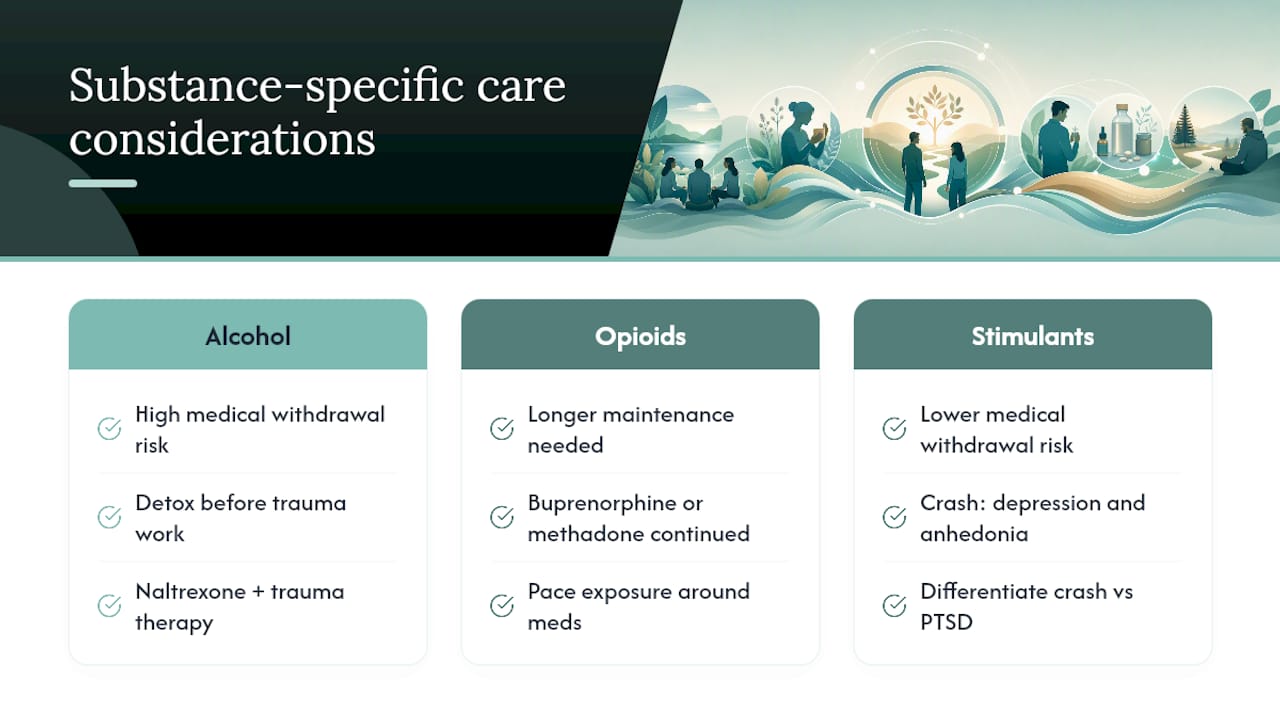
Alcohol and opioid use disorders create different clinical pictures when PTSD is also present, and providers who treat them identically are missing something important.
Alcohol withdrawal carries acute medical risk, seizures and delirium tremens among them, which means medical detox has to happen before any serious trauma processing starts. Once stabilized, alcohol use disorder tends to respond well to naltrexone paired with trauma-focused therapy, since the medication dulls the reward response while therapy addresses the trauma driving the urge to drink in the first place.
Opioid use disorder usually calls for a longer medication timeline. Buprenorphine or methadone maintenance often continues well into and beyond the active trauma therapy phase, since abrupt discontinuation raises relapse risk sharply. Cravings in opioid use disorder are also frequently tied to physical pain memories and specific trauma triggers in a way that alcohol cravings sometimes aren't, which means exposure work has to be paced around medication stability, not around a fixed timeline.
Stimulant use (methamphetamine, cocaine) adds a different wrinkle: withdrawal is less medically dangerous but the crash often includes intense depression and anhedonia, symptoms that can look identical to PTSD's numbing cluster. Distinguishing the two accurately shapes when trauma work should start.
None of this changes which trauma therapies work. COPE, PE, CPT, and EMDR remain the backbone regardless of substance. What changes is sequencing, medication coordination, and how quickly a person can safely tolerate exposure work.
What Does Long-Term Recovery Look Like With PTSD and Addiction?
Relapse prevention for co-occurring PTSD and addiction has to plan for trauma triggers specifically, not just generic cravings. A relapse prevention plan that only lists "avoid bars" or "delete dealer numbers" misses the trigger category that actually drives most relapses in this population: trauma reminders like anniversaries, specific sounds, certain relationship dynamics, or unexpected reminders of the traumatic event.
Effective long-term plans build in a few specific elements. A written list of personal trauma triggers, paired with a rehearsed coping response for each one, turns a vague fear into something manageable. Continued outpatient trauma therapy after residential discharge keeps the work going instead of letting it stop cold at the point of highest vulnerability. Ongoing psychoeducation about the relationship between PTSD symptom flares and craving spikes helps someone recognize a warning sign before it becomes a crisis rather than after.
Support groups for PTSD and dual-recovery peer groups add something individual therapy can't: the experience of hearing someone else describe the exact same self-medication loop and realizing it isn't a personal failure. Mindfulness practices, including grounding techniques and body-based regulation skills, give people a fast, portable tool for the moment a trigger hits and there's no therapist in the room.
Recovery from this combination is rarely linear. A setback in PTSD symptoms doesn't erase progress on the substance use side, and vice versa. The plans that hold up over years, not months, are the ones that treat both conditions as permanently linked rather than assuming one "graduates" while the other lingers.
How Should Families Be Involved in Dual Diagnosis Treatment?
Family involvement changes outcomes, but it has to be structured carefully when trauma is part of the picture. Untrained family participation can accidentally recreate the exact dynamics, blame, minimization, walking on eggshells, that made the trauma harder to process in the first place.
A family program built for dual diagnosis typically does three things well. It educates family members on what PTSD and addiction actually look like from the inside, replacing "why can't they just stop" with a working understanding of the self-medication loop. It teaches communication skills that avoid retraumatizing language, since well-meaning comments about "moving on" or "just relax" often land as dismissive to someone with PTSD. And it sets boundaries that protect both the patient's recovery and the family's own well-being, since caregiver burnout is common and rarely addressed.
Family therapy sessions work best when they happen alongside, not instead of, the patient's individual trauma work. A spouse or parent doesn't need to hear every detail of the trauma itself to be a supportive part of recovery. They need to understand triggers, relapse warning signs, and how to respond during a flashback or craving episode without escalating the moment.
Case management often extends to family coordination too, particularly around discharge planning: what does the home environment need to look like for this person to stay safe, and does the family need its own support resources, including Al-Anon-style groups or its own therapy, to sustain that environment long term.
How Do PTSD and Addiction Affect Veterans, Women, and Adolescents Differently?
Population matters enormously in how PTSD and addiction show up and how treatment needs to adapt.
Veterans carry some of the highest documented rates of comorbid PTSD and SUD, often tied to combat exposure, military sexual trauma, or the abrupt identity loss of leaving service. Treatment for this population benefits from clinicians familiar with military culture and VA system navigation, and programs coordinating with VA benefits or VA/DoD guidance tend to see better engagement.
Women more frequently develop PTSD from interpersonal trauma, sexual assault or domestic violence, rather than combat or accident-related trauma. That distinction shapes treatment: safety and trust-building often need more front-loaded attention before exposure work begins, and co-ed treatment environments can themselves feel unsafe for some trauma histories, making gender-specific programming a meaningful consideration.
Adolescents present a different challenge entirely, since their trauma often stems from ongoing situations, bullying, family instability, abuse, rather than a single discrete event, and their substance use frequently escalates faster relative to adult onset patterns. Family involvement isn't optional for this group in the way it can be for adults; the home environment is usually still the primary environment they're returning to daily.
None of these populations need a fundamentally different set of therapies. COPE, PE, CPT, and EMDR remain the evidence base across all three. What changes is pacing, safety-building emphasis, and how the surrounding support system gets built into the plan.
Where to Find Authoritative PTSD and Addiction Resources
A few sources are worth bookmarking directly. The National Center for PTSD publishes clinician guidance and public-facing summaries on trauma and substance use. SAMHSA's trauma-informed care resources cover training materials and program standards for providers and patients alike. The VA/DoD comorbid PTSD and SUD review offers a detailed look at practice recommendations for clinicians. For anyone in immediate crisis, the 988 Suicide and Crisis Lifeline connects to trained counselors around the clock and is worth having saved before it's needed.
A Realistic Look at What Recovery From PTSD and Addiction Requires
Progress with this combination is rarely a straight line, and any program promising otherwise is overselling. Integrated care works because it treats the substance use as downstream of something real, not as a standalone behavior problem to correct. That's the entire logic behind trauma-focused therapy paired with SUD treatment rather than run in sequence.
Safety and consent are non-negotiable in trauma work. Nobody should be pushed into exposure-based therapy before they're ready, and readiness is a clinical judgment, not a fixed timeline. If you're in crisis or unsafe right now, that takes priority over any treatment plan. Reach out for an assessment, ask hard questions of any provider, and expect real coordination between the mental health side and the addiction side. Anything less isn't integrated care.
— Jim
Getting Residential Care That Treats PTSD and Addiction as One Problem
Most treatment centers still split trauma care and addiction care into separate tracks, handing you off between providers who rarely talk to each other. Connected Recovery runs both as one coordinated plan, in a 12-bed boutique setting where staff know your history well enough to catch the difference between a withdrawal symptom and a trauma trigger.
That small scale is deliberate. With 24/7 medical supervision and a low patient count, clinicians can pace trauma-focused work to actual readiness instead of a program calendar, while medically supervised detox and medication-assisted treatment run alongside therapy rather than as a separate hand-off. If you're evaluating residential treatment for co-occurring PTSD and substance use, start with a dual diagnosis assessment to see whether this level of integrated, individualized care fits your situation. Reach out to schedule an intake conversation and get a clear picture of what a coordinated treatment plan would look like for you.
This article is general information, not a substitute for advice from a qualified doctor. Consult a qualified healthcare professional about your own circumstances before acting on anything here.
Sources
- Substance Use and PTSD - PTSD: National Center for PTSD
- Systematic review and network meta-analyses of psychotherapy and pharmacologic treatments for PTSD+SUD
- Trauma-Informed Approaches and Programs | SAMHSA
FAQ
How Does Trauma Affect Addiction Recovery?
Unresolved trauma drives relapse by keeping the original coping mechanism, substance use, attached to unresolved emotional pain. When trauma symptoms go untreated, cravings and PTSD symptom flares tend to escalate together, which is why addressing trauma directly, rather than after the fact, improves recovery odds.
What Is the Relationship Between Trauma and Substance Abuse?
Trauma and substance use are linked primarily through self-medication and avoidance: substances temporarily dull hypervigilance, intrusive memories, and emotional numbness. A large proportion of people with PTSD also have a co-occurring substance use disorder, according to the National Center for PTSD., making the two conditions more the rule than the exception in clinical settings.
What Is the Most Effective Treatment for PTSD?
Trauma-focused therapies, Prolonged Exposure, Cognitive Processing Therapy, and EMDR, carry the strongest evidence base for PTSD, backed by manualized, randomized controlled trials. For people with co-occurring substance use, integrated approaches like COPE that combine trauma processing with relapse prevention show the best outcomes in network meta-analyses.
What Is the Relationship Between Trauma and Alcohol Use?
Alcohol is one of the most common substances used to self-medicate PTSD symptoms because it quickly dampens anxiety and hyperarousal. Combining trauma-focused therapy with naltrexone has shown better alcohol-related outcomes than supportive counseling alone in trial data reviewed in recent meta-analyses.
Does Connected Recovery Treat Both PTSD and Addiction?
Yes. Connected Recovery provides dual diagnosis treatment that addresses PTSD and substance use disorders concurrently, supported by medically supervised detox and 24/7 clinical oversight within a 12-bed residential setting. Program pricing is available by contacting the facility directly.