
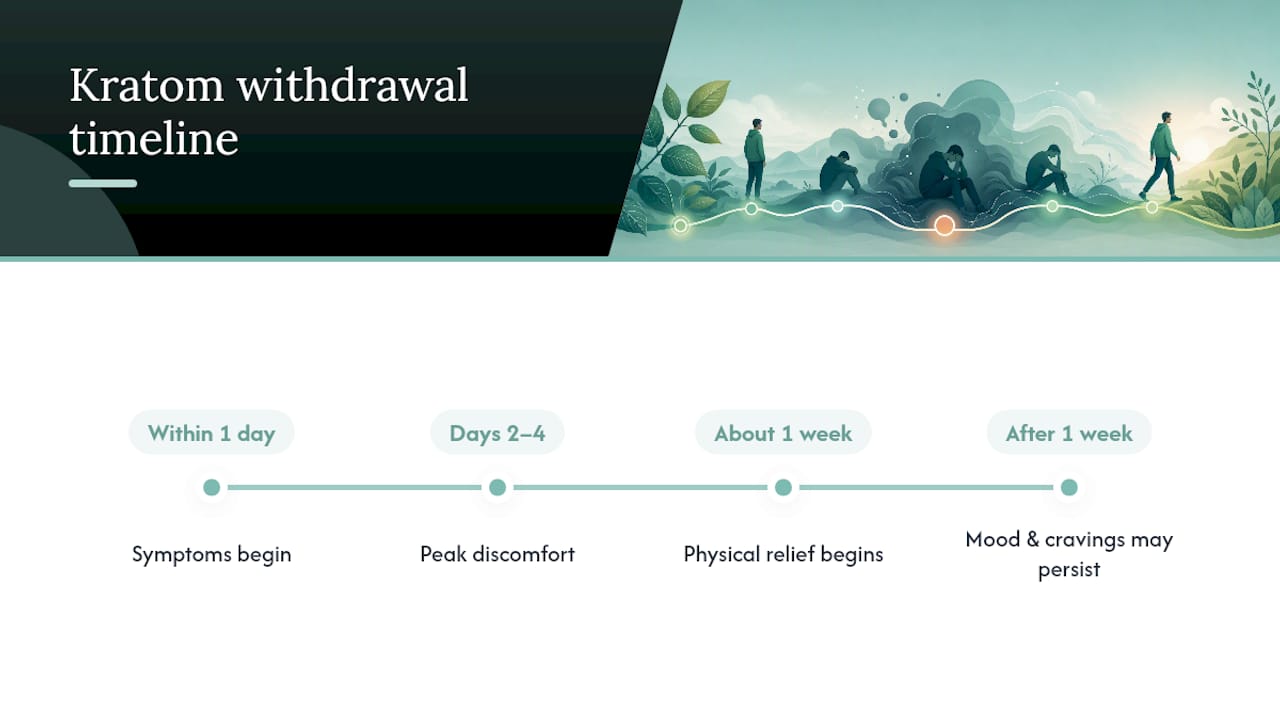
Kratom withdrawal usually starts within 12 to 24 hours of the last dose, peaks around days 2 through 4, and produces a mix of muscle aches, GI upset, sweating, anxiety, and cravings. Acute physical symptoms typically resolve within 5 to 7 days, though mood and craving can linger for weeks. Frequent, high-dose users, extract users, and anyone with prior opioid use or a serious mental health condition should consider medical supervision rather than going it alone.
TL;DR:
- Higher frequency dosing and use of concentrated extracts significantly increase the severity and duration of kratom withdrawal symptoms.
- Withdrawal symptoms usually appear within 12 to 24 hours, peak around days 2 to 4, and mostly resolve within a week, but cravings can persist for weeks.
- People with prior opioid use or mental health conditions face a higher risk of severe withdrawal and should seek medical supervision before stopping.
- Supportive home care, including hydration, pain relief, and sleep management, is effective for mild cases, but severe symptoms or comorbidities require professional detox.
- Psychological symptoms like anxiety, depression, and cravings often outlast physical withdrawal, requiring ongoing mental health support and structured relapse prevention plans.
Table of Contents
- Physical Symptoms of Kratom Withdrawal and How They Show Up
- Psychological Symptoms: Anxiety, Mood, Sleep, and Cravings
- How Long Does Kratom Withdrawal Last?
- What Makes Kratom Withdrawal Worse?
- How to Manage Kratom Withdrawal Safely at Home
- What Medical Treatment for Kratom Withdrawal Actually Looks Like
- When to Seek Professional Detox Care for Kratom Withdrawal
- Your Recovery Plan for the Weeks After Withdrawal
- The Bottom Line on Kratom Withdrawal
- Why the "It's Natural, So It's Easy" Advice Misses the Point
- Sources
Physical Symptoms of Kratom Withdrawal and How They Show Up
The body's reaction to stopping kratom looks a lot like a bad flu layered on top of restless, jittery discomfort. Reported physical symptoms include muscle aches, nausea, diarrhea, sweating, chills, tremor, and insomnia, and most people experience several of these at once rather than just one or two.
Muscle and joint aches tend to show up early and settle into the lower back, legs, and shoulders. Tremors and chills often arrive alongside sweating episodes that can soak through clothing within minutes, then vanish just as fast. This pattern of temperature swings is one of the more physically uncomfortable parts of the process, even when it isn't medically dangerous.
Gastrointestinal symptoms are almost universal in moderate to severe withdrawal:
- Nausea, sometimes severe enough to affect appetite for days
- Vomiting, usually intermittent rather than constant
- Diarrhea, which is the symptom most likely to cause dehydration if untreated
- Dry mouth, which can make swallowing food uncomfortable during the peak days
Autonomic symptoms round out the physical picture. A runny nose and watery eyes mimic a cold, while heart rate and blood pressure can climb temporarily as the nervous system recalibrates without the substance it had adjusted to. None of these signs are unique to kratom. They overlap heavily with classic opioid withdrawal because kratom's active alkaloids act on some of the same receptors.
Symptom severity is not uniform. Survey data using standardized withdrawal scales found that most people report mild to moderate symptoms on average, with the more severe scores concentrated among people dosing more than six times a day or using concentrated extracts. That's a meaningful distinction: the person taking a moderate leaf powder dose twice a day is having a very different experience than someone using high-potency extracts around the clock.
Product formulation adds another layer of unpredictability. Kratom products vary widely in alkaloid content, and whole leaf versus concentrated formulations likely affect how intense withdrawal feels, though the research on this is still thin. If you don't know exactly what you've been taking, that uncertainty alone is a reason to get a clinical assessment rather than guess at what to expect.
Psychological Symptoms: Anxiety, Mood, Sleep, and Cravings
The physical symptoms grab attention first, but the psychological ones are usually what makes withdrawal hard to push through. Anxiety, irritability, depressed mood, and low energy are all commonly reported during kratom withdrawal, and they frequently outlast the physical discomfort by weeks.
-
Anxiety and irritability. These often peak alongside the physical symptoms in the first several days, but low-grade anxiety can persist well past the point where nausea and aches have faded. Short temper and a sense of being on edge are common complaints during this stretch.
-
Depressed mood and fatigue. A flat, low-energy state frequently follows the acute phase. This isn't just tiredness from poor sleep. It reflects the nervous system readjusting to functioning without the substance, and it can make ordinary tasks feel harder than they should.
-
Sleep disruption and restless legs. Insomnia is one of the most frequently reported symptoms, and restless legs syndrome sometimes appears alongside it. Poor sleep compounds every other symptom on this list, since fatigue makes mood and craving management noticeably harder.
-
Craving. This is the symptom most directly tied to relapse. Cravings can spike unpredictably, often triggered by stress, boredom, or simply the routine of a time of day when kratom used to be part of the schedule. Unlike the physical symptoms, craving doesn't follow a clean timeline. It can flare weeks after the physical withdrawal has resolved.
The overlap between these symptoms and general anxiety disorders is part of why kratom withdrawal is easy to misread. If you're managing this at home, practical coping steps for withdrawal-related anxiety can help you get through the harder stretches without treating every anxious moment as an emergency. Still, if depressed mood deepens rather than lifts over the first two weeks, that's a signal worth discussing with a clinician rather than waiting out.
How Long Does Kratom Withdrawal Last?
Most people want a straight answer to one question: when does this end? The honest answer has two parts, because the physical and psychological timelines don't run at the same speed.
The physical timeline is fairly consistent across case reports and clinical reviews:
- Hours 12 to 24: First symptoms appear, usually starting with restlessness, mild anxiety, and the first hints of muscle discomfort.
- Days 2 to 4: Peak severity. This is when GI symptoms, sweating, tremor, and insomnia are typically at their worst.
- Days 5 to 7: Most acute physical symptoms resolve for the majority of people, especially those with lower-frequency use histories.
- Week 2 and beyond: Physical symptoms fade, but sleep problems and low energy can still show up in waves.
- Weeks to months: Mood instability and cravings are the long tail of kratom withdrawal. They don't affect everyone this long, but for people who used frequently or at high doses, this post-acute stretch is real and worth planning for.
That last phase is the one most people underestimate. It's easy to assume that once the flu-like symptoms are gone, withdrawal is over. But the psychological piece, particularly craving, often follows its own slower curve, and that mismatch between how you feel physically and how vulnerable you still are to relapse is exactly where a lot of setbacks happen.
Timelines shift based on how often and how much someone was using, which product type they took, and whether they had any prior opioid exposure. Someone who used a low dose of kratom tea occasionally will likely have a shorter, milder course than someone taking concentrated extract multiple times a day for months.
What Makes Kratom Withdrawal Worse?
Not everyone's withdrawal looks the same, and the research points to a few specific factors that predict a rougher course. Knowing where you fall on this list helps you decide whether home management is reasonable or whether you should line up medical support before you stop.
- Dosing frequency. This is the strongest predictor identified in survey research. How often someone dosed mattered more than how much they took at once when it came to predicting withdrawal symptom count and severity.
- Extract or concentrated product use. Formulations with higher alkaloid concentration, including products marketed around 7-hydroxymitragynine, appear linked to more intense withdrawal, though the evidence base here is still limited.
- Prior opioid use. A history of opioid dependence, even one that predates kratom use entirely, tends to compound withdrawal severity and complicates treatment choices.
- Co-occurring mental health conditions. Anxiety disorders, depression, and other psychiatric conditions can amplify the psychological symptoms of withdrawal and make self-management riskier.
Pro Tip: Ask yourself three questions before deciding to stop on your own: Am I dosing more than four or five times a day? Am I using an extract rather than raw leaf or powder? Do I have a history of opioid use or an existing mental health diagnosis? Two or more "yes" answers is a strong argument for at least a phone consultation with a clinician before you taper.
Clinicians who evaluate kratom use often note that frequency patterns reveal more than the dose itself. Someone dosing small amounts eight times a day may be at higher risk than someone taking a larger dose just once or twice, because the frequency reflects how tightly the body has adapted to a near-constant presence of the substance.
How to Manage Kratom Withdrawal Safely at Home
For people with a milder use history, mild to moderate symptoms are often manageable outside a clinical setting, provided you're paying attention to warning signs. A slow taper rather than an abrupt stop tends to reduce the intensity of the peak days, giving the body more time to adjust gradually instead of all at once.
Basic supportive care makes a real difference during the acute phase:
- Hydrate consistently and replace electrolytes, since diarrhea and sweating can deplete both quickly.
- Use over-the-counter anti-nausea remedies as needed, and consider ginger or bland foods if vomiting makes eating difficult.
- Over-the-counter pain relievers can address muscle aches, and loperamide can help control diarrhea when it's persistent.
- Protect sleep as much as possible: consistent bedtimes, minimal screens before bed, and light physical activity during the day to support natural fatigue.
- Eat what you can tolerate, even if appetite is low. Small, frequent meals are usually easier to manage than trying to eat full portions.
Some symptoms cross the line from uncomfortable to urgent. Seek medical care if you can't keep fluids down for more than a day, if psychiatric symptoms like severe anxiety or suicidal thoughts appear, or if you notice signs of serious autonomic instability such as a racing heart that doesn't settle or extreme blood pressure swings. Managing anxiety during detox at home has real limits, and structured strategies for that specific symptom can help, but they're not a substitute for medical evaluation when symptoms escalate.
What Medical Treatment for Kratom Withdrawal Actually Looks Like
Clinical literature describes a fairly consistent hierarchy of treatment options, starting conservative and escalating only when needed. The goal in most clinical settings isn't to eliminate every symptom immediately. It's to manage the ones that pose real risk or genuine suffering while the body works through withdrawal.
Non-opioid symptomatic management is usually the first line. Clonidine and lofexidine are described in case series and clinical reviews as effective for autonomic symptoms like elevated heart rate, sweating, and anxiety, without introducing another substance with dependence potential. Anti-nausea medication, sleep aids, and pain relievers round out the symptomatic toolkit.
For more severe cases, some clinical reports describe buprenorphine-naloxone induction, with doses in case reports ranging from 4 mg to 8 mg and higher in complex presentations. This is where the treatment picture gets more nuanced.
Buprenorphine can relieve withdrawal in cases described in clinical reports, but immediate high-dose induction in a patient who has never used a full opioid agonist carries real risk of creating a new dependence rather than resolving one. Clinicians often favor conservative, symptom-driven approaches first, reserving buprenorphine for cases where non-opioid management has failed or where withdrawal severity clearly warrants it.
That caution matters because kratom users are frequently opioid-naive even though kratom itself acts on opioid receptors. Treating them the same way a clinician would treat someone withdrawing from prescription opioids or heroin isn't automatically appropriate.
- Clonidine and lofexidine for autonomic symptom control without added dependence risk
- Buprenorphine-naloxone reserved for selected, more severe cases under close supervision
- Symptomatic medications for nausea, insomnia, and pain as first-line supportive care
- Ongoing monitoring for drug interactions, since kratom affects liver enzyme pathways (CYP) and drug transport proteins (P-gp) that can alter how other medications are metabolized
Treatment has to be individualized. Someone's dosing history, other substances involved, and mental health status all shape which combination of these tools makes sense, which is exactly why self-treating a severe case with borrowed medication is a gamble rather than a plan.
When to Seek Professional Detox Care for Kratom Withdrawal
Certain signs mean home management isn't the safer option anymore. Severe autonomic instability, an inability to stay hydrated, psychiatric symptoms that escalate rather than improve, or a home taper that keeps failing are all clinical indicators that it's time to move into a supervised setting. The FDA has flagged kratom's opioid-like effects and dependence risk as a public health concern precisely because these risks are frequently underestimated by people who consider kratom a purely herbal, low-risk product.
Medically supervised detox exists for exactly this gap. It typically includes:
- 24/7 monitoring so autonomic symptoms and dehydration are caught and managed before they become dangerous
- Medication management using the same symptomatic and, when appropriate, opioid-based tools described in clinical literature
- Integrated care for co-occurring mental health conditions, since anxiety and depression during withdrawal often need direct treatment rather than just waiting them out
- Individualized tapering plans instead of a one-size-fits-all protocol
- A bridge into aftercare planning so the post-acute mood and craving phase doesn't get managed alone
Some boutique 12-bed facilities offer individualized attention, 24/7 medical supervision, and integrated treatment for co-occurring substance use and mental health disorders. Detox is only the entry point; the same medically supervised detox program is designed to connect directly into longer-term care, which matters given how much of kratom withdrawal's real difficulty shows up after the physical symptoms fade. A detailed breakdown of what detox and withdrawal actually involve can help you understand what a supervised program covers before you commit to one.
Your Recovery Plan for the Weeks After Withdrawal
The first week after acute withdrawal fades is about consolidation, not celebration. Sleep, hydration, and staying in contact with a clinician if you had a rough physical course should take priority over anything else. This is also when the temptation to declare victory and stop paying attention creeps in, which is exactly the wrong instinct.
Weeks two through four are where the psychological work really starts. This is the window to begin or continue therapy, particularly approaches like cognitive behavioral therapy and motivational interviewing, both of which have strong track records for substance use recovery generally. Peer support groups also become more useful here, once the initial physical fog has cleared enough to engage meaningfully.
By months two and three, the focus shifts to follow-up care and, if a clinician recommended it, ongoing medication support. This is also the stretch where relapse risk from lingering cravings is highest, so having a concrete plan matters more than good intentions.
- Identify your top two or three craving triggers and write down a specific distraction plan for each
- Keep a short list of emergency contacts, whether that's a sponsor, therapist, or trusted friend, that you'll actually call in the moment
- Remove or avoid environments and routines tied to prior use where realistically possible
- Schedule follow-up appointments before you feel like you need them, not after
Pro Tip: Write your craving action plan down on paper, not just in your head, before you're actually craving. In the moment, decision-making is impaired by exactly the stress the craving is causing, so a pre-made plan removes the need to think clearly when it matters most.
Programs built around structured aftercare planning exist because this stretch is where a lot of otherwise successful detoxes fall apart.
The Bottom Line on Kratom Withdrawal
Expect symptoms within a day, peak discomfort by day 2 to 4, and physical relief within a week, with mood and cravings potentially trailing for longer. Mild, infrequent use often resolves safely at home with basic supportive care. Frequent or extract use, prior opioid history, or unmanageable symptoms call for supervised detox rather than a solo attempt.
Why the "It's Natural, So It's Easy" Advice Misses the Point
The biggest failure in how kratom withdrawal gets discussed isn't the symptom lists, which are fairly consistent across the clinical literature. It's the framing that because kratom is a plant product, withdrawal must be gentler than "real" opioid withdrawal. The research doesn't support that comfort. Dosing frequency, not the source of the compound, predicts severity, and frequent users report a symptom burden that overlaps heavily with classic opioid withdrawal.
What gets underweighted is the psychological tail. Most home-remedy advice focuses entirely on the physical week, then goes quiet right when craving and mood instability become the actual threat to staying stopped. That's backwards. The physical symptoms are unpleasant but time-limited and predictable. The weeks after are where relapse actually happens, and that's where planning deserves the most attention, not the least.
If I had to prioritize one thing for readers, it's this: don't judge your risk by how "natural" your source felt. Judge it by frequency, product concentration, and what else is going on with your mental health. That's what the evidence says actually matters.
— Jim
Sources
- Kratom withdrawal: Discussions and conclusions of a scientific expert forum
- Clinical reviews describing kratom's effects and withdrawal presentations