
The transition detox to residential care is defined as the immediate handoff from medically supervised detoxification to a structured residential treatment program. This step is the single most important move you make after detox. Without it, the highest-risk relapse window opens fast, within the first 7 days post-detox. SAMHSA, Connected Recovery, and clinical research all confirm the same thing: detox alone does not produce lasting recovery. This guide walks you through the timeline, preparation, step-by-step process, and how to clear the most common barriers standing between detox and residential treatment.
Why is a quick transition from detox to residential care crucial?
Detox removes the substance from your body. It does not fix the behavioral patterns, emotional triggers, or mental health conditions that drove the addiction. That work happens in residential care. Skipping or delaying the move from detox to rehab leaves you physically stable but psychologically unprotected.
The timing matters more than most people realize. The ideal transition timeline is same-day or next-day, targeting a gap of 0–24 hours. Any delay beyond that increases relapse risk sharply during the first 7 days post-detox. That window is when cravings peak and coping skills are weakest.
The concept behind this is called continuity of care. It means your treatment does not stop and restart. It flows from one phase to the next without a gap. Coordinated, continuous care sequences, detox followed by residential followed by outpatient, produce much better outcomes than isolated phases treated separately.
| Transition timeline | Relapse risk level | Clinical recommendation |
|---|---|---|
| 0–24 hours | Lowest | Strongly recommended |
| 1–3 days | Moderate | Acceptable with active support |
| 4–7 days | High | Requires daily professional contact |
| 7+ days | Very high | Considered a care gap |
- Detox clears physical dependence but leaves behavioral causes untreated.
- The first 7 days post-detox carry the highest relapse risk of the entire recovery process.
- Same-day or next-day admission to residential care is the clinical gold standard.
- Continuity of care, not individual phase length, is the biggest predictor of recovery success.
Pro Tip: Ask your detox team on day one what the plan is for your next level of care. If they cannot give you a confirmed answer, that is a red flag worth addressing immediately.
What do you need to prepare before moving to residential care?
Preparation for the detox to rehab transition starts at detox intake, not at discharge. The biggest mistake families make is waiting until the final day of detox to think about what comes next. By then, bed availability may be limited and insurance authorization may not be in place.

Completing detox without a confirmed admission to the next level of care exposes patients to the highest-risk recovery window. The fix is simple: confirm the residential placement before discharge is scheduled. Your detox team should be coordinating this on your behalf.
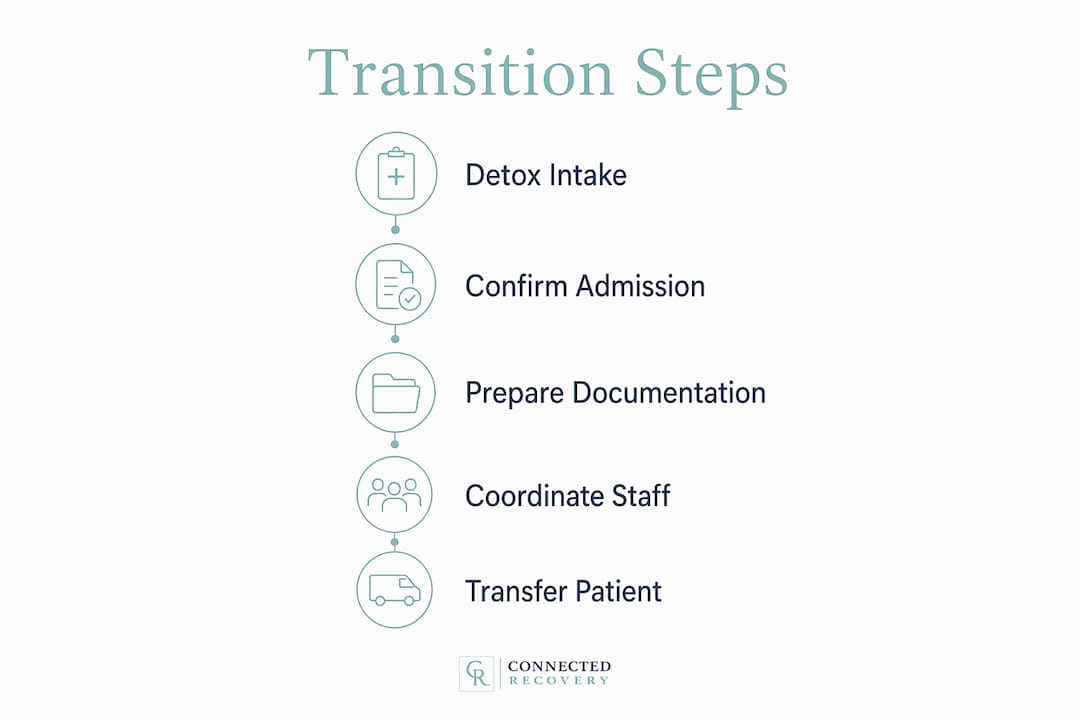
Medical prerequisites before discharge
Your detox medical team must clear you before transfer. Clearance means withdrawal symptoms are stable, vital signs are within safe range, and any acute psychiatric symptoms are managed. This is not a formality. Alcohol and benzodiazepine withdrawal can cause seizures and delirium tremens, making medically supervised detox a non-negotiable first step before residential admission.
Administrative steps that cannot wait
- Medical records transfer: your full detox chart, medication list, and clinical notes must reach the residential facility before you arrive.
- Insurance authorization: residential care requires pre-authorization from most insurers. Start this process on day one of detox.
- Assessment scheduling: many residential programs require a clinical intake assessment. Schedule it during detox, not after discharge.
- Family communication: designate one family contact who stays in regular communication with both the detox team and the residential program.
Pro Tip: Families should ask at detox admission: "What does the transition to the next level of care look like, and is it confirmed before discharge?" That one question reveals whether the program has a real handoff plan.
How do you execute the step-by-step transition from detox to residential care?
The step-by-step process for moving from a detox facility to residential care follows a clear sequence. Each step depends on the one before it. Skipping any step creates gaps that raise relapse risk.
- Detox team arranges referral and confirms a residential bed. This happens during detox, not at the end. The clinical team identifies appropriate residential programs based on your diagnosis, insurance, and geographic needs.
- Transfer of detailed medical records to residential staff. The receiving facility needs your full detox chart: medications administered, withdrawal severity scores, psychiatric notes, and any co-occurring diagnoses.
- Clinical assessment by the residential program before admission. Most programs conduct a pre-admission interview or assessment. This can happen by phone or in person during the final days of detox.
- Admission process and psychological stabilization. On arrival, residential staff orient you to the program, review house rules, and begin emotional stabilization. The first 48 hours focus on settling in, not intensive therapy.
- Continuation or adjustment of Medication Assisted Treatment (MAT). If you were on MAT during detox, MAT continues seamlessly into residential care. Abrupt discontinuation at this stage is clinically unsafe and unnecessary.
| Transition approach | Advantages | Considerations |
|---|---|---|
| Same facility (detox and residential on-site) | No physical transfer, familiar staff, faster handoff | Fewer options, may not match all clinical needs |
| Different facilities | More program choices, specialized care available | Requires thorough record transfer and coordination |
Clinical staff coordination through thorough documentation and case management is what makes cross-facility transitions safe and effective. Location matters far less than the quality of the handoff.
Pro Tip: If you are moving to a different residential facility, request a direct phone call between your detox physician and the residential medical director before your transfer date. That conversation prevents medication errors and speeds up your intake.
What common challenges occur during the transition and how do you overcome them?
Logistical barriers are the most common reason transitions fail. Insurance delays, limited bed availability, and geographic preferences all create gaps between detox discharge and residential admission. These gaps are dangerous but preventable.
"Delays in transition often stem from insurance, bed availability, or logistics but can be mitigated by staying connected to professional support and safe environments." — RehabPulse, 2026
The most persistent misconception is that you must stay at the same facility for both detox and residential care. That is false. Patients do not need to remain at the same facility. Accurate transfer of records and medication history allows safe care across different facilities. Continuity of care is the clinical priority, not physical location.
- Insurance delays: Start the pre-authorization process on day one of detox. Ask the detox facility's case manager to handle this directly with your insurer.
- Bed availability: Identify two or three residential programs during detox, not just one. Having a backup option prevents a gap if your first choice has no open beds.
- Geographic preferences: Proximity to family can support recovery, but the quality of the residential program matters more than distance. Evaluate both.
- Emotional resistance: Many patients feel anxious about moving to a new environment after detox. This is normal. Residential staff are trained to manage this transition with care.
Families play a critical role here. Advocate loudly for a confirmed residential admission before your loved one is discharged. If the detox program cannot confirm placement, contact residential programs directly and loop in the detox case manager. Do not wait for the system to move on its own.
Pro Tip: If a gap in care is unavoidable, arrange daily check-ins with a counselor, sponsor, or recovery support specialist during the waiting period. Isolation during this window is the primary driver of relapse.
What does residential care after detox actually involve?
Residential treatment is where the real behavioral work of recovery begins. A standard residential program runs 28–90 days, depending on the severity of addiction, co-occurring mental health conditions, and individual progress. The setting is structured, supervised, and designed to remove you from the environments and triggers that sustained the addiction.
Detox focuses on medical stabilization. Residential care focuses on the psychological and social roots of substance use. These are different problems requiring different tools. Therapy modalities in residential programs typically include individual therapy, group therapy, family therapy, and structured relapse prevention programming. Cognitive Behavioral Therapy (CBT) and Dialectical Behavior Therapy (DBT) are among the most widely used evidence-based approaches.
Co-occurring mental health disorders, such as depression, anxiety, PTSD, and bipolar disorder, are addressed through dual diagnosis treatment. Treating both conditions simultaneously produces significantly better outcomes than treating addiction alone. Connected Recovery integrates dual diagnosis care directly into its residential program, which is a key differentiator from single-focus facilities.
- Individual therapy addresses personal trauma, triggers, and cognitive patterns driving substance use.
- Group therapy builds accountability, social skills, and peer support within a structured setting.
- Family therapy repairs relationships and educates loved ones on how to support recovery without enabling relapse.
- MAT continuation stabilizes brain chemistry while behavioral therapies build new coping skills.
- Discharge and aftercare planning begins early in residential care, not at the end.
Residential treatment is not a punishment or a last resort. It is the phase where recovery becomes sustainable. Patients who complete a full residential program and transition to outpatient care have substantially better long-term outcomes than those who stop after detox alone.
Key takeaways
The transition between detox and residential care, not the length of either phase alone, is the most critical factor in achieving lasting recovery from addiction.
| Point | Details |
|---|---|
| Time the transition right | Aim for a 0–24 hour gap between detox discharge and residential admission to minimize relapse risk. |
| Confirm placement before discharge | Secure a confirmed residential bed before detox ends to avoid the highest-risk recovery window. |
| Records transfer is non-negotiable | Full medical and clinical records must reach the residential facility before you arrive. |
| Location matters less than coordination | Safe transitions happen across different facilities when record sharing and communication are thorough. |
| MAT continues through the transition | Medication Assisted Treatment should not stop at detox discharge; it carries forward into residential care. |
What I've learned watching transitions succeed and fail
I have seen the same pattern repeat itself more times than I can count. A person completes detox, feels physically better, and decides they are ready to manage on their own. Two weeks later, they are back at square one. The problem was never willpower. The problem was the gap.
The transitions that succeed share one thing: someone made a phone call before discharge day. A case manager, a family member, a counselor, someone confirmed the bed, transferred the records, and made sure the patient walked from one door directly into another. That handoff is everything.
What surprises most families is how much they can influence this process. You do not have to wait for the system to act. Ask the question directly: "Is the next placement confirmed?" If the answer is vague, push harder. The detox team works for the patient, and a good team will welcome that advocacy.
The other thing I want families to understand is that moving to a different residential facility is not a setback. Some of the best outcomes I have seen came from patients who transferred across the country to find the right program. The clinical handoff, done properly, makes the location irrelevant. What matters is that the care continues without a break.
Recovery is not a single event. It is a sequence. Detox starts it. Residential care builds it. The transition between them is the hinge everything turns on. Protect that hinge.
— Jim
How Connected Recovery supports your move from detox to residential care
Connected Recovery, located in Van Nuys, CA, operates both medical detox and residential treatment programs under one roof, which eliminates the most common transition barrier: the gap between facilities. With a 12-bed capacity, every patient receives individualized attention from a clinical team that knows their full history from day one of detox through residential discharge.
Connected Recovery's integrated model includes 24/7 medical supervision, dual diagnosis treatment, Medication Assisted Treatment, and structured discharge planning. The admissions team coordinates insurance authorization, bed confirmation, and record transfers so that the transition happens on your timeline, not the system's. If you or someone you love is approaching the end of detox and needs a confirmed next step, contact Connected Recovery directly to begin the admissions process today.
FAQ
What is the ideal timeline to transition from detox to residential care?
The ideal transition happens within 0–24 hours of detox discharge. Any gap beyond 24 hours increases relapse risk during the highest-risk first 7 days post-detox.
Do you have to stay at the same facility for detox and residential treatment?
No. Patients can safely move from detox to residential care at a different facility. Thorough record transfer and medication history sharing make cross-facility transitions clinically safe.
What happens if there is a delay between detox and residential admission?
Stay connected to professional support daily during any gap. Isolation during this window is the primary driver of relapse, so daily contact with a counselor or recovery specialist is critical.
Does Medication Assisted Treatment stop after detox?
MAT does not stop at detox discharge. It continues into residential care when clinically appropriate, stabilizing patients while behavioral therapies build new coping skills.
What questions should families ask at detox intake?
Ask: "What does the transition to the next level of care look like, and is it confirmed before discharge?" This question reveals whether the program has a real handoff plan in place.