
Effective communication with detox facility staff is the single most important skill a family member or caregiver can develop during a loved one’s recovery. Detox is a medically supervised process involving nurses, physicians, counselors, and case managers who each hold different pieces of your loved one’s care plan. Knowing how to reach the right person, at the right time, with the right questions determines how much useful information you actually receive. This guide covers the contact methods, timing strategies, and conversation techniques that turn anxious check-ins into productive partnerships.
How to communicate with detox facility staff effectively
Detox facilities are staffed by multidisciplinary teams, and each role carries a distinct scope of responsibility. Understanding who does what is the first step toward getting the answers you need without frustrating the people providing care.
Here is a breakdown of the most common roles you will encounter:
-
Physicians and Medical Directors: They oversee the clinical detox protocol, prescribe medications, and make decisions about medical interventions. They are typically available during morning rounds and are not the right contact for emotional or logistical questions.
-
Registered Nurses (RNs): Nurses are your most accessible point of contact for day-to-day medical updates. They monitor vitals, administer medications, and observe withdrawal symptoms in real time.
-
Licensed Counselors: Counselors focus on the psychological side of recovery. They conduct individual and group therapy sessions and can speak to behavioral progress and emotional stability.
-
Case Managers: Case managers coordinate the logistics of treatment, including insurance, discharge planning, and referrals to aftercare programs. They are the right contact for questions about next steps and aftercare planning.
-
Admissions Coordinators: These staff members handle intake paperwork, consent forms, and initial family communication protocols. They are often the first person you speak with and can direct you to the right department.
Knowing this structure matters because asking a nurse about discharge timelines or asking a case manager about medication side effects wastes everyone’s time. Direct your questions to the person whose role actually covers that topic. This one adjustment alone will make your interactions noticeably more productive.
What are the best ways to contact detox staff?

Timing and method are as important as the content of your questions. Clinical teams operate on structured schedules, and interrupting the wrong moment can result in incomplete answers or no answer at all.
Follow these steps to maximize every interaction:
-
Learn the rounding schedule. Clinical teams review patient plans during scheduled rounds, most often in the mornings. Calling or visiting immediately after rounds gives you the most current information available.
-
Request a scheduled call. Rather than calling at random, ask the admissions coordinator or charge nurse to schedule a brief daily or every-other-day update call. This respects staff time and gives you a reliable window.
-
Use written messages when appropriate. Many facilities accept written questions through a patient portal or a message left with the charge nurse. Written questions give staff time to gather accurate answers rather than responding off the cuff.
-
Limit yourself to three focused questions per interaction. Experts recommend choosing three focused questions to get useful information without overwhelming the care team. More than three questions in one conversation often results in rushed, incomplete answers.
-
Designate one family point person. Facilities regularly deal with multiple family members calling separately and asking the same questions. A single family liaison reduces staff burden and keeps the information your family receives consistent.
Pro Tip: Write your three questions the night before any scheduled call. Prioritize them by urgency so that if time runs short, you have already covered what matters most.
The method you choose also signals your level of preparation to the staff. Families who call with organized, specific questions are taken more seriously and receive more thorough responses. That is not speculation. It is a pattern every experienced caregiver advocate recognizes.
How should you prepare for conversations with detox staff?
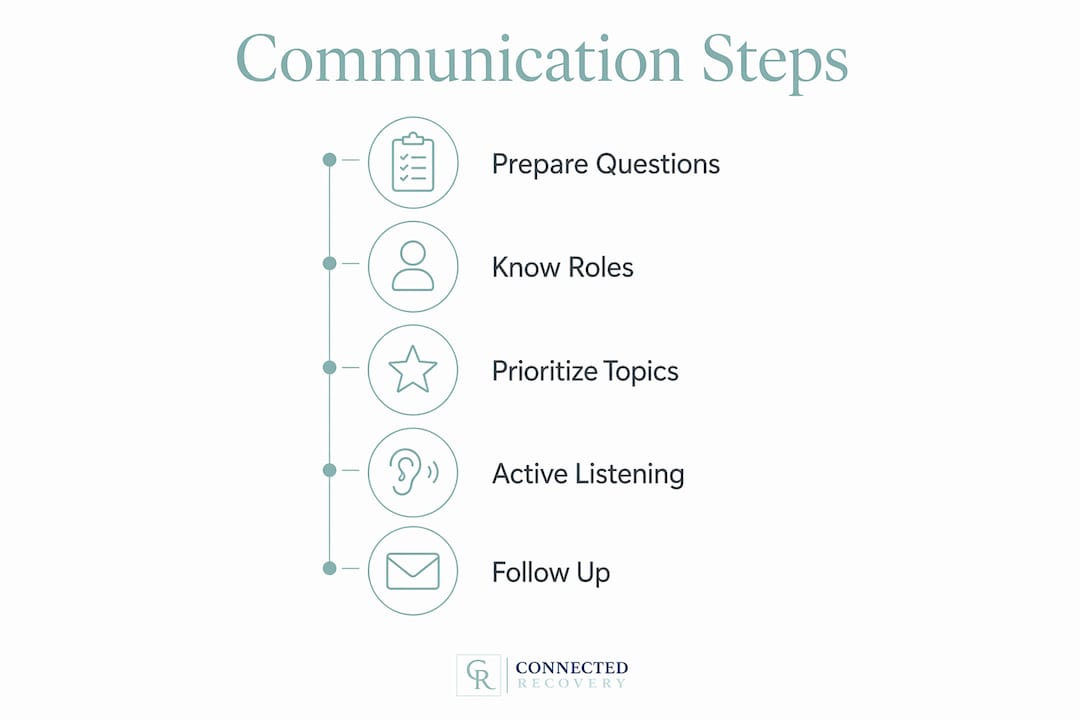
Preparation is what separates a productive five-minute call from a frustrating ten-minute one. The techniques below apply whether you are speaking with a nurse at the bedside or a case manager over the phone.
-
Write questions down in advance. Emotionally stressed family members frequently forget what they planned to ask once a conversation starts. A written list keeps you on track and signals to staff that you are organized and respectful of their time.
-
Use the teach-back method. After receiving any medical information, repeat it back in your own words to confirm you understood correctly. For example: “So what I’m hearing is that the medication taper will take five days, and we should expect some sleep disruption during that period. Is that right?” This technique catches misunderstandings before they become problems.
-
Take notes during every update. Emotionally stressed family members often struggle to retain details without written notes. Designate one person to take notes during calls so the family has an accurate record to reference later.
-
Maintain a calm, respectful tone throughout. This is not just courtesy. Hostile or anxious behavior from family members can cause staff to limit the information they share. A calm tone keeps the conversation collaborative rather than defensive.
Pro Tip: Ask one clarifying question at the end of every call: “Is there anything we should watch for or prepare for in the next 48 hours?” This question consistently surfaces information that staff might not volunteer on their own.
Effective communication is an active partnership requiring preparation, active listening, and a willingness to collaborate. Families who treat conversations as a two-way exchange rather than a one-sided information download consistently report better outcomes and stronger relationships with the care team.
What common communication challenges should you expect?
Even well-prepared families run into friction. Knowing what to expect reduces the chance that a difficult moment derails the entire relationship with the care team.
-
Information discrepancies between staff members. Hearing different details from a nurse and a physician is common. Information often hasn’t fully disseminated through a fast-paced clinical team yet. The fix is to ask who the best single source of truth is for a specific question, then direct that question to that person.
-
Emotional reactions that escalate conversations. Fear and grief are normal during a loved one’s detox. Acting on those emotions during a staff call, however, can damage the relationship. If you feel yourself becoming upset, it is acceptable to say, “I need a moment,” pause, and continue when you are steady.
-
Feeling dismissed or rushed. Staff are managing multiple patients simultaneously. If you feel a conversation was cut short, ask to schedule a longer follow-up rather than pressing for more time in the moment.
-
Conflicting information about discharge or next steps. Discharge timelines change frequently in detox settings. Rather than reacting to a single update, ask the case manager to confirm any timeline in writing or through a formal care conference.
Dr. Betsy Bennett notes that understanding provider constraints and motivations is the foundation of productive communication with medical teams. Staff who feel understood and respected are more likely to go beyond the minimum when answering your questions. Acknowledging their workload openly, with a simple statement like “I know you’re managing a lot of patients right now,” builds goodwill that pays off over the course of a treatment stay.
What resources help families communicate better with detox facilities?
Several tools and programs exist specifically to support families who need help engaging with treatment teams.
| Resource | Type | What It Offers |
|---|---|---|
| SAMHSA National Helpline (1-800-662-4357) | Hotline | Free, confidential, 24/7 referrals and treatment information |
| LA County Substance Abuse Helpline | Hotline | Local referrals and crisis support for Los Angeles County residents |
| Connectedrecoverycenter Family Program | Facility Program | Education, mediation, and family engagement during detox and residential treatment |
| Case Management Services | Facility Service | Coordinated communication between families and the clinical team |
| Patient Portals | Digital Tool | Secure messaging and document sharing with the care team |
The SAMHSA National Helpline and LA County helpline both offer 24/7 free confidential support and referrals to treatment centers. These lines are not just for crisis moments. They can help you understand what questions to ask a facility before or during admission.
Connectedrecoverycenter’s family program provides structured education and mediation that helps families stay engaged with treatment plans without overwhelming the clinical team. Facilities that offer formal family programs produce better communication outcomes because the process is built into the treatment model rather than left to chance. Case management services take this further by assigning a dedicated coordinator who acts as the primary communication channel between your family and the rest of the care team.
What i’ve learned about talking to detox staff after years in recovery support
The advice I give families most often is the advice they resist most: prepare fewer questions, not more. Every instinct tells you to gather as much information as possible, especially when someone you love is in a vulnerable state. But clinical staff respond better to focused, specific questions than to open-ended information requests. Three sharp questions will always outperform ten scattered ones.
The second thing I have seen make a consistent difference is the family liaison model. When one person coordinates all communication, the care team stops bracing for the next call. They start treating that person as a partner rather than a source of pressure. That shift in dynamic changes everything about the quality of information you receive.
The third observation is the one most people overlook. Acknowledging staff constraints openly, saying out loud that you recognize they are managing multiple patients and that you appreciate their time, is not just politeness. Acknowledging staff constraints builds trust and improves responsiveness during high-stress periods. Staff are human. They respond to being seen as people, not just service providers.
Finally, I recommend that families actively learn about the detox process itself. When you understand what a medication taper involves or why withdrawal symptoms peak at a certain point, your questions become more specific and your conversations become more productive. Knowledge is not just reassuring. It makes you a better advocate.
— Jim
How Connectedrecoverycenter supports family communication during detox
Connectedrecoverycenter is a boutique 12-bed facility in Van Nuys, CA, built specifically for the kind of close-contact communication that larger centers cannot offer. With 24/7 medical supervision and individualized treatment plans, the clinical team has the capacity to engage meaningfully with families rather than routing every call through a general intake line.
The facility’s medical detox program includes structured family communication as part of the treatment model. Case management services coordinate updates between the clinical team and a designated family contact, reducing confusion and keeping everyone aligned on the care plan. If you are ready to take the next step, the admissions team can walk you through communication protocols before your loved one even arrives. Reach out today to learn how Connectedrecoverycenter makes family engagement a built-in part of recovery.
Key takeaways
Effective communication with detox facility staff requires preparation, role awareness, and a calm, respectful approach that treats every interaction as a collaborative partnership.
| Point | Details |
|---|---|
| Know staff roles | Direct questions to the right person: nurses for medical updates, case managers for logistics. |
| Time your contact well | Call after morning rounds when clinical teams have the most current patient information. |
| Limit to three questions | Three focused questions per interaction produce more complete answers than open-ended conversations. |
| Use the teach-back method | Repeat medical information back in your own words to confirm accurate understanding. |
| Designate one family liaison | A single point of contact reduces staff burden and keeps family communication consistent. |
FAQ
What is the best time to call a detox facility for updates?
The best time to call is shortly after morning rounds, when clinical teams have reviewed patient plans and have the most current information available. Ask the charge nurse or admissions coordinator for the facility’s specific rounding schedule.
How do i ask detox facility questions without overwhelming staff?
Limit each interaction to three focused, prioritized questions. Write them down in advance and direct each question to the staff member whose role covers that topic.
Can family members attend meetings with the treatment team?
Many detox facilities offer formal care conferences or family therapy sessions where family members can meet directly with the treatment team. Ask the case manager about family program options available at your specific facility.
What should i do if i get conflicting information from different staff members?
Information discrepancies are common in fast-paced clinical environments because updates do not always reach every team member simultaneously. Ask the case manager or charge nurse to confirm the most current version of any plan in writing.
Is there a helpline i can call for guidance on communicating with a detox facility?
The SAMHSA National Helpline at 1-800-662-4357 provides free, confidential, 24/7 support and can help you understand what questions to ask a treatment facility before or during admission.