
Yes. FMLA can cover substance use disorder treatment when it meets the legal test for a "serious health condition," and inpatient rehab almost always does. Under the Family and Medical Leave Act, eligible employees get up to 12 workweeks of unpaid, job-protected leave, and your employer has to keep your group health coverage active the whole time. The catch: the treatment has to come from a healthcare provider or someone you were referred to by one. 29 CFR § 825.119 spells out that distinction, and it matters. Short-term disability is a separate benefit entirely, one that can replace lost income while FMLA protects your job.
Key Takeaways
FMLA protects your job for up to 12 weeks of substance use disorder treatment by a healthcare provider, but it pays nothing, so pairing it with short-term disability and proper documentation determines whether treatment is financially and professionally survivable.
| Point | Details |
|---|---|
| Treatment must come from a provider | FMLA covers care by a health care provider or someone referred by one, not absence for active substance use. |
| Meet the eligibility tests first | You need a covered employer, 12 months of tenure, and 1,250 hours worked before FMLA applies. |
| FMLA is unpaid; plan separately | Short-term disability can replace 50 to 70 percent of wages while FMLA protects your position. |
| Documentation timing prevents disputes | Get admission letters and certification forms submitted early to avoid denial or delayed designation. |
| Connected Recovery streamlines certification | Its Van Nuys facility issues admission and discharge paperwork built to satisfy employer FMLA requirements directly. |
Table of Contents
- Does FMLA for Rehab Cover Substance Use Disorder Treatment?
- Who Qualifies for FMLA Leave for Rehab?
- What Types of Rehab Treatment Does FMLA Cover?
- How to Apply for FMLA for Rehab
- Is FMLA Leave for Rehab Paid or Unpaid?
- Can You Be Fired While on FMLA for Rehab?
- A Practical Checklist Before You Request FMLA for Rehab
- How State Family and Medical Leave Laws Interact With FMLA
- Common Problems People Run Into With FMLA for Rehab
- What Happens to Your Benefits Beyond Health Insurance During FMLA?
- How Employers Can Support a Successful Return to Work
- Editorial Take: What the Rulebook Doesn't Tell You
- Getting FMLA-Ready Care Without the Runaround
- Sources
Does FMLA for Rehab Cover Substance Use Disorder Treatment?
FMLA defines a "serious health condition" as inpatient care or continuing treatment by a health care provider, and substance use disorder treatment fits both categories when it's handled correctly. The DOL's FMLA fact sheet treats a hospital stay, hospice stay, or residential medical care facility admission as inpatient care outright. Continuing treatment covers things like ongoing outpatient counseling or a multi-visit treatment plan.
Here's where people get tripped up: FMLA protects time off for treatment, not time off because of substance use itself. Missing work because you're actively using does not qualify. Missing work because you checked into a program does, according to the elaws FMLA Advisor. That line, treatment versus use, is the entire legal foundation of this benefit, and it's why documentation from a real provider matters so much.
Who Qualifies for FMLA Leave for Rehab?
FMLA only applies if your employer is covered and you meet the employee eligibility tests. Employers must have 50 or more employees within 75 miles of your worksite. You need 12 months of employment (not necessarily consecutive) and at least 1,250 hours worked in the past year, roughly 24 hours a week on average.
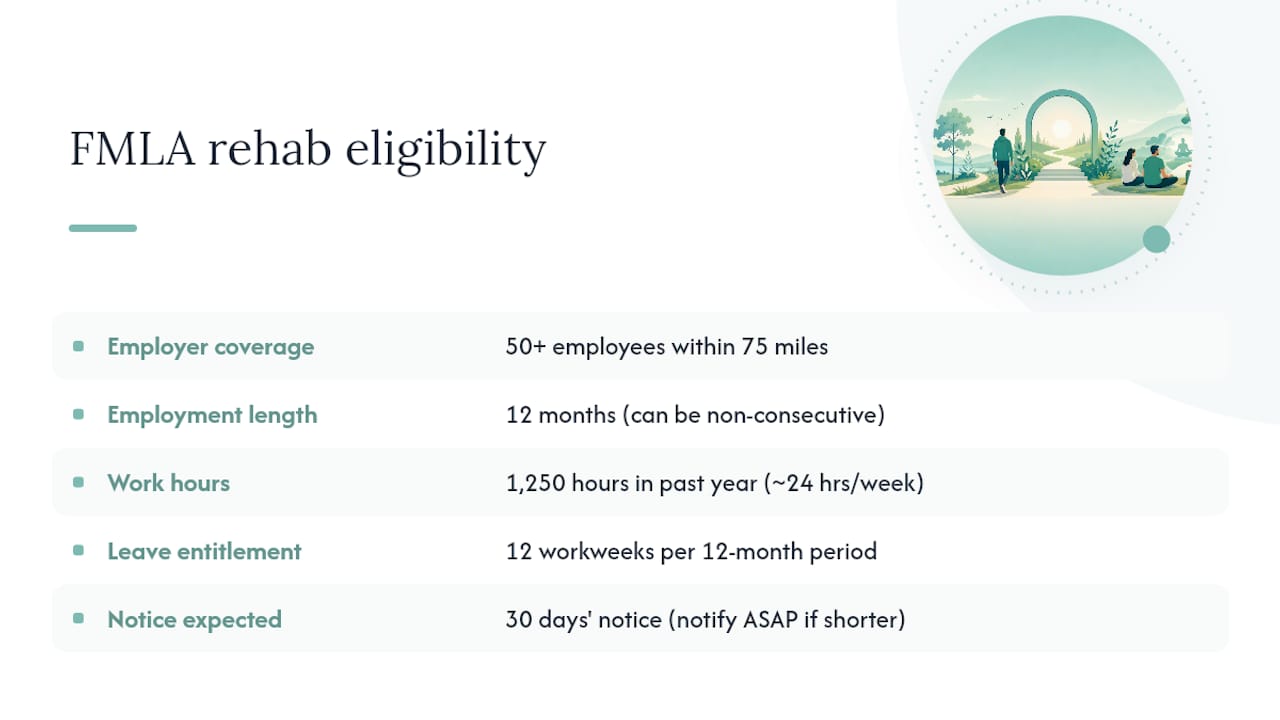
Meet those thresholds and you're entitled to 12 workweeks of leave in a 12-month period, per DOL Fact Sheet #28F. That leave doesn't have to be used in one continuous block. Intermittent leave lets you attend outpatient sessions or step down from residential care in stages rather than burning the entire 12 weeks at once, according to the DOL's FMLA FAQ.
If you can see the need coming, and most rehab admissions are planned, you're expected to give your employer 30 days' notice. If treatment starts on shorter notice, notify HR as soon as it's practicable, even if that's the same day.
What Types of Rehab Treatment Does FMLA Cover?
Inpatient and residential treatment almost always satisfy the "inpatient care" definition when a doctor or licensed provider determines it's medically necessary. That includes medical detox, residential programs like the kind Connected Recovery runs in Van Nuys, and hospital-based stabilization.

Outpatient treatment qualifies too, under the "continuing treatment" standard, when it involves a real course of care: an intake assessment, a treatment plan, and follow-up visits with a licensed provider. A single ER visit with no follow-up generally won't cut it.
The referral piece confuses a lot of people. FMLA extends coverage to a "provider of health care services on referral by a health care provider," per the elaws Advisor. In plain terms: if your doctor refers you to a licensed addiction counselor or a specific treatment program, that counselor's or program's care counts, even though they're not the one who wrote the referral. This is exactly how most people access individualized residential care in practice.
How to Apply for FMLA for Rehab
Requesting FMLA for rehab comes down to timing and paperwork. Here's the sequence that avoids denials:
- Get documentation from your provider first. An admission letter, anticipated length of stay, and diagnosis language that ties to a serious health condition. This becomes the backbone of your certification.
- Notify HR 30 days ahead if you can. If treatment is urgent, notify them as soon as practicable, even verbally, followed by written confirmation.
- Request the FMLA certification form (often WH-380E) and get it to your provider quickly. The DOL's FAQ page covers what's required if your employer's forms differ from federal ones.
- Submit the completed certification within the 15 calendar days your employer typically allows.
- Keep copies of everything. Every form, every email, every date stamp.
Pro Tip: Ask HR in writing whether they intend to designate the leave as FMLA before you leave for treatment, not after. Getting that confirmation in writing protects you if there's ever a dispute about whether your job was actually protected during your absence.
You can also ask HR about running paid leave concurrently with FMLA (more on that below), and it's reasonable to request that your medical certification be handled by whoever in HR manages confidential records, not your direct manager.
Is FMLA Leave for Rehab Paid or Unpaid?
FMLA itself is unpaid. What it guarantees is your job and your group health insurance, not your paycheck. That's the part people misunderstand most often.
Short-term disability for rehab is a completely separate benefit, and it's the piece that actually replaces income. STD plans commonly pay 50 to 70 percent of wages, though the exact percentage and duration depend entirely on your employer's plan or your private policy. Whether short term disability covers rehab at all depends on how the plan defines a qualifying condition, so check your plan documents or call your insurer before you assume anything.
Employers are also allowed to require you to use accrued paid leave, vacation days or sick time, concurrently with FMLA rather than stacking one after the other. If you have PTO saved up, this is often your best option for actually getting paid while you're out. Ask HR directly which paid leave categories apply and whether insurance coverage for detox affects your out-of-pocket costs during that window.
Can You Be Fired While on FMLA for Rehab?
FMLA guarantees reinstatement to the same or an equivalent position once your leave ends, with equivalent pay, benefits, and responsibilities. That protection is real, but it has limits people often overlook.
Your employer can still enforce a legitimate, non-discriminatory substance-use policy. If your company has a documented policy that a positive drug test or a specific conduct violation results in termination, and that policy applies equally to everyone, FMLA doesn't shield you from it. What it does prohibit is firing you because you requested or used FMLA leave. The regulatory text draws that line clearly: treatment is protected, workplace policy violations are not automatically excused.
On privacy, your medical certification should go to HR or a designated leave administrator, not circulate through your management chain. Details about your diagnosis or treatment type generally shouldn't reach your supervisor. If you're worried about how a program appears on your record, confidentiality protections in addiction treatment explain how that information stays contained even after you return to work.
A Practical Checklist Before You Request FMLA for Rehab
Getting FMLA approved smoothly usually comes down to having the right paperwork ready before you talk to HR. A short list handles most of what's needed:
- Written medical certification naming your condition and expected treatment duration
- An admission letter from the treatment center with anticipated dates
- HR contact information and your company's leave policy document
- A short-term disability claim started in parallel, if your plan offers one
- A payment or financing plan if insurance doesn't cover the full stay
- An aftercare or step-down plan for your return date
Most accredited treatment centers, including residential programs in Van Nuys, routinely issue admission letters and discharge summaries built specifically to satisfy employer certification requests. Ask for these documents on day one of intake rather than waiting until HR asks twice.
Pro Tip: Request your admission and anticipated discharge letter before your certification deadline, not after. Certifications that arrive late are one of the most common reasons FMLA designations get delayed or denied.
How State Family and Medical Leave Laws Interact With FMLA
FMLA sets a federal floor, not a ceiling. A growing number of states, including California, New Jersey, New York, and Washington, run their own paid family and medical leave programs that can run alongside FMLA or extend beyond it.
California's situation matters most for readers here, since Connected Recovery operates in Van Nuys. California Family Rights Act (CFRA) leave often mirrors FMLA's 12-week structure but applies to smaller employers, those with just five or more employees rather than the federal 50-employee threshold. That means someone who doesn't qualify for federal FMLA at a smaller company might still have job protection under CFRA. California also runs State Disability Insurance (SDI), which functions similarly to short-term disability and can provide wage replacement while CFRA protects your job.
When federal and state leave laws overlap and cover the same absence, they generally run concurrently rather than stacking to give you extra total weeks off. But when only one applies, say, you work for a company too small for federal FMLA but big enough for CFRA, the state law becomes your only protection, and it's worth knowing that before assuming you have no options.
The practical move is to ask HR directly which laws apply to your specific employer and how leave is being designated. Don't assume your state offers nothing just because FMLA is the more commonly discussed option. Some state programs also offer paid benefits that FMLA never provides, which can change your entire financial plan for treatment.
Common Problems People Run Into With FMLA for Rehab
The single biggest dispute point is timing. Employees sometimes wait until they're mid-crisis to request leave, and by then documentation is thin, HR is confused, and the 30-day notice window has already been missed. Employers can't deny leave just because notice wasn't perfect when the need was genuinely unforeseeable, but a paper trail showing you notified them "as soon as practicable" protects you if there's ever a challenge.
A second recurring issue: certification pushback. Some employers request more detail than a treatment provider is comfortable sharing, or the certification form comes back vague and gets rejected. If your employer says a certification is incomplete, you get seven calendar days to fix it, they can't simply deny leave outright without giving you that chance, under DOL guidance.
A third problem shows up around intermittent leave for outpatient care. Employers can require you to schedule treatment sessions in a way that minimizes workplace disruption, and disputes happen when employees assume their preferred schedule is guaranteed. It usually isn't, though your provider's medical necessity generally takes precedence over pure convenience.
Finally, some employees discover mid-leave that their employer never formally designated the time as FMLA, leaving them unprotected without realizing it. That's exactly why getting written confirmation of your leave designation before you start treatment isn't just a nice-to-have. It's the single easiest way to prevent a dispute from happening in the first place.
What Happens to Your Benefits Beyond Health Insurance During FMLA?
Group health insurance gets the most attention because FMLA explicitly requires employers to maintain it. Other benefits get murkier, and this is where people are frequently surprised.
Retirement plan contributions, 401(k) matching in particular, are not required to continue accruing during unpaid FMLA leave the same way health coverage does. If you're not receiving a paycheck, there's often no salary to defer or match against, so contributions typically pause until you return. Some employers structure this differently, so it's worth asking HR directly rather than assuming your 401(k) match keeps running.
Seniority-based benefits, like vacation accrual rate increases or eligibility for certain bonuses tied to continuous active service, can also be affected depending on your employer's specific policy. FMLA guarantees you don't lose seniority you'd already earned before your leave started, but it doesn't guarantee you keep accruing every benefit at the same pace while you're out.
Stock vesting schedules, if your compensation includes equity, are another area where FMLA leave can create gaps. Some vesting schedules pause during extended unpaid leave, others don't, and this detail lives entirely in your specific equity agreement rather than in federal law.
The takeaway is simple: don't assume every benefit you had before rehab keeps running exactly as it did. Ask HR for a written summary of exactly which benefits continue, which pause, and which resume automatically when you return. That one conversation prevents most of the financial surprises people report after coming back from treatment.
How Employers Can Support a Successful Return to Work
Employers who handle this well tend to do a few specific things differently than those who don't. The goal isn't just legal compliance, it's making sure a returning employee actually succeeds rather than relapsing into the same pressures that contributed to the problem.
Clear, low-friction communication during leave matters more than most managers realize. A single HR contact person, rather than a rotating cast of people asking for updates, keeps the process from feeling like surveillance. Employers should also confirm in writing, before the employee leaves, exactly what "equivalent position" means for their return, since ambiguity here creates anxiety during treatment that has nothing to do with recovery itself.
A phased return, even a partial week schedule for the first two weeks back, tends to produce better outcomes than dropping someone back into a full caseload on day one. This is also where intermittent FMLA can help: outpatient follow-up sessions can continue on a protected schedule even after the employee is technically back at work.
Training managers to avoid asking about diagnosis details, and routing all medical documentation through HR rather than direct supervisors, protects both the employee's privacy and the company from liability. Finally, connecting returning employees with an aftercare planning resource before their last day of treatment, rather than after they're already back at their desk, tends to produce far better long-term retention than leaving that step to chance.
Editorial Take: What the Rulebook Doesn't Tell You
Most FMLA explainers stop at eligibility math: 50 employees, 1,250 hours, 12 weeks. That's the easy part. The part nobody prepares people for is the gap between what the law promises and what actually happens inside an HR department that's never processed a rehab request before.
The conventional advice, "just get a doctor's note," undersells how much friction shows up around certification language and referral documentation. I'd argue the single highest leverage move isn't legal knowledge at all. It's requesting your admission and discharge paperwork from the treatment provider before you ever walk into HR's office. A clinic that already knows how to write certification language employers accept saves you weeks of back and forth during the exact moment you have the least capacity to fight bureaucracy.
The other blind spot: people treat FMLA and short-term disability as the same conversation. They're not. One protects your job. The other protects your paycheck. Ignoring either one because you're focused on the other is the most common and most avoidable mistake I see in how people plan for treatment leave.
— Jim
Getting FMLA-Ready Care Without the Runaround
Connected Recovery is built for exactly the situation this article describes: someone who needs their employer to see clean, credible documentation, fast, so treatment can start without a paperwork standoff. As a 12-bed facility in Van Nuys, Connected Recovery keeps the admission process personal enough that you're not waiting in a queue behind dozens of other intakes to get the letter your HR department needs.
The clinical team issues admission letters, anticipated treatment timelines, and discharge summaries as a standard part of intake, the exact documents your FMLA certification depends on. Combined with 24/7 medical supervision and integrated care for co-occurring mental health conditions, you're not stitching together separate providers while also trying to satisfy an employer's paperwork deadline. If you're weighing medical detox or a full residential treatment stay, reach out to Connected Recovery's admissions team now to get your documentation timeline mapped out before you give HR your 30-day notice.
Sources
For direct verification, consult the DOL's FMLA fact sheet, 29 CFR § 825.119, the elaws FMLA Advisor, and SAMHSA's treatment data.
This article is general information, not a substitute for advice from a qualified doctor. Consult a qualified healthcare professional about your own circumstances before acting on anything here.
- Fact Sheet #28F: The Family and Medical Leave Act
- elaws - Family and Medical Leave Act Advisor: Serious Health Condition - Leave for Treatment of Substance Abuse
- 29 CFR § 825.119 - Leave for treatment of substance abuse
Recommended
- HIPAA Protections in Rehab Programs: Your Rights Explained | Connected Recovery Inc.
- Smoking in Rehab: What U.S. Policies Actually Allow | Connected Recovery Inc.
- Steps to Emergency Rehab Admission: Act Fast, Get Help | Connected Recovery Inc.
- How Rehab Protects Your Professional Reputation | Connected Recovery Inc.