
Cross addiction means that while you are recovering from one substance or behavior, another one starts to take its place or runs alongside it. It is a real risk, but it is not the inevitable outcome of getting sober, and it is most manageable when the whole picture is treated together: the substances, the mental health symptoms underneath them, and the daily routines that hold recovery up. That integrated approach is how we think about care at Connected Recovery, a 12-bed residential and detox facility in Van Nuys, Los Angeles. This guide explains the term in plain language, what research says about how common it is, which signs matter, and what to do if you notice a shift in yourself or someone you love.
TL;DR
- Cross addiction is when addiction to one substance is linked to addiction to others, either as a replacement after use of the first drops or as several addictions at once.
- Large U.S. data show that people whose substance use disorder went into remission were less than half as likely to develop a new one as people whose disorder continued. Recovery does not usually cause substitution.
- Risk rises with untreated mental health conditions, early-onset substance use, and a lack of coping skills, so treating both sides together matters.
- A slip or a new habit is a signal to adjust the plan, not a verdict. Acting early with your treatment team works better than waiting.
- Withdrawal, overdose, or thoughts of suicide are emergencies: call 911 or call or text 988.
Table of Contents
- What cross addiction actually means
- How common is it, really?
- Who is more likely to be affected
- Common patterns in early recovery
- Warning signs worth acting on
- Lowering the risk: what a recovery plan should include
- When a slip happens
- When to get urgent help
- Our perspective
- How Connected Recovery can help
- FAQ
- Sources
What cross addiction actually means
The term gets used loosely, so it helps to pin it down. SAMHSA, the federal agency for behavioral health, describes cross-addiction as addiction to one substance linked with addiction to others. That includes using more of a second substance with similar effects when use of the first falls, and it includes being addicted to more than one substance at the same time.
Two neighboring terms are easy to confuse with it:
- Cross-dependence is the pharmacological version. The American Psychiatric Association's dictionary defines it as one substance relieving the withdrawal from another with similar effects. It also lists simultaneous dependence on several substances as a meaning, which is what many people call cross-addiction.
- A co-occurring disorder is a different thing: a substance use disorder and a mental health condition, such as depression, anxiety or PTSD, present together. SAMHSA's guidance on co-occurring disorders treats this as its own category, separate from the pattern of moving between substances.
The two often travel together, though. When anxiety or trauma is driving the first addiction and nothing addresses it, the mind looks for another way to quiet it. That is why the mental health side belongs in any conversation about cross addiction.
One more distinction matters. Physical dependence and tolerance are not the same as addiction. SAMHSA warns that treating them as interchangeable can lead to misdiagnosis, including in people who take opioids for chronic pain under medical care. A person can be dependent on a prescribed medication without having an addiction, so the label should come from an assessment, not a guess.
How common is it, really?
Popular articles often present cross addiction as almost certain. The research is more nuanced, and knowing it can lower the fear without lowering your guard.
A nationally representative U.S. study in JAMA Psychiatry followed 34,653 adults interviewed three years apart. New substance use disorders appeared in 13.1% of people whose disorder had remitted, compared with 27.2% of those whose had not. The authors concluded that remission was linked to less than half the risk, which challenges the assumption that getting well typically pushes people into a new addiction.
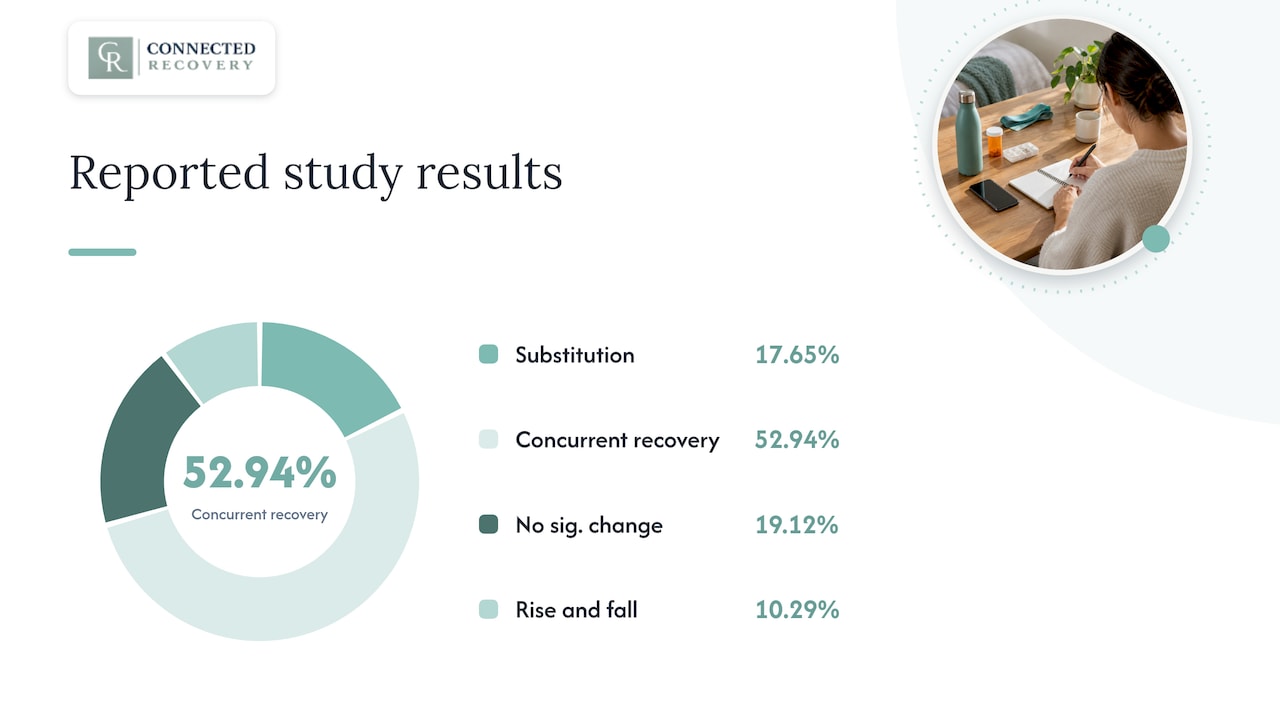
A 2021 systematic review of 96 studies found mixed results. Of the studies reporting statistics, 17.65% supported substitution, 52.94% supported concurrent recovery (improvement across substances together), 19.12% found no significant change, and 10.29% found both increases and decreases. Substances most often reported included opioids, cannabis, nicotine, alcohol, cocaine and gambling. A separate scoping review of 63 studies found the idea of substitute addiction itself is defined inconsistently, and identified two possible forms: long-term replacement and temporary replacement.
What this means for you: substitution is one possible path, not the default one. Many people recover across the board. Still, one in eight remitters in the large study did develop a new disorder, which is enough reason to plan for it.
Who is more likely to be affected
The same JAMA Psychiatry study found that male sex, younger age, never being married, earlier onset of substance use, and psychiatric comorbidity were associated with higher odds of a new disorder during follow-up. SAMHSA's guidance likewise names genetic, psychological and environmental factors as addiction risks, with mental illness and early substance use among them.
In practice, the risk factor you can most change is the one nobody is looking at. An untreated anxiety disorder, depression, or trauma history leaves the original reason for using in place. Our pages on anxiety and addiction treatment and on why treating schizophrenia and addiction together matters walk through how that overlap works.
Common patterns in early recovery
Cross addiction does not always involve another drug. Several patterns come up repeatedly.
A similar substance. Someone stops one opioid, depressant or stimulant and increases another with comparable effects. This is the textbook case described in SAMHSA's definition.
Cannabis, nicotine and alcohol. These are socially accepted or legal in many places, so they can feel like a harmless middle ground. In a small 2024 U.S. interview study, 14 adults in early recovery from opioid or stimulant addiction described using more cannabis to manage psychiatric symptoms, withdrawal or cravings, and boredom. They also reported side effects such as reduced productivity and social anxiety. A sample that small cannot tell us how common this is, but it shows why people reach for these substances and why the reasons deserve attention.
Food, exercise and body image. Eating disorders and substance use overlap often. SAMHSA's January 2026 advisory lists warning signs including preoccupation with food, weight or body image, restrictive dieting or fasting, food rituals and loss of control around food. It adds that rigid food or exercise routines, shame about eating and fluctuating weight should be monitored even before diagnostic criteria are met. Our article on eating disorders and substance use covers the overlap in more depth.
Gambling and other behaviors. Gambling disorder is the one behavioral addiction firmly recognized in the DSM-5, and internet gaming disorder sits in its research section. A 2018 review in the Annual Review of Clinical Psychology found the evidence for other proposed behavioral addictions inconclusive, and stressed that distress and impairment in daily life are what separate a disorder from a strong interest.
Warning signs worth acting on
A new habit is not automatically an addiction. Coffee, a workout routine or a new hobby can be part of a healthy recovery. The questions that matter are about the pattern, not the activity:
- Loss of control. Are you doing it more, or for longer, than you meant to?
- Harm. Is it affecting your sleep, health, money, work or relationships?
- Function. Are you using it to avoid a feeling, a craving or a memory rather than to enjoy something?
- Secrecy. Are you hiding it from your counselor, sponsor or family?
- Mood changes. Has anxiety, low mood or irritability grown alongside it?
SAMHSA's guidance points toward assessing the specific substance or behavior, the loss of control, the harms and any mental health symptoms instead of applying "cross addiction" as a standalone diagnosis. If two or three of the questions above ring true, bring it to a clinician who can do that assessment.
Lowering the risk: what a recovery plan should include
SAMHSA's guidance on stimulant use disorders advises identifying high-risk situations and early warning signs of a return to use, building coping and stress-management skills, and fostering balanced leisure. Translated into a working plan:
- Treat every condition at once. SAMHSA's 2026 advisory says people with co-occurring eating disorders and substance use disorders should be screened, identified and treated concurrently, because treating only one leaves room for switching between problem behaviors. The same logic applies to anxiety, depression, trauma and other mental health conditions.
- Name your high-risk situations. Late nights, certain people, pay day, conflict, boredom. Plan something specific for each.
- Build real leisure. Recovery goes better when free time has structure and meaning, not just empty hours.
- Keep support in the loop. Meetings, counseling and contact with a sponsor or case manager all give you a place to say "I have noticed something."
- Be honest about everything you take. Tell your care team about caffeine, nicotine, cannabis, supplements and prescriptions, not just the main substance.
If you live with chronic pain
Pain is a special case, because pain treatment can collide with recovery. SAMHSA notes that chronic pain and addiction both fluctuate and need ongoing management, and that treatment for one can support or conflict with treatment for the other. For adults with a substance use history, it recommends non-opioid pain relievers when appropriate, nonpharmacological care such as cognitive behavioral therapy and exercise, and treatment of related conditions. Opioids are advised only when the likely benefits outweigh the risks, and only while they are clearly helping. Reading up on non-opioid pain management options can help you prepare questions for your prescriber. Never stop or change a prescribed medication on your own: talk to the prescribing doctor first.
When a slip happens
A return to use, or a new behavior that worries you, is not proof that treatment failed. SAMHSA's guidance says a slip may indicate the treatment plan needs adjusting, and lists responses such as more mutual-help meetings, more counseling, contact with a sponsor, coping strategies and leisure activities. A practical sequence:
- Tell someone the same day: a counselor, sponsor, case manager or trusted family member.
- Describe what happened and what you were feeling beforehand, without editing it.
- Ask for the plan to be revisited, including whether an untreated mental health symptom is behind it.
- If the use is repeated, or you cannot stop, step up the level of care rather than waiting for it to resolve.
Our relapse prevention program is built around exactly this kind of early adjustment.
When to get urgent help
Some situations cannot wait for an appointment.
- Overdose, or someone who cannot be woken, is breathing slowly or has blue lips: call 911. If opioids are suspected and naloxone is available, give it while you wait for help.
- Thoughts of suicide or self-harm: call or text 988, the Suicide and Crisis Lifeline, or call 911 if there is immediate danger.
- Withdrawal with seizures, confusion, hallucinations, or severe agitation: treat it as an emergency and call 911. Alcohol and sedative withdrawal in particular can become dangerous without medical care.
- A planned stop after heavy or long-term use: do not quit alone. Withdrawal can be unpredictable, especially when more than one substance is involved. Medical supervision is the safe route.
That last point is where families often call us. Detox that is supervised around the clock lets the body stabilize while clinicians watch for complications. Our articles on what clinicians check during detox monitoring and on safe withdrawal from several substances at once explain what that looks like.
Our perspective
Cross addiction worries people because it makes recovery sound like a game of whack-a-mole. In our experience of how care should be built, it usually points to something simpler: the original reason for using was never fully treated.
That is why we keep Connected Recovery small, with 12 beds. A small house means the people caring for you can know you well enough to notice when something shifts, whether that is a new craving, a change in sleep, or a sudden new habit. We treat substance use and co-occurring mental health conditions together, with 24/7 medical supervision, a plan tailored to each person, and recovery planning that runs from detox through aftercare.
If you take one thing from this article, let it be this: a new pattern is information. Bring it to your team early, and let the plan change with you.
Jim
How Connected Recovery can help
If you or someone you love is stopping one substance while worried about another, or is facing addiction and anxiety, depression or trauma at the same time, our team in Van Nuys can start with medically supervised detox and continue into residential treatment. Our dual diagnosis treatment addresses substance use and mental health conditions together, and our aftercare planning is designed to carry the plan beyond discharge. To ask about admission, visit our main site.
Medication-assisted treatment is also part of what we offer, for people for whom it fits their recovery plan; you can read about MAT here.
FAQ
Is cross addiction the same as substituting one drug for another?
Substitution is one form of it. Cross addiction also covers being addicted to several substances at once. Research shows substitution is only one of several patterns, and many people improve across substances together.
Is cross addiction the same as a co-occurring disorder?
No. A co-occurring disorder is a substance use disorder together with a mental health condition. Cross addiction is about moving between or combining substances or behaviors. The two often overlap, which is why treating both together is so important.
Does getting sober make a new addiction likely?
Not usually. In a large U.S. study, people in remission were less than half as likely to develop a new substance use disorder as people whose disorder continued. Risk is higher with untreated mental health conditions and early-onset use, so a plan that covers those matters.
What should I do if I notice a new habit getting out of hand?
Tell your counselor, sponsor or care team promptly and describe how often it happens, what it costs you and what you feel before it. That allows your plan to be adjusted early. If you cannot stop, or feel unsafe, seek help right away, and call 988 or 911 in a crisis.
Sources
- SAMHSA TIP 54: Managing Chronic Pain in Adults With or in Recovery From Substance Use Disorders
- APA Dictionary of Psychology: cross-dependence
- SAMHSA: Substance Use Disorder Treatment for People With Co-Occurring Disorders
- JAMA Psychiatry study: Testing the drug substitution switching-addictions hypothesis
- A systematic review of addiction substitution in recovery
- Substitute Addictions in Persons with Substance Use Disorders: scoping review
- Cannabis use in early recovery: qualitative study, 2024
- SAMHSA advisory: Evidence-Based Care for Clients With Co-Occurring Substance Use and Eating Disorders
- Behavioral Addictions as Mental Disorders: To Be or Not To Be?
- SAMHSA treatment guidance for stimulant use disorders
- Non-opioid pain management options