
Cognitive behavioral therapy works in addiction rehab, but not the way most marketing copy implies. CBT does not cure addiction on its own. It teaches skills, primarily around triggers, urges, and relapse prevention, that people carry with them long after formal treatment ends.
TL;DR:
- CBT yields the strongest results in the first few months after treatment, with effects diminishing by around eight months if not reinforced.
- Most addiction-focused CBT programs involve 8 to 16 sessions emphasizing skills practice, trigger mapping, and homework adherence for better outcomes.
- Integrating CBT with medication-assisted treatment, mental health care, or contingency management improves early engagement and long-term success.
- Therapist certification in addiction-specific CBT and ongoing supervision significantly impact treatment quality and effectiveness.
- Residential and supervised outpatient settings, including computerized programs, offer safer environments for practicing coping skills and reducing relapse risk.
Table of Contents
- What the Evidence Says About CBT for Substance Use Disorders
- Core CBT Components Used in Addiction Rehab
- How CBT Is Delivered in Rehab: Residential, Outpatient, and Computerized Options
- What Are the Best CBT Techniques for Cravings and High-Risk Moments?
- What to Expect From a CBT-Based Rehab Program and Realistic Outcomes
- Does CBT Work Differently for Alcohol, Opioids, and Stimulants?
- How Does CBT Address Co-Occurring Mental Health Disorders?
- What Training Do Therapists Need to Deliver CBT for Addiction?
- A Clinician's View on Practical CBT in Rehab
- Getting Started With CBT-Based Treatment at Connected Recovery
- Sources
- FAQ
What the Evidence Says About CBT for Substance Use Disorders
CBT has more research behind it than almost any other behavioral treatment for substance use disorders, and the numbers are specific enough to be useful. A systematic review applying the Society of Clinical Psychology's criteria for empirically supported treatments found CBT produces outcomes better than minimal or no treatment.
The effect size in plain terms: Compared with people who get little or no structured treatment, those in CBT report meaningfully less substance use, especially in the months right after treatment. Compared with other active therapies, like motivational interviewing or contingency management, CBT often performs about the same rather than better.
That second point matters more than it sounds. A meta-analysis of CBT for alcohol and other drug use disorders found small or non-significant effects when CBT went head-to-head against other active treatments, and effects at early follow-up, one to six months, were consistently larger than those measured at eight months or beyond. In other words, CBT gets people moving in the right direction fast, but the gains can fade without reinforcement.
The evidence base is strongest for alcohol, cocaine, and cannabis use disorders, somewhat thinner and more mixed for opioid use disorder when CBT stands alone. Researchers also flag real heterogeneity across studies, meaning therapist skill, session dose, and client motivation all shift outcomes in ways a single average effect size cannot capture.
Core CBT Components Used in Addiction Rehab
Every credible CBT program for substance use builds on three pillars, and clinical manuals like the NCBI Bookshelf's brief CBT guide describe them consistently across settings.
Functional analysis comes first. A therapist and client map out the exact chain: what triggered the urge, what thoughts and feelings followed, what behavior resulted, and what consequence reinforced the pattern. This is not abstract reflection. It is detective work on a person's own history, usually written out session by session.
Coping skills training builds on that map. Sessions target:
- Urge management and tolerance for discomfort without acting on it
- Drink and drug refusal skills, rehearsed through role-play
- Emotion regulation for anger, boredom, and anxiety that commonly precede use
- Problem-solving frameworks for the practical stressors that trigger relapse
Relapse prevention draws heavily on Alan Marlatt's original model, particularly the idea of Apparently Irrelevant Decisions, small choices that seem harmless but quietly chain toward risk, and the abstinence violation effect, where one lapse spirals into a full relapse because the person interprets it as total failure. Good CBT explicitly reframes a lapse as data, not defeat.
Homework ties it together. Clinical overviews consistently link homework compliance to stronger, more durable outcomes.
Pro Tip: Ask your therapist to write your functional analysis down on paper, not just discuss it verbally. Reviewing your own trigger chain in your own handwriting makes the pattern harder to rationalize away later.
How CBT Is Delivered in Rehab: Residential, Outpatient, and Computerized Options
The setting shapes how much CBT can actually stick.
- Residential and detox settings offer more supervised practice time and a controlled environment where cravings can be worked through safely, often alongside medical monitoring for withdrawal.
- Outpatient programs typically run 8 to 12 weeks, with weekly sessions and homework assigned between visits, requiring more self-direction since the client faces real-world triggers daily.
- Computerized CBT, such as CBT4CBT, has shown genuine efficacy as an adjunct to standard outpatient treatment, and in some trials, as a virtual stand-alone option with light clinical monitoring, improving both abstinence rates and the quality of coping skills learned.
- Integration with other treatments matters at every level. CBT paired with medication-assisted treatment, motivational interviewing, or contingency management tends to improve early engagement and retention more than CBT alone.
A residential structure typically front-loads practice and safety; outpatient CBT asks a person to apply new skills against live triggers almost immediately, which is harder but also closer to real recovery conditions.
What Are the Best CBT Techniques for Cravings and High-Risk Moments?
Cravings peak and fall, usually within 20 to 30 minutes, and CBT gives you specific moves for that window rather than vague willpower advice.
- Urge surf. Notice the physical sensations of the craving, the tightness, the restlessness, without judging them or acting on them. Treat the urge like a wave: it builds, peaks, and recedes on its own.
- Use the delay rule. Commit to waiting 30 minutes before acting on any urge. Keep a short list of distractions ready, a walk, a phone call, a specific playlist, so the delay isn't just empty willpower.
- Substitute the behavior. Replace the ritual around use, not just the substance. If evenings are the trigger, schedule something concrete in that slot: a gym session, a meeting, a call to a sponsor.
- Rehearse refusal out loud. Role-play saying no to a specific person in a specific scenario during your session, not just in your head. Awkward rehearsal beats a blank mind in the actual moment.
- Keep a craving journal. Log the trigger, intensity on a 1 to 10 scale, and what you did. Patterns show up fast once it's on paper.
Pro Tip: Write your distraction menu down before a craving hits, not during one. Decision fatigue in the moment is exactly what CBT is designed to route around.
What to Expect From a CBT-Based Rehab Program and Realistic Outcomes
Most CBT-based programs run 8 to 16 sessions, structured around skills practice, trigger review, and weekly planning rather than open-ended talk therapy. Session count varies by setting and severity, but the short, skills-focused format is deliberate. It matches how the evidence base was built and tested.
Progress gets tracked concretely: frequency of use, quantity per use, and weeks of continuous abstinence, not just self-reported mood. Homework adherence is one of the strongest predictors clinicians watch, since structured practice outside sessions consistently correlates with better long-term avoidance of use and higher confidence in staying sober.
One cohort evaluation of an intensive, integrated outpatient program found medium to large improvements across craving, depression, anxiety, and hope, suggesting that programs combining CBT with other supports can move the needle on mental health, not just use itself. The catch is durability. Early gains are real, but without aftercare planning and continued practice, the skills learned in eight intensive weeks tend to erode by the eight-month mark.
Does CBT Work Differently for Alcohol, Opioids, and Stimulants?
CBT's mechanics stay the same across substances, functional analysis, coping skills, relapse prevention, but what triggers a craving and what a lapse looks like shifts considerably by substance.
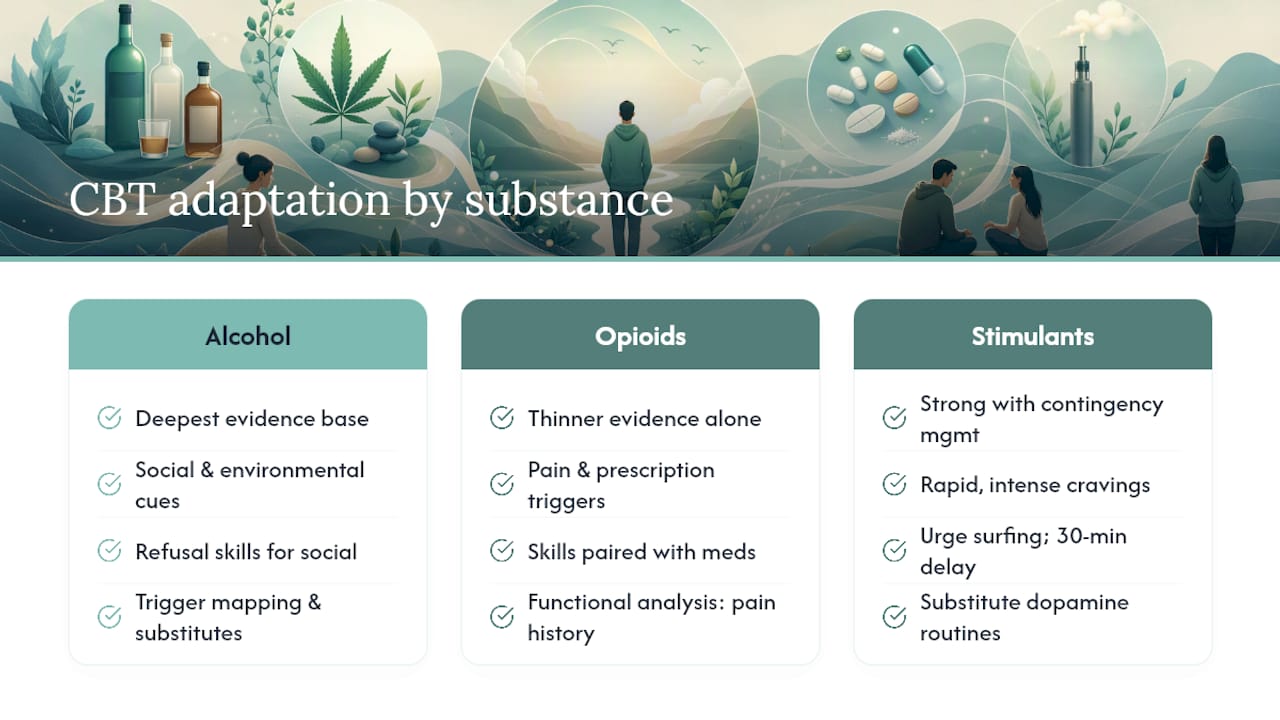
For alcohol use disorder, CBT has the deepest evidence base and often targets social and environmental cues: happy hour rituals, specific bars, certain company. Refusal skills training tends to focus heavily on social situations because alcohol use is frequently tied to shared occasions.
For opioid use disorder, CBT alone shows a thinner evidence record, and most clinical guidelines pair it with medication-assisted treatment rather than using it as a stand-alone intervention. The physiological grip of opioid withdrawal means coping skills have to work alongside pharmacological support, not instead of it. Functional analysis for opioids often centers on pain management history and prescription triggers as much as environmental cues.
For stimulant use disorder, cocaine and methamphetamine in particular, CBT combined with contingency management has some of the stronger outcome data in the field. Cravings tend to spike faster and harder with stimulants, so urge surfing and the 30 minute delay rule get heavier emphasis, and behavioral substitution often targets the dopamine driven routines around use, socializing, staying up late, specific locations, rather than a single trigger.
The practical takeaway: the CBT skeleton is consistent, but a program worth trusting adapts the trigger mapping and the substitute behaviors to the actual substance, not a generic template.
How Does CBT Address Co-Occurring Mental Health Disorders?
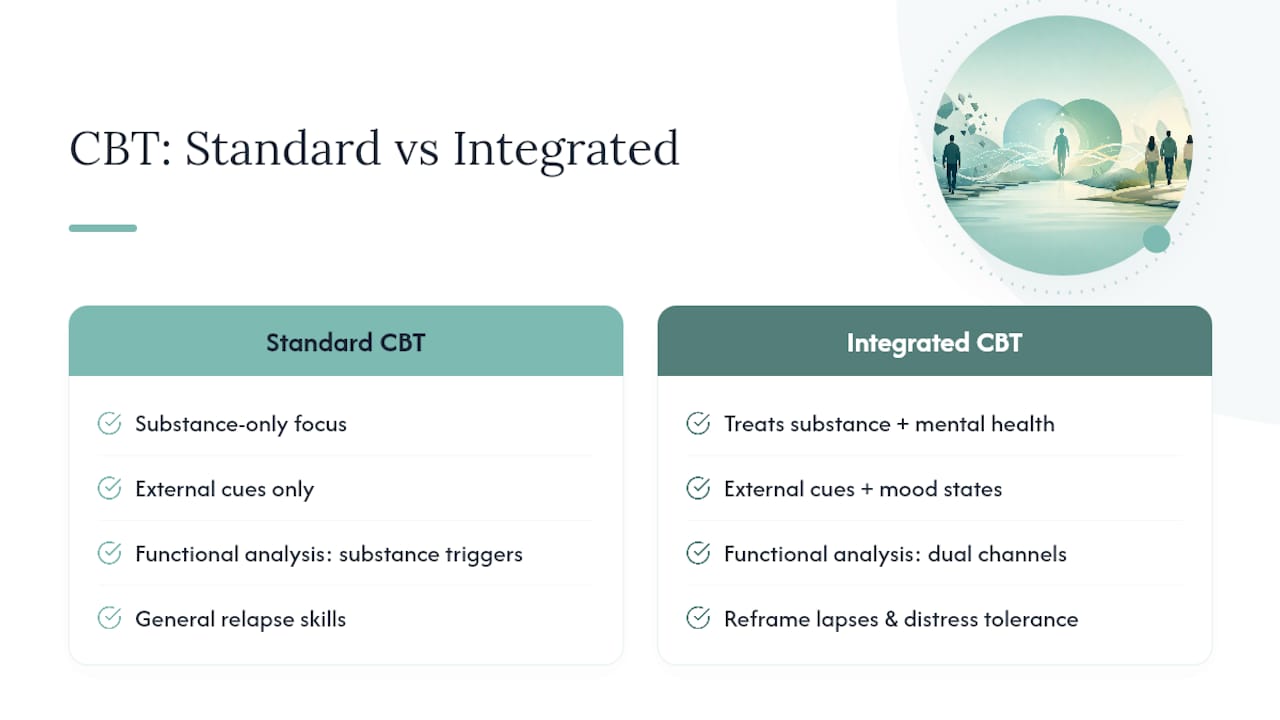
Substance use and mental health conditions like depression, anxiety, PTSD, and bipolar disorder feed each other constantly, which is why CBT for addiction rarely works in isolation from mental health treatment. A craving triggered by anxiety needs a different intervention than one triggered by boredom, and functional analysis has to capture both channels at once.
Integrated CBT for co-occurring disorders typically expands the standard trigger map to include mood states, not just external cues. A person might drink to quiet racing thoughts before sleep or use stimulants to counteract depressive fatigue. Treating only the substance use while ignoring the underlying mood disorder tends to produce short-lived gains, since the untreated condition keeps generating the same triggers.
Treating mental health issues alongside substance use also changes how relapse prevention gets taught. The abstinence violation effect hits harder in someone with depression or low self-esteem, so therapists working with dual diagnosis clients spend more time explicitly reframing lapses and building distress tolerance skills borrowed from dialectical behavior therapy.
This is also where session pacing matters. Clients managing both a substance use disorder and something like generalized anxiety often need slower skill introduction and more repetition, since anxiety can interfere with the working memory required to absorb new coping strategies in a single session. Programs equipped for dual diagnosis build that flexibility into scheduling rather than forcing every client through an identical session count.
What Training Do Therapists Need to Deliver CBT for Addiction?
Not every therapist licensed to practice CBT is equipped to deliver it for substance use disorders specifically, and that distinction matters more than most people realize when choosing a program.
A therapist delivering CBT in addiction treatment typically holds a graduate degree in psychology, clinical social work, or counseling, along with a state license such as LCSW, LMFT, LPC, or a doctoral-level clinical psychology credential. Licensure alone does not guarantee addiction-specific competency, though. Specialized certification in substance use treatment, often an addiction counselor credential layered on top of the core license, signals additional training in functional analysis for SUD, relapse prevention frameworks, and the specific ways cravings and triggers operate differently from general anxiety or mood work.
Ongoing supervision and consultation matter too. CBT for addiction is a skills-based, manualized approach, and therapists benefit from case consultation to stay consistent with the treatment model rather than drifting into generic supportive counseling. Programs that treat co-occurring disorders need staff cross-trained in both addiction-specific CBT and general mental health treatment, since the two skill sets do not automatically transfer.
For clients and families evaluating a program, it is reasonable to ask directly what credentials the CBT-delivering staff hold and whether they have specific training in addiction treatment, not just general talk therapy.
A Clinician's View on Practical CBT in Rehab
The gap between CBT research and CBT in practice comes down to dosage and supervision, not the underlying technique. A meta-analysis showing moderate effects at six months assumes consistent session attendance and real homework completion. Most outpatient dropout happens precisely when cravings are hardest to manage alone, which is exactly when unsupervised practice fails.
That is the argument for structure during early recovery. At Connected Recovery, a 12-bed capacity means CBT plans get built around one person's actual trigger chain, not a generic template, with 24/7 medical supervision covering the early period when skills are least reliable. The comprehensive model runs from initial detox through aftercare, which matters because the research is clear that CBT gains fade without continued support past the six-month mark. Individualized admission assessments can help calibrate session pacing and skills practice to what someone can absorb, especially when a co-occurring disorder is complicating the picture. Evidence-based technique still needs a setting built to protect the practice time it requires.
— Jim
Getting Started With CBT-Based Treatment at Connected Recovery
CBT works best when it is practiced somewhere safe enough to fail forward, not just talked about in weekly sessions. Connected Recovery builds that setting around a 12-bed facility where every CBT plan is shaped by an individual's own trigger history rather than a one-size-fits-all program.
The program covers the full arc a person actually needs:
- Medical detox with 24/7 supervision during the highest-risk withdrawal period
- Residential treatment where CBT skills get supervised practice time daily, not just once a week
- Dual diagnosis care for clients whose substance use is tangled up with anxiety, depression, or other mental health conditions
Combining CBT with structured coping strategies, like the approaches outlined by Journey Mental Health, can reinforce skills between sessions. The boutique size means staff notice when homework compliance slips and adjust before a lapse turns into a full relapse.
If you or a family member is considering a CBT-based rehab program, contact the treatment center’s admissions line to ask about CBT dosing and aftercare planning before making a commitment.
This article is general information, not a substitute for advice from a qualified doctor. Consult a qualified healthcare professional about your own circumstances before acting on anything here.
Sources
- Substance Use Disorder: A Systematic Review and Application of the Society of Clinical Psychology Criteria for Empirically Supported Treatments
- Brief Cognitive-Behavioral Therapy - Brief Interventions and Brief Therapies for Substance Abuse - NCBI Bookshelf
- Overview of Cognitive Behavioral Therapy for Substance Use Disorders - Ohio SUD Center of Excellence
FAQ
Does CBT Actually Reduce Substance Use in Rehab?
Yes. A systematic review found CBT produces outcomes better than minimal or no treatment, with the strongest effects showing up one to six months after treatment.
How Many CBT Sessions Does Addiction Treatment Usually Include?
Most CBT-based programs for substance use run 8 to 16 sessions, structured around skills practice and homework, according to clinical CBT manuals.
Can CBT Help With Both Addiction and Anxiety or Depression?
CBT is commonly adapted to address co-occurring mental health conditions alongside substance use, since treating both together tends to produce more durable recovery than treating substance use alone.
Is Computerized CBT as Effective as In-Person Therapy?
Computerized CBT programs like CBT4CBT have shown genuine efficacy as an adjunct to standard treatment and, in some trials, as a monitored stand-alone option, though most evidence supports it alongside clinical oversight rather than fully replacing it.
What Happens if CBT Skills Fade After Rehab Ends?
Research shows CBT's effects are strongest at one to six months and can weaken by eight months without reinforcement, which is why continued aftercare planning and ongoing practice matter as much as the initial treatment.