
Buprenorphine is an evidence-backed medication that reduces withdrawal severity and increases the chance of completing medically supervised opioid detox, but only when induction timing and clinical supervision are handled correctly. Started too early, before withdrawal has genuinely set in, it can trigger a worse reaction called precipitated withdrawal. Started at the right time, under the right monitoring, it is one of the most reliable tools available for getting through opioid withdrawal and into ongoing recovery care.
TL;DR:
- Starting buprenorphine too early, before withdrawal signs are evident, significantly increases the risk of precipitated withdrawal and treatment failure.
- Waiting for a Clinical Opiate Withdrawal Scale score of 12 or higher, and appropriate time after last opioid use, is essential to avoid adverse reactions.
- Long-acting opioids like fentanyl require longer observation periods, often beyond 24 hours, due to their fat storage and prolonged receptor occupancy.
- Inpatient settings provide the safest environment for induction in high-risk patients, while stable individuals may succeed with office-based or home induction.
- Successful detoxification depends heavily on post-induction care, including retention strategies and transitioning into ongoing recovery programs.
Table of Contents
- How Buprenorphine Works for Opioid Detox
- Who Is a Good Candidate for Buprenorphine-Assisted Detox
- Getting the Timing Right: How to Avoid Precipitated Withdrawal
- Dosing and Taper Schedules: What the Research Supports
- Choosing the Right Setting for Buprenorphine Detox
- Managing Precipitated Withdrawal When It Happens
- Safety Considerations, Drug Interactions, and Special Populations
- What to Expect During Detox and What Comes Next
- How Connected Recovery Applies This Evidence in Practice
- An Editorial Take on Buprenorphine Detox
- Get Supervised Buprenorphine Detox at Connected Recovery
- Sources
- FAQ
How Buprenorphine Works for Opioid Detox
Buprenorphine is a partial agonist at the mu opioid receptor. That single pharmacological fact explains almost everything about why it works, why it's safer than full agonists, and why timing it wrong causes problems.
Full agonists like heroin, oxycodone, or fentanyl activate the mu receptor at full strength. Buprenorphine activates the same receptor only partially, but it binds to it with unusually high affinity. Think of it like a key that fits the lock better than any other key on the ring, but only turns the mechanism partway. Once buprenorphine occupies that receptor, it satisfies enough of the brain's opioid demand to blunt withdrawal symptoms and cravings, while its partial activation creates a ceiling effect on respiratory depression. That ceiling is why buprenorphine carries a lower overdose risk than methadone or other full agonists, a point echoed in clinical pharmacology references on medication-assisted treatment.
The high receptor affinity is also the catch. Because buprenorphine binds so tightly, it can knock a full agonist off the receptor and replace it with only partial activation. If someone still has heroin or fentanyl actively occupying those receptors, buprenorphine's arrival causes a sudden net drop in opioid effect. That is precipitated withdrawal, and it's the single biggest risk in this entire process.
Buprenorphine comes in several forms suited to different phases of care:
- Sublingual or buccal film/tablet (often combined with naloxone as Suboxone for detox) is the standard for induction and early stabilization.
- Monthly subcutaneous injection works for patients already stabilized on a sublingual dose.
- Six-month subdermal implant suits long-term maintenance in patients with a proven steady dose requirement.
Extended-release formulations are never used for initial induction. They require a documented stable dose on the transmucosal form first, because there's no way to adjust an implant on the fly if the dose turns out to be wrong.
Who Is a Good Candidate for Buprenorphine-Assisted Detox
Buprenorphine-assisted detox fits most adults with moderate to severe opioid use disorder who are motivated to stop using and can tolerate a structured induction process. It works for people withdrawing from heroin, prescription opioids like oxycodone, and increasingly fentanyl, though fentanyl changes the timing calculus considerably.
Certain factors push toward more caution or a different plan entirely:
- Severe hepatic impairment can alter how buprenorphine is metabolized, and clinicians typically adjust dosing or monitoring frequency as a result.
- Concurrent use of benzodiazepines, alcohol, or other CNS depressants raises sedation risk and needs explicit management before and during induction.
- Pregnancy doesn't rule out buprenorphine. Medically supervised use is often the preferred approach for opioid dependence during pregnancy, though extended-release and implant formulations are generally avoided in favor of the sublingual form, which allows finer dose control.
- Heavy fentanyl exposure complicates timing because fentanyl accumulates in fat tissue and can leave receptors occupied longer than a urine test would suggest, which pushes many prescribers toward longer observation windows.
Methadone maintenance patients switching to buprenorphine face the highest precipitated withdrawal risk of any group, because methadone's long half-life means residual full-agonist activity can linger for days.
Setting matters as much as the medication itself. Patients with unstable housing, high-risk polysubstance use, or a history of severe withdrawal complications generally do better starting in an inpatient or residential setting where staff can intervene immediately if something goes wrong. Lower-risk, stable patients with reliable support at home are often reasonable candidates for office-based or even home induction under a prescriber's guidance.
Getting the Timing Right: How to Avoid Precipitated Withdrawal
This is the part of buprenorphine treatment where good intentions go wrong most often. Starting the medication too soon, before the body has cleared enough of the original opioid, is the number one preventable cause of a bad induction experience.
The Clinical Opiate Withdrawal Scale (COWS) is the standard tool clinicians use to decide when someone is ready. It scores eleven observable signs, including pulse rate, sweating, restlessness, pupil size, bone or joint aches, and gastrointestinal symptoms, on a scale that adds up to a total score. Most clinical protocols treat a COWS score of 12 or higher as the signal that withdrawal has progressed enough to start buprenorphine safely. Below that threshold, the risk of precipitating a worse reaction outweighs the benefit of starting early.
Waiting periods vary by what the person was using last:
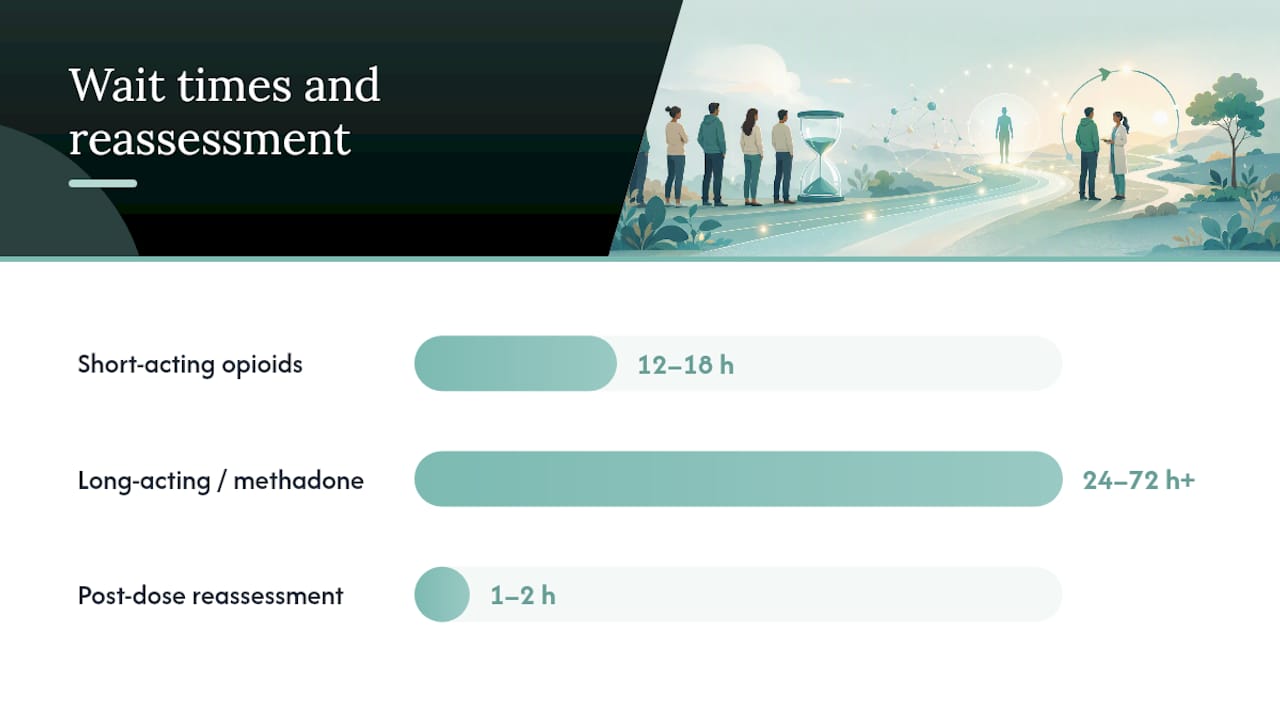
- Short-acting opioids (heroin, oxycodone, hydrocodone): wait roughly 12 to 18 hours after the last use, per ASAM's national practice guideline, and confirm objective withdrawal signs rather than relying on the clock alone.
- Long-acting full agonists and methadone: wait 24 to 72 hours, sometimes longer, since residual receptor occupancy takes far longer to clear.
- Fentanyl: prescribers increasingly wait longer than standard short-acting protocols suggest and watch for withdrawal signs more cautiously, since fentanyl's fat solubility means it can linger unpredictably.
Office-based induction, where a patient takes the first dose under direct observation, is generally preferred for anyone whose withdrawal timeline is uncertain or who has never been through induction before. Home induction can work well for stable, experienced patients with a trusted prescriber relationship, clear instructions, and a phone line open if things go sideways, an approach supported by practical clinical guidance on induction timing. It is not the right starting point for someone new to treatment or using fentanyl-contaminated supply.
Once the first dose is given, monitoring continues. A common protocol calls for an initial 2 to 4 mg dose, then reassessment every hour or two, with additional 2 to 4 mg increments if withdrawal symptoms persist and no oversedation appears.
Pro Tip: If you're planning a home induction, don't just track the hours since your last use. Track your actual COWS-type symptoms. Someone using fentanyl might feel "due" for a dose at hour 18 by the clock but still test low on observable withdrawal signs, and starting early on the clock alone is exactly how precipitated withdrawal happens.
Dosing and Taper Schedules: What the Research Supports
Most inductions start at 2 to 4 mg of buprenorphine, often combined with naloxone in a 4:1 ratio, given as a sublingual film or tablet. The FDA label caps typical maintenance dosing around 24 mg per day, though many stable patients do well in the 8 to 24 mg range, adjusted based on symptom control and craving suppression rather than a fixed formula.
From there, two broad paths diverge, and the choice depends heavily on the person's goals and clinical picture.
- Short-term structured taper: the NIDA Clinical Trials Network's 13-day buprenorphine taper is the most rigorously studied short protocol. In the CTN trial, inpatient participants completing the 13-day buprenorphine taper had a 77% success rate versus 22% for clonidine; outpatient completion was 29% for buprenorphine against just 5% for clonidine. That gap is one of the clearest pieces of evidence in the entire literature for choosing buprenorphine over alpha-2 agonists like clonidine or lofexidine.
- Extended maintenance-to-taper: many patients, especially those with longer use histories or co-occurring mental health conditions, do better staying on a maintenance dose for months before attempting any taper at all. The Cochrane review on buprenorphine for withdrawal found consistently better retention and lower withdrawal severity scores with buprenorphine compared to clonidine or lofexidine, with a number needed to treat of roughly 4 for an additional favorable outcome, though direct comparisons with tapered methadone remain limited.
Clinicians generally reserve the short taper for people in a structured setting, motivated toward abstinence, with a clear next step like naltrexone or ongoing counseling already lined up. Slower, extended tapers make more sense for people with longer dependence histories, unstable housing, or additional psychiatric complexity, where rushing the taper tends to backfire.
For anyone planning to transition to naltrexone after buprenorphine, timing matters just as much as it did at induction. Most protocols call for a gap of 7 to 14 days after the last buprenorphine dose before starting naltrexone, since starting too soon on an opioid antagonist while buprenorphine is still active causes the same kind of precipitated reaction as starting buprenorphine too early on a full agonist.
Choosing the Right Setting for Buprenorphine Detox
Where someone goes through detox changes what's possible clinically, and it's a decision worth making deliberately rather than by default.
Inpatient or residential detox gives 24/7 medical monitoring, which matters most for people with a history of severe withdrawal, complex polysubstance use, or unstable home environments. Staff can adjust doses in real time, manage complications immediately, and catch precipitated withdrawal early instead of the patient riding it out alone.
Office-based opioid treatment (OBOT) works for stable patients who don't need round-the-clock supervision. Typical OBOT protocols include weekly visits early in treatment, prescription drug monitoring program checks, and urine drug testing until the patient is clinically stable, per ASAM's guideline.
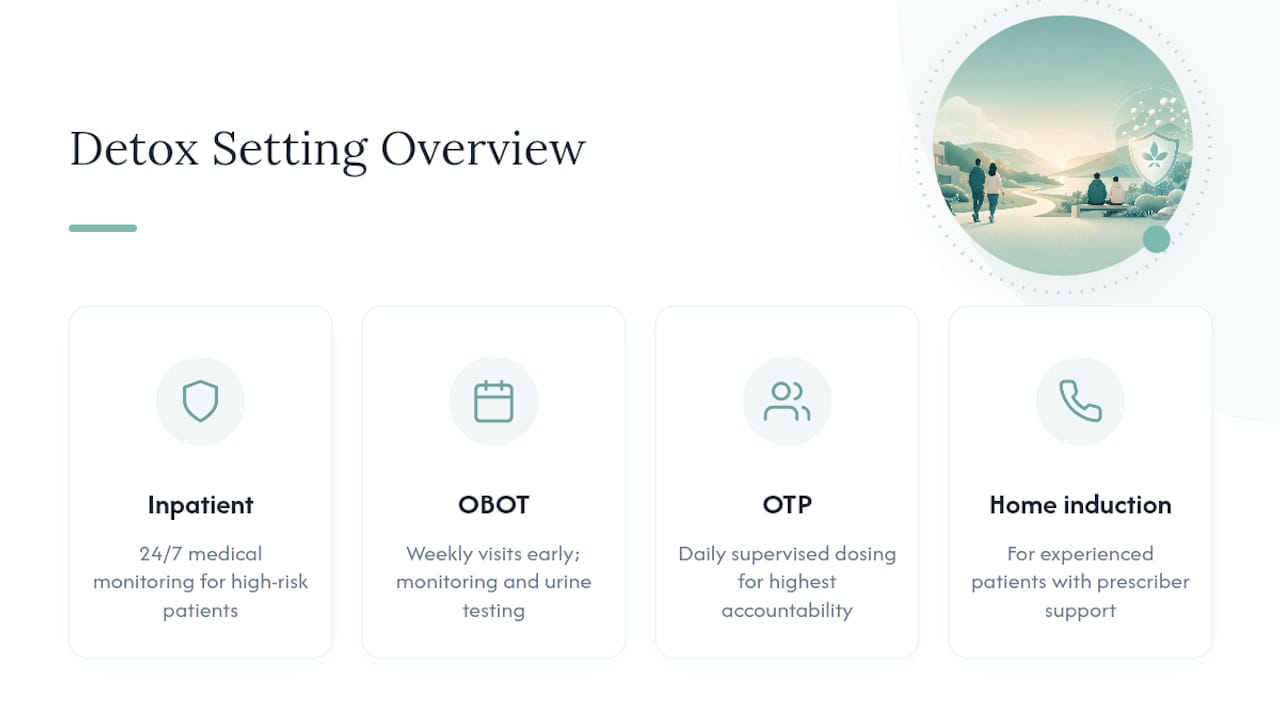
Opioid Treatment Programs (OTPs) provide daily supervised dosing and are often required for patients using methadone or those who need the highest level of structural accountability, including frequent in-person contact.
Home induction suits experienced patients with a strong relationship with their prescriber, clear safety instructions, and a reliable way to reach medical support if symptoms escalate. It is generally not the right starting point for anyone new to treatment, using fentanyl-contaminated opioids, or lacking a stable home environment.
The severity of dependence, history of complications, and available support at home should drive this decision, not convenience alone.
Managing Precipitated Withdrawal When It Happens
Buprenorphine-precipitated opioid withdrawal, sometimes shortened to BPOW in clinical literature, shows up as a sudden, sharp worsening of withdrawal symptoms within 30 to 90 minutes of a dose, rather than the gradual improvement induction is supposed to produce. Patients describe it as far more intense than their baseline withdrawal, and it can be frightening enough that people abandon treatment on the spot.
The honest answer here is that the evidence for managing BPOW once it starts is thin. A systematic review of pharmacological strategies for BPOW identified 43 studies, most of them case reports or small case series, and rated the overall evidence quality as low to very low.
What the evidence shows: Across the reviewed studies, clinicians most often responded to precipitated withdrawal with additional transmucosal buprenorphine doses and symptomatic medications. One pilot trial suggested intravenous magnesium sulfate alongside symptom-directed treatment might ease symptoms faster, but that finding comes from a single small study and needs replication before it becomes standard practice.
Common rescue approaches described in the literature include:
- Additional buprenorphine doses, given transmucosally, on the reasoning that occupying more receptors with the partial agonist eventually outcompetes the deficit that caused the reaction.
- Symptomatic agents like clonidine for autonomic symptoms and, in some cases, benzodiazepines for severe agitation, used cautiously given the added sedation risk.
- IV magnesium sulfate, an approach from pilot-level data only, not an established protocol.
- Short-acting opioid rescue in an emergency department setting, used sparingly and only when symptoms are severe enough to warrant it.
If precipitated withdrawal hits and doesn't resolve with a modest additional buprenorphine dose within a reasonable window, escalation to an emergency department or inpatient unit is the appropriate move. This is exactly the kind of complication a boutique residential setting with continuous nursing coverage is built to catch early, before it turns into a reason someone walks out of treatment.
Safety Considerations, Drug Interactions, and Special Populations
Buprenorphine is safer than full agonists on several measures, but it isn't risk-free, and a few interactions deserve specific attention.
- CNS depressants — benzodiazepines, alcohol, and other sedatives — combined with buprenorphine raise the risk of dangerous sedation and respiratory suppression. Anyone on a benzodiazepine prescription needs that disclosed and managed before induction, not discovered afterward.
- Pregnancy is not a contraindication. Medically supervised buprenorphine treatment is often preferred over untreated opioid dependence during pregnancy, but extended-release injectable and implant formulations are typically avoided in favor of the sublingual form for tighter dose control and easier adjustment.
- Hepatic impairment changes how buprenorphine is processed, and clinicians typically increase monitoring or adjust dosing in patients with significant liver disease. Extended-release formulations carry added caution here since dose correction isn't possible once administered.
- Fentanyl-era induction requires more vigilance across the board. Its fat solubility and unpredictable elimination push many prescribers toward longer observation windows and a stronger preference for office-based over home induction, a shift documented in recent clinical guidance on induction timing.
Anyone managing co-occurring mental health conditions alongside opioid use disorder needs a plan that treats both simultaneously. Treating the addiction while leaving anxiety, depression, or trauma unaddressed is one of the most common reasons detox alone doesn't hold.
What to Expect During Detox and What Comes Next
Symptom trajectory on a buprenorphine-assisted taper is generally smoother and shorter than an unmedicated detox. Most patients notice significant relief within hours of a correctly timed first dose, with peak comfort improvement over the following 2 to 3 days and continued stabilization through the first week. Cravings tend to drop noticeably once a maintenance dose is reached, which is part of why retention rates run so much higher than with non-opioid medications alone.
Medication is only part of the picture, though. Counseling, case management, and a concrete aftercare plan consistently separate people who stay in recovery from people who detox and relapse within weeks. A structured understanding of the detox timeline helps set realistic expectations going in, and knowing how to manage withdrawal-related anxiety in the moment matters just as much as the medication schedule.
After stabilization, two main paths open up:
- Continuing buprenorphine maintenance for an extended period, sometimes indefinitely, which the evidence supports as a legitimate long-term strategy rather than a stopgap.
- Tapering toward naltrexone or transitioning into residential follow-up care for people who want to move off all opioid medications eventually.
Clinicians increasingly measure success less by short-term abstinence and more by retention in treatment and consistent opioid-negative testing over time, a framing the Cochrane review's findings support directly. Detox that doesn't connect to ongoing care is a much weaker predictor of long-term recovery than detox that does.
How Connected Recovery Applies This Evidence in Practice
A residential treatment model built around managing risks like those highlighted in this evidence uses 24/7 medical supervision. Induction timing is managed by staff trained to read COWS-based signs rather than relying on the clock alone, which cuts down the chance of precipitated withdrawal that home or unsupervised inductions carry.
Because some facilities treat substance use and co-occurring mental health disorders together, dosing decisions account for what else is happening clinically, not just the withdrawal timeline. Smaller boutique sizes typically mean closer, more consistent monitoring than a larger unit and that aftercare planning starts well before discharge rather than as an afterthought. Readers wanting more detail on opioid addiction treatment approaches or fentanyl-specific withdrawal patterns can find further clinical detail in Connected Recovery's other resources.
An Editorial Take on Buprenorphine Detox
The research is more decisive than most public conversation about opioid treatment suggests. Buprenorphine beats non-opioid alternatives like clonidine on completion and retention by a wide margin, and the CTN data on that point isn't close. Where the conventional advice falls short is in treating induction like a formality instead of the highest-risk moment in the entire process. Too many guides bury the COWS threshold and the waiting windows in a footnote when they should be the headline.
The other place mainstream advice gets it wrong is framing detox as an endpoint. It isn't. A completed taper with no aftercare plan is a fragile outcome, and the data on retention versus short-term abstinence backs that up clearly. If you take one thing from this article, prioritize the setting and the follow-up plan as much as the medication itself. Buprenorphine does its job well. What happens in the weeks after the last dose determines whether that job actually mattered.
— Jim
Get Supervised Buprenorphine Detox at Connected Recovery
Some boutique treatment centers offer an alternative to large, impersonal detox units for anyone who needs induction and taper managed with consistent clinical attention rather than a rotating shift of unfamiliar staff. Smaller bed capacity enables every client's induction timing, dose adjustments, and early complications to be monitored continuously by the same core medical team, rather than handed off between shifts on a large ward.

That level of attention matters most in the first 72 hours, exactly when precipitated withdrawal risk is highest and when a rushed or poorly timed dose can undo days of progress. Connected Recovery's medical detox program in Van Nuys is built around that window, with integrated dual-diagnosis care for anyone managing a co-occurring mental health condition alongside opioid dependence, and a direct path into residential treatment and aftercare planning once detox is complete. If you or someone you love is weighing when and where to start buprenorphine treatment, reach out to Connected Recovery to talk through insurance coverage, timing, and what admission looks like this week.
Sources
The clinical guidance in this article draws on the Cochrane review on buprenorphine for opioid withdrawal, the NIDA CTN factsheet on the 13-day buprenorphine taper, ASAM's national practice guideline for medications in opioid use disorder treatment, the systematic review on managing precipitated withdrawal, and pharmacology chapters from the NCBI Bookshelf on medication-assisted treatment. Anyone comparing treatment facilities can also check a national directory of substance use treatment programs for additional options. Clinicians should consult these primary sources directly for patient-specific dosing and induction decisions rather than relying on summary guidance alone.
This article is general information, not a substitute for advice from a qualified doctor. Consult a qualified healthcare professional about your own circumstances before acting on anything here.
- Short-Term Opioid Withdrawal Using Buprenorphine: Findings and Strategies From a NIDA Clinical Trials Network (CTN) Study.
- ASAM National Practice Guideline for the Use of Medications in the Treatment of Opioid Use Disorder.
- Practical guidance on induction timing and precipitated withdrawal prevention.
FAQ
What medication is used for opioid detoxification?
Buprenorphine, often combined with naloxone, is one of the most studied medications for opioid detox, alongside methadone and, for milder cases, non-opioid options like clonidine or lofexidine.
What is the 3-day rule for buprenorphine?
There's no single universal "3-day rule," but many protocols call for waiting roughly 24 to 72 hours after last using long-acting opioids like methadone before starting buprenorphine, to avoid precipitated withdrawal.
What opioid is buprenorphine most like?
Buprenorphine is chemically distinct from full agonists but is often compared to methadone in effect, since both are used for opioid dependence treatment, though buprenorphine's partial agonist activity gives it a ceiling effect that methadone lacks.
How does buprenorphine help with opioid dependence?
It occupies mu opioid receptors with high affinity but only partial activation, which reduces withdrawal symptoms and cravings while lowering overdose risk compared to full agonists, and it's linked to significantly better treatment retention than non-opioid alternatives like clonidine.
Is home induction safe for starting buprenorphine?
Home induction can be safe for stable, experienced patients with clear prescriber guidance and a reliable way to reach medical support, but it's not recommended for people new to treatment, using fentanyl, or without a stable support system at home.