
Benzodiazepine withdrawal can be medically dangerous, capable of triggering seizures, delirium, and other life-threatening complications, especially after abrupt cessation. Do not stop taking a benzodiazepine suddenly. If you or someone you know has been using these medications regularly, the safe path is a supervised, gradual taper, guided by a prescriber or an addiction medicine specialist who can adjust the pace based on how the body responds.
TL;DR:
- Short-acting, high-potency benzodiazepines like alprazolam pose a higher risk of severe withdrawal symptoms within one to two days of stopping abruptly.
- Withdrawal symptoms typically follow phases, with the highest emergency risk occurring within the first week, especially for seizures and perceptual disturbances.
- Emergency signs requiring immediate care include seizures, severe confusion, hallucinations with agitation, and dangerously elevated blood pressure or heart rate.
- People on high doses, with previous withdrawal attempts, or using additional substances face a greater risk, and their tapering should be closely supervised by a healthcare professional.
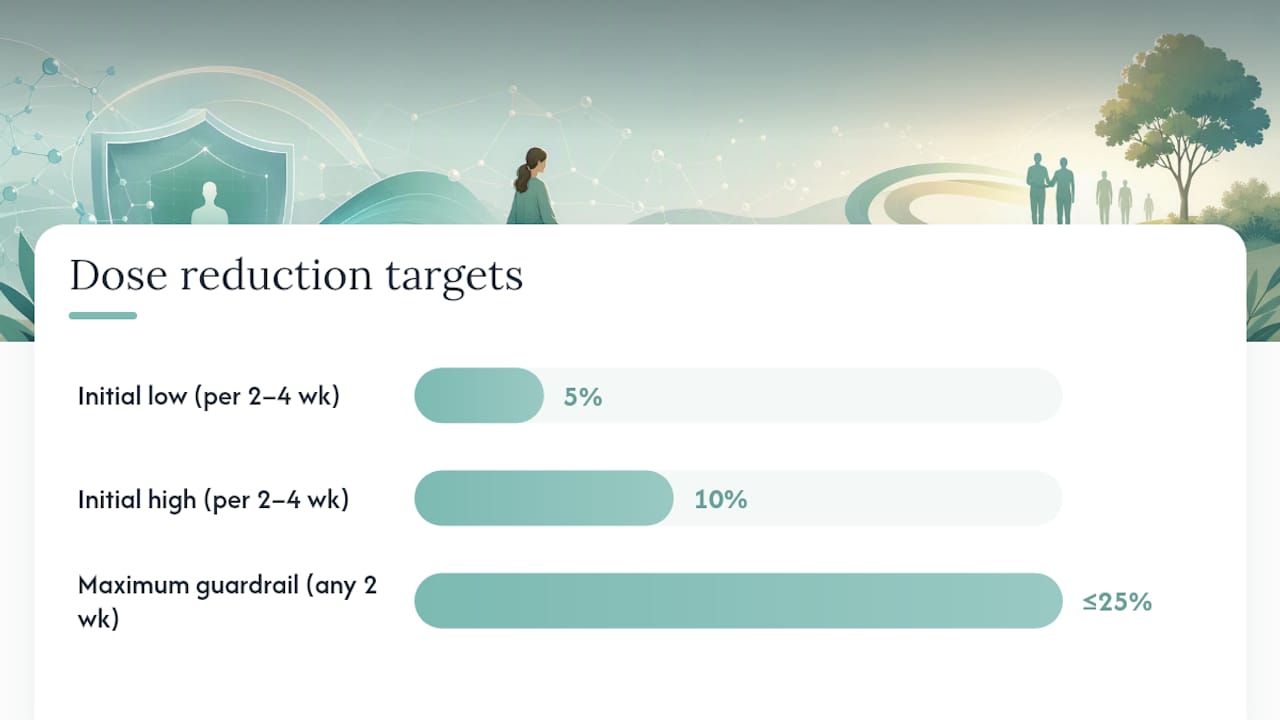
- Gradual tapering at 5% to 10% dose reductions every 2 to 4 weeks under medical guidance is safest, with inpatient detox for those with complex medical or psychiatric conditions.
Table of Contents
- What Are the Symptoms of Benzo Withdrawal?
- How Long Does Benzo Withdrawal Last?
- What Are the Emergency Warning Signs?
- Who Is Most at Risk for Severe Withdrawal?
- How Should Benzodiazepines Be Tapered Safely?
- What Does Medically Supervised Detox Actually Provide?
- Can Benzo Withdrawal Cause Lasting Cognitive Problems?
- What Are the Mental Health Risks During Withdrawal?
- How Should High-Risk Groups Approach Benzo Withdrawal?
- How Do Emergency Rooms Treat Benzo Withdrawal?
- How Do You Know If It's Withdrawal or the Original Anxiety Coming Back?
- Clinical Perspective: Tapering as Harm Reduction
- Get Medically Supervised Support for Benzo Withdrawal
- Sources
- FAQ
What Are the Symptoms of Benzo Withdrawal?
Most people going through benzodiazepine withdrawal experience a predictable cluster of symptoms tied to the nervous system rebounding after prolonged suppression. These are uncomfortable but usually manageable with the right support.
- Rebound anxiety, often worse than the anxiety that led to the prescription in the first place
- Insomnia and fragmented sleep
- Tremor, muscle tension, and sweating
- Heart palpitations and elevated blood pressure
- Nausea, cramping, or other GI upset
- Headaches and trouble concentrating
A smaller subset of patients develops more serious neuropsychiatric symptoms: visual or tactile hallucinations, severe agitation, and suicidal thoughts. These are not "just anxiety" and should never be dismissed as an inconvenient side effect. Benzodiazepine withdrawal is one of the few drug withdrawal syndromes that can produce life-threatening complications like seizures and delirium, particularly after abrupt cessation or in people with prior withdrawal attempts. Any hallucination, marked confusion, or thought of self-harm during a taper warrants same-day medical contact, not a wait-and-see approach.
How Long Does Benzo Withdrawal Last?
Timing depends heavily on the specific drug's half-life. Short-acting benzodiazepines like alprazolam tend to produce withdrawal symptoms within 1 to 2 days after the last dose, while longer-acting agents like diazepam may not show symptoms for 5 to 10 days. That delay can lull people into a false sense of security with long-acting drugs, right before symptoms peak.
Withdrawal generally moves through recognizable phases:
- Early phase (days 1 to 4): autonomic symptoms dominate, racing heart, sweating, restlessness
- Middle phase (days 4 to 14): mood and anxiety symptoms intensify, alongside insomnia
- Acute neurologic phase: highest risk window for seizures and perceptual disturbances, usually within the first one to two weeks
- Protracted phase: lower-grade anxiety, sleep disruption, and cognitive fog that can persist for months in some people
The first one to two weeks carry the highest risk for emergency complications. After that, monitoring shifts toward managing lingering, lower-intensity symptoms rather than acute danger.
What Are the Emergency Warning Signs?
Some withdrawal complications require immediate medical intervention, not a phone call to schedule an appointment next week. Seizures are the most feared complication, and they tend to cluster in the first week after abrupt discontinuation, especially with short-acting, high-potency drugs like alprazolam or lorazepam.
Call 911 or go to the emergency department if you notice any of the following:
- A seizure of any duration or a loss of consciousness
- Signs of delirium: severe confusion, disorientation, or not recognizing familiar people or places
- Hallucinations combined with agitation or paranoia
- Extreme autonomic instability, very high heart rate, high fever, or dangerously elevated blood pressure
- Suicidal thoughts or any expressed intent to self-harm
When you reach a clinician or emergency team, tell them exactly which benzodiazepine was used, the daily dose, how long it was taken, and the date and time of the last dose. That single piece of history changes treatment decisions immediately. Reviews of benzodiazepine withdrawal management consistently note that severity rises sharply with higher doses, longer duration of use, and polydrug use, which is exactly the information an ER team needs within the first few minutes.
Who Is Most at Risk for Severe Withdrawal?
Not everyone tapering off a benzodiazepine faces the same danger. Risk clusters around a few identifiable factors, and knowing where you fall on that list should shape how cautious the taper needs to be.
- Short-acting, high-potency drugs such as alprazolam carry more withdrawal risk than longer-acting agents
- High daily doses and use extending beyond four to eight months
- A history of prior withdrawal attempts, since repeated withdrawal can sensitize the nervous system through a process called kindling, making each subsequent attempt potentially worse
- Concurrent alcohol or opioid use
- Significant psychiatric comorbidity or a personal history of seizures
- Older age, which slows drug clearance and increases sensitivity to withdrawal effects
Clinical practice factors matter just as much as patient history. Abrupt discontinuation, rapid tapering schedules, or bouncing between multiple prescribers without a coordinated plan all raise the odds of a rough, dangerous withdrawal.
How Should Benzodiazepines Be Tapered Safely?
Guideline-consensus recommendations call for initial reductions of about 5% to 10% of the dose every 2 to 4 weeks, with most panels advising against cutting more than 25% within any two-week span. Slower is safer here. The nervous system needs time to recalibrate to lower drug levels, and rushing the schedule is one of the most common ways an otherwise manageable taper turns into an emergency.
For patients on short-acting, high-potency drugs, some clinicians switch to an equivalent dose of a longer-acting benzodiazepine before beginning the taper, since the smoother pharmacokinetics can reduce peak-to-trough symptom swings. This substitution strategy isn't universal and carries its own dosing complexities, so it belongs in the hands of a prescriber familiar with the conversion math.
Current guideline summaries note that most patients can taper safely as outpatients with close follow-up, but inpatient or medically monitored detox is indicated for people with high equivalent doses, a seizure history, polysubstance dependence, or serious psychiatric or medical comorbidity.
A few practical steps make any taper safer:
- Write down the exact dose, drug, and schedule, and keep a copy for every provider involved
- Confirm you have a direct line to your prescriber or clinic, not just a general office number
- Line up social support, someone who checks in daily during the first two weeks
- Avoid alcohol and other CNS depressants entirely during the taper
- Agree on an emergency plan in advance: which symptoms mean call the clinic, and which mean go to the ER
Pro Tip: Keep a simple daily symptom log, sleep hours, anxiety level on a 1 to 10 scale, any tremor or palpitations. That log turns a vague "I feel worse" phone call into specific data your prescriber can actually act on.
What Does Medically Supervised Detox Actually Provide?
Medical detox is designed specifically for the risk factors described above. Medical detox provides 24/7 medical monitoring, individualized taper plans, medication management, and integrated dual-diagnosis care for co-occurring mental health conditions inside a facility built around close, hands-on attention. That level of supervision matters most for people on high doses, anyone with a prior severe withdrawal, or those managing polysubstance use alongside benzodiazepine dependence. For a closer look at what the early days involve, see our benzo detox timeline, and for coping strategies during acute symptoms, our guide to withdrawal and anxiety breaks down concrete first steps.
Can Benzo Withdrawal Cause Lasting Cognitive Problems?
Some people experience cognitive symptoms that outlast the acute withdrawal window by months. Protracted withdrawal, sometimes described informally as post-acute withdrawal, can include persistent trouble with concentration, working memory lapses, word-finding difficulty, and a mental fog that makes ordinary tasks feel heavier than they should.
The mechanism isn't fully settled, but long-term benzodiazepine use itself is already linked to measurable harms. Guideline literature on long-term use points to cognitive impairment and increased fall risk as established concerns, separate from withdrawal itself, which complicates the picture: some cognitive symptoms during recovery may reflect the drug's prior effects wearing off rather than new damage from withdrawal.
What clinicians generally observe is a gradual improvement curve. Cognitive symptoms that show up during protracted withdrawal tend to soften over weeks to months as the nervous system continues adjusting, though the pace varies enormously from person to person. Age, duration of prior use, dose, and whether other substances were involved all shape how quickly that recovery happens.
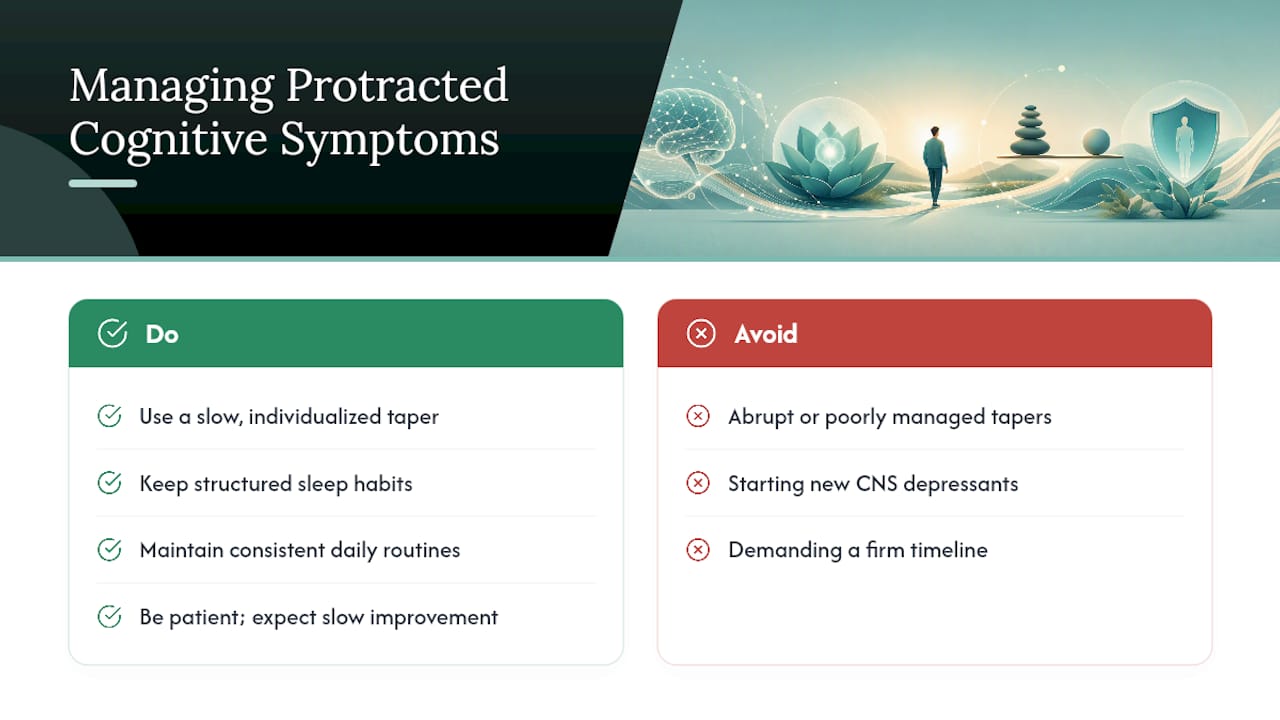
There's no reliable way to predict exactly how long lingering fog will last for any individual, and that uncertainty is genuinely frustrating for people who want a firm timeline. The honest answer is that most people see steady, if slow, improvement, and abrupt or poorly managed tapers appear to make protracted symptoms worse, which is one more argument for the slow, individualized approach outlined earlier. Patience during this phase isn't passive. Structured sleep habits, consistent routines, and avoiding new CNS depressants all support the recovery process even when progress feels invisible week to week.
What Are the Mental Health Risks During Withdrawal?
Withdrawal is not just a physical event. The same nervous system rebound that produces tremor and racing heart also intensifies emotional volatility, and that combination creates real psychological risk during the process.
Rebound anxiety during withdrawal can feel more intense than whatever anxiety originally led to the prescription, which catches many people off guard and can trigger a demoralizing sense that "nothing is working." Depression, irritability, and emotional flatness are common companions. In more severe cases, suicidal ideation is a recognized risk during benzodiazepine withdrawal, particularly in people tapering too quickly or those with pre-existing mood disorders.
This is precisely why isolation during a taper is dangerous. Family involvement, regular check-ins with a prescriber, and access to counseling support create a safety net that catches warning signs early. Organizations like The Pursuit Counseling work specifically on separating withdrawal-driven anxiety from pre-existing anxiety disorders, a distinction that matters for treatment planning and for reassuring patients that what they're feeling has a name and a timeline.
Anyone supporting a person through withdrawal should treat any statement about hopelessness, being a burden, or wanting to disappear as urgent, not as venting. A same-day call to the prescribing clinician, or a trip to the emergency department if there's any immediate danger, is the appropriate response every time, without exception. Mental health risk during withdrawal deserves the same urgency as a physical symptom like chest pain. It often gets less.
How Should High-Risk Groups Approach Benzo Withdrawal?
Certain populations need a modified approach to tapering, and treating everyone with the same generic schedule ignores real physiological differences.
Older adults clear benzodiazepines more slowly and are more sensitive to both the drugs and their withdrawal effects.
Pregnant patients face a genuinely difficult tradeoff. Abrupt discontinuation carries seizure risk that can also harm the fetus, but continued use carries its own considerations. This population should never attempt a taper without direct obstetric and psychiatric coordination, since the right answer depends on gestational stage, dose history, and underlying diagnosis.
Patients with comorbid psychiatric conditions, particularly bipolar disorder, PTSD, or a prior suicide attempt, need psychiatric involvement built into the taper plan from day one, not added after symptoms escalate. Withdrawal-related anxiety and mood instability can mask or worsen an underlying condition, making a coordinated care team essential.
Patients with comorbid medical conditions, including seizure disorders, cardiac disease, or significant liver or kidney impairment, need dose adjustments and monitoring tailored to how their bodies actually process the medication. A cardiac patient facing withdrawal-driven tachycardia, for instance, needs a different monitoring plan than a healthy 30-year-old with the same drug history. In every one of these groups, the same principle applies: individualized pacing, professional oversight, and no assumption that a standard schedule fits every body.
How Do Emergency Rooms Treat Benzo Withdrawal?
Emergency clinicians follow a fairly structured process when someone presents with suspected benzodiazepine withdrawal, because the stakes of misdiagnosis are high. The first steps involve confirming the substance, dose, and timing of last use, then checking vital signs for the autonomic instability that signals escalating risk, elevated heart rate, high blood pressure, fever, and tremor severity.
If a seizure has already occurred, the priority shifts to airway protection and often reinstating a benzodiazepine, typically a longer-acting one like diazepam or lorazepam, to stabilize the nervous system before considering any further taper. This is standard practice precisely because abrupt cessation is what triggers most severe complications in the first place, so reintroducing controlled dosing interrupts the crisis.
For withdrawal delirium, the picture is more complex. Confusion, disorientation, and hallucinations require ruling out other causes, infection, metabolic imbalance, other substance withdrawal, before attributing symptoms purely to benzodiazepines. That workup takes time, which is one reason emergency stays for withdrawal delirium often extend into hospital admission rather than a same-day discharge.
Patients presenting with polysubstance withdrawal, particularly combined alcohol and benzodiazepine dependence, face compounded seizure risk and typically require inpatient monitoring rather than outpatient management. The emergency protocol in these cases prioritizes stabilization first, detailed taper planning second, handled after the acute danger has passed and ideally coordinated with a facility equipped for ongoing medical detox.
How Do You Know If It's Withdrawal or the Original Anxiety Coming Back?
This is one of the trickiest calls in benzodiazepine care, and even experienced clinicians sometimes get it wrong. Withdrawal-driven anxiety tends to arrive alongside physical signs, tremor, sweating, rapid heartbeat, that track closely with the taper schedule and typically ease as the body stabilizes at each new dose. Anxiety that represents the return of an original condition tends to be more purely psychological and doesn't necessarily correlate with dose timing.
Timing is the biggest clue. Symptoms that spike specifically in the days right after a dose reduction and then partially settle before the next cut point toward withdrawal. Symptoms that stay constant regardless of where you are in the taper, or that mirror exactly what a person experienced before ever starting the medication, suggest the underlying condition is resurfacing rather than a withdrawal effect.
Clinicians also watch for symptom clusters that don't fit the classic withdrawal picture, new-onset panic attacks with a very different quality than before, or anxiety that keeps intensifying weeks after a dose change rather than settling. Misreading this distinction has real consequences: treating recurring anxiety as withdrawal might mean unnecessarily slowing an already appropriate taper, while treating true withdrawal as "the anxiety coming back" can lead a prescriber to reinstate the benzodiazepine and prolong the underlying dependence.
This is exactly the kind of judgment call that benefits from continuity of care. A single provider tracking the whole taper, rather than urgent care visits with different clinicians each time, catches these patterns far more reliably.
Clinical Perspective: Tapering as Harm Reduction
Neither staying on a benzodiazepine indefinitely nor tapering carelessly is the safe option. Both carry real risk, and good clinical care weighs them honestly rather than pretending one path is risk-free. Slow, sometimes uncomfortably slow, tapering paired with nonpharmacologic supports like CBT for insomnia or anxiety tends to outperform speed. Protracted symptoms are real for some people, and a fair recovery timeline accounts for that instead of promising a clean finish line.
— Jim
Get Medically Supervised Support for Benzo Withdrawal
If any of the risk factors above sound familiar, high dose, prior severe withdrawal, polysubstance use, or a seizure history, a home taper without medical backup is a real gamble. Certain facilities offer specialized care for this issue, providing 24/7 medical monitoring, individualized taper plans, medication management, and integrated dual-diagnosis care for anyone whose anxiety or depression complicates withdrawal.

Our team assesses dose history, prior withdrawal attempts, and co-occurring conditions before building a taper schedule suited to your actual physiology, not a generic template. For people who need round-the-clock oversight during the highest-risk early days, our medical detox program provides that safety net directly. Anyone likely to need longer stabilization afterward can transition into residential treatment without changing facilities or care teams. Reach out for an assessment, intake can often be arranged quickly for people showing high-risk signs.
This article is general information, not a substitute for advice from a qualified doctor. Consult a qualified healthcare professional about your own circumstances before acting on anything here.
Sources
- Comprehensive review of benzodiazepine withdrawal risks and management (PMC12898709)
- AAFP practice guideline: benzodiazepine tapering (2026)
FAQ
What Are the Risk Factors for Benzodiazepine Withdrawal?
The biggest risk factors are short-acting, high-potency drugs like alprazolam, high daily doses, use longer than four to eight months, prior withdrawal attempts, concurrent alcohol or opioid use, and a personal history of seizures or serious psychiatric illness.
How Should I Taper My Benzodiazepines?
Most guideline-based approaches start with reductions of about 5% to 10% of the dose every 2 to 4 weeks, with recommendations generally advising against exceeding a 25% reduction in any two-week period, always under a prescriber's supervision rather than on your own schedule.
Can Xanax Withdrawal Cause Insomnia?
Yes. Alprazolam (Xanax) is short-acting and high-potency, which makes rebound insomnia and anxiety especially common and often more intense than with longer-acting benzodiazepines.
When Should I Go to the Emergency Room for Benzo Withdrawal?
Seek emergency care immediately for any seizure, severe confusion or disorientation, hallucinations with agitation, dangerously high heart rate or blood pressure, or any thoughts of self-harm.
Is Medical Detox Necessary for Everyone Stopping Benzodiazepines?
Not always. Many people can taper safely as outpatients with close prescriber follow-up, but medical detox is strongly advised for high doses, prior severe withdrawal, polysubstance use, or significant psychiatric or medical comorbidity, situations where facilities like Connected Recovery provide the monitoring outpatient care can't match.