
Yes, there are several effective non-12-step alternatives to AA, including SMART Recovery, LifeRing, SOS, Women for Sobriety, Moderation Management, and faith or mindfulness-based paths like Recovery Dharma and Celebrate Recovery. The right fit depends on your beliefs, your goals (abstinence or moderation), and how severe your drinking has become. For some people, none of this works until medically supervised detox, residential care, or medication-assisted treatment stabilizes things first.
TL;DR:
- Peer-led programs like LifeRing and SOS are less structured but prioritize autonomy and may suit those avoiding formal curriculums or spiritual frameworks.
- Secular options such as SMART Recovery and Wellbriety tend to attract higher-income, more educated participants with lower clinical severity levels.
- Medically supervised detox and treatment are essential for those experiencing withdrawal symptoms or with severe alcohol dependence before engaging in peer support.
- Testing programs over a three-week period by attending multiple meetings helps identify the best fit based on personal response, rather than relying solely on program labels.
- Consistent participation in any recovery program yields better outcomes than switching frequently, regardless of the specific approach chosen.
Table of Contents
- Top AA Alternatives at a Glance
- What Each Alternative Actually Offers
- How to Choose the Right Program for You
- When Clinical Care Should Come Before or Alongside Peer Support
- Testing Fit: A Simple Way to Compare Approaches
- Where to Go for More Research and Support
- The Honest Take on AA Alternatives
- Sources
Top AA Alternatives at a Glance
Most people land on the right program faster once they see the options side by side. Each of these groups approaches recovery from a different angle, some secular, some spiritual, some built around a specific skill set.
- SMART Recovery: Cognitive behavioral tools and a four-point program run by trained facilitators. Best for secular, skills-based recovery. Meets both online and in-person, though in-person density varies by region.
- LifeRing: Peer-led "self-help" meetings built on sobriety, secularity, and self-empowerment. Best for people who want peer support without a higher power. Mostly in-person with a growing online presence.
- SOS (Secular Organizations for Sobriety): Loosely affiliated local groups with no set curriculum. Best for people who want sobriety-focused meetings free of any religious framework. Availability skews toward legacy in-person groups.
- Women for Sobriety: A gender-specific program centered on emotional growth and self-worth. Best for women seeking a support space shaped by their own experience. Runs in-person chapters and online meetings.
- Moderation Management: A peer-support program for people who want to cut back rather than quit entirely. Best for lower-severity drinkers exploring harm reduction. Primarily online, with some in-person groups.
- Recovery Dharma / Refuge Recovery: Buddhist-influenced, mindfulness-centered recovery. Best for people drawn to meditation and non-theistic spirituality. Growing rapidly online.
- Celebrate Recovery: A Christian, faith-based 12-step adaptation. Best for people who want recovery grounded in Christian community. Widely available through churches.
- Wellbriety: Indigenous-centered healing that blends recovery with cultural and spiritual practices. Best for Native American and Indigenous participants seeking culturally rooted support. Availability is regional, often tied to tribal health programs.
What Each Alternative Actually Offers
SMART Recovery runs on a four-point program built from cognitive behavioral therapy and rational emotive behavior therapy: building motivation, managing urges, solving problems constructively, and living a balanced life. Meetings are facilitator-led rather than peer-led, which changes the room's dynamic considerably. Instead of sharing life stories, members work through specific tools for the week's actual struggles. A 2023 analysis found that about 71% of SMART Recovery attendees reported reduced substance use, and Harvard Health's reporting on addiction researcher Dr. John Kelly work notes that SMART's CBT foundation and facilitator-led structure are a major draw, though meetings remain far less common than AA's in most areas. A separate national study found SMART-only participants tended to have higher income, more education, and lower clinical severity than AA-only participants, a pattern worth knowing if you're trying to gauge whether the room will feel like your peer group.
LifeRing organizes itself around three S's: sobriety, secularity, and self-help. There's no sponsor system and no steps. Instead, members write their own "personal recovery program," a living document they revise as they go. Meetings run more like structured discussions than storytelling circles.
SOS takes the opposite approach to structure: almost none. Local groups set their own norms, and the only unifying idea is that sobriety doesn't require a spiritual framework. That autonomy is a strength for people who dislike rigid formats, but it also means quality and consistency vary group to group.
Women for Sobriety runs on its New Life Program, thirteen affirmations focused on emotional growth, self-respect, and letting go of guilt. It was built specifically because AA's language and structure, developed by and largely for men in the 1930s, didn't address the guilt and self-esteem patterns many women in early sobriety describe.
Moderation Management is the one program on this list that doesn't require abstinence. It's built for people in the earlier stages of problem drinking who want to cut back to a defined, safer level rather than quit outright. It's not appropriate for anyone with significant physical dependence, a history of failed moderation attempts, or medical risk from continued drinking.
The Buddhist-influenced options, Recovery Dharma and Refuge Recovery, lean on meditation and the Four Noble Truths rather than a higher power. Celebrate Recovery reframes the 12 steps through explicitly Christian scripture and community. Wellbriety weaves in Indigenous ceremony and cultural healing practices, often through tribal health partnerships.
Pro Tip: Don't assume "secular" means "less structured." SMART Recovery's four-point program is arguably more structured than AA's steps. Secular just means the structure isn't built on surrendering to a higher power.
How to Choose the Right Program for You
Picking a program comes down to three filters, applied in order.
- Philosophy first. Decide whether you want a spiritual framework, a secular/scientific one, or a faith-specific one. This single choice eliminates most of the list immediately.
- Format second. Peer-led groups (LifeRing, SOS) feel different from facilitator-led ones (SMART). Sit in on both formats before committing.
- Goal third. Be honest about whether you're aiming for total abstinence or moderation. Moderation Management only makes sense for the latter.
At your first meeting, ask directly: How does this group view medication-assisted treatment? Are facilitators trained, and by whom? Is attendance confidential? Watch for red flags: hostility toward MAT, pressure to adopt a specific belief system, or a meeting schedule that changes without notice. Before settling in, run through an accessibility checklist: meeting frequency, online options for when you can't attend in person, childcare availability, and language support.
When Clinical Care Should Come Before or Alongside Peer Support
Peer support groups help people stay accountable and connected, but they were never built to manage medical risk. If you're experiencing withdrawal symptoms, have a co-occurring psychiatric condition, live in an unstable or unsafe environment, or have tried and failed to cut back multiple times on your own, that's a signal to get a clinical evaluation before or alongside any peer program.
Severe alcohol withdrawal can include seizures and delirium tremens, both medical emergencies. Clinical guidance is consistent on this point: medically supervised detox, residential stabilization, or medication-assisted treatment should come first for anyone with a moderate-to-severe drinking history, and peer support works best afterward, not as a substitute.
At Connected Recovery, that's the model built into every admission: 24/7 medical supervision during detox, individualized treatment planning across a 12-bed facility, and integrated care for co-occurring mental health disorders. Peer-support groups become far more useful once withdrawal is managed and the underlying psychiatric picture is clear. Programs like residential detox exist specifically for that stabilization window before peer support can do its job well.
Testing Fit: A Simple Way to Compare Approaches
You don't need to commit to one program for months to know if it fits. Run a structured three-week trial instead.
- Attend two to three meetings a week across one or two programs.
- After each meeting, log one line: your mood, any triggers, and whether it felt useful.
- At the end of three weeks, review the log for patterns rather than relying on memory.
Some people pair AA's fellowship with SMART's tools rather than choosing one, since engagement quality tends to predict outcomes more than the program label itself. When local meetings are scarce, online SMART sessions and digital worksheets fill the gap without waiting for an in-person group to form.
Pro Tip: Log your one-line entry right after the meeting, not later that night. Same-day notes catch the honest reaction before you talk yourself into liking (or dismissing) a group you barely gave a chance.
Where to Go for More Research and Support
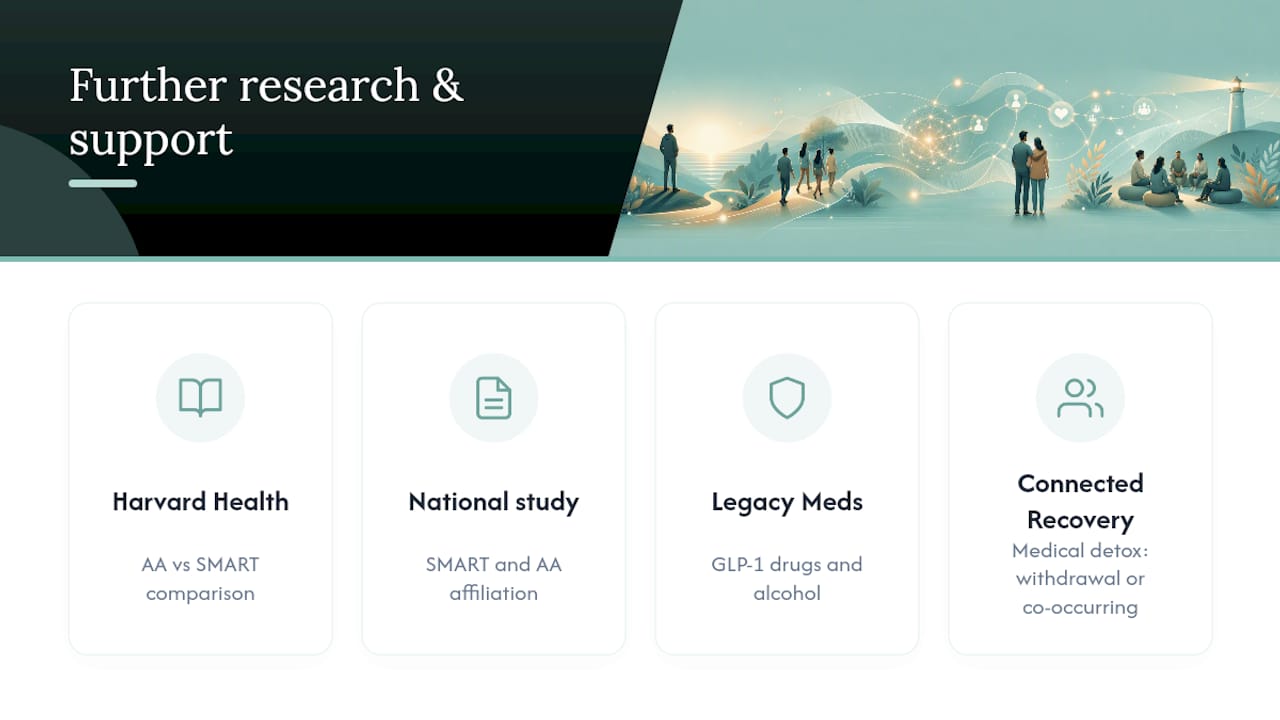
For deeper reading beyond program websites, Harvard Health's comparison of AA and SMART Recovery is a solid starting point, alongside the underlying national study on SMART and AA affiliation. For clinical questions around medication and alcohol use, Legacy Meds' overview of GLP-1 drugs and alcohol is worth a look. If withdrawal risk or co-occurring conditions are part of your situation, Connected Recovery's medical detox program is a direct next step.
The Honest Take on AA Alternatives
The research doesn't support crowning one program as objectively best. It supports something less satisfying but more useful: engagement predicts outcomes more reliably than program philosophy does. A person who shows up consistently to SMART gets roughly the same benefit as a person who shows up consistently to AA, and both outperform someone who samples five programs and commits to none.
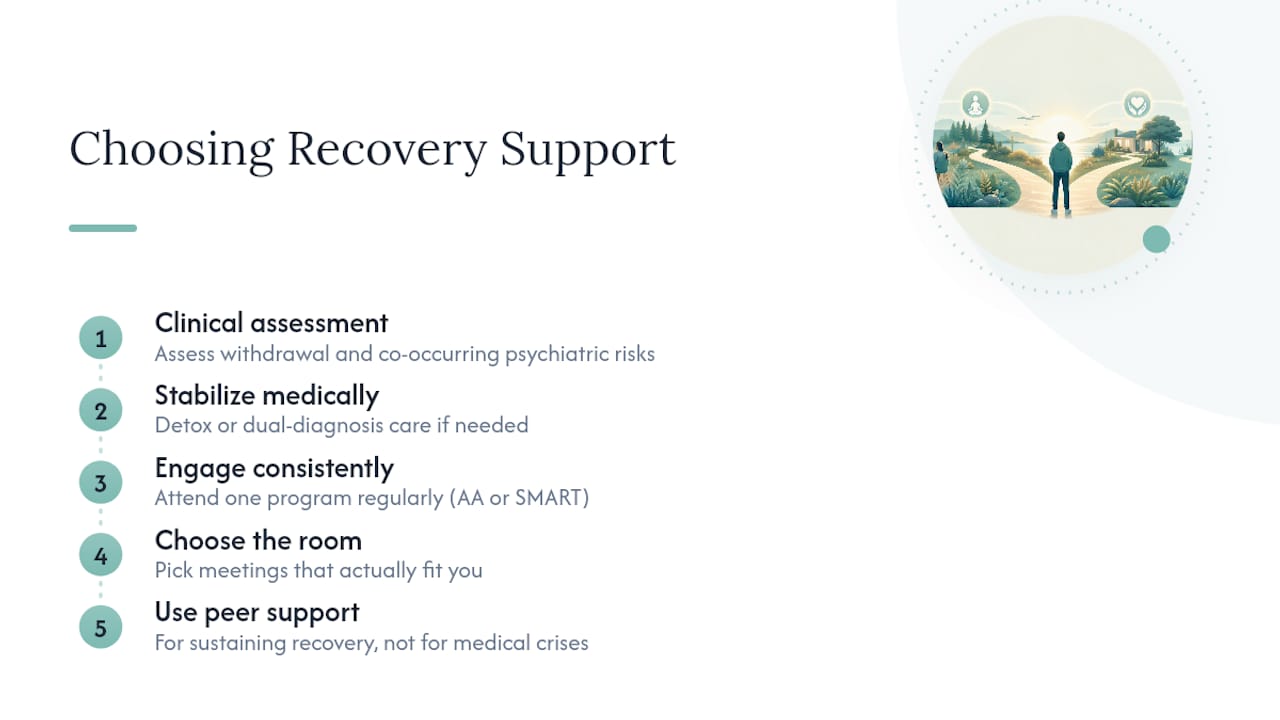
Where conventional advice falls short is in treating peer support as a complete answer. It isn't, especially for anyone with real withdrawal risk or an untreated psychiatric condition sitting underneath the drinking. I'd tell anyone reading this to get a clinical assessment before betting everything on a meeting format, secular or not. Peer groups are excellent at sustaining recovery. They're the wrong tool for managing a medical crisis. Get stabilized first, through dual diagnosis care if a mental health condition is in the mix, then pick the room that actually fits who you are.
— Jim
This article is general information, not a substitute for advice from a qualified doctor. Consult a qualified healthcare professional about your own circumstances before acting on anything here.
Sources
- Want to stop harmful drinking? AA versus SMART Recovery - Harvard Health
- Who affiliates with SMART recovery? A comparison of individuals attending SMART recovery, alcoholics anonymous, both, or neither - PMC
- Comparison of 12-step groups to mutual help alternatives for AUD in a large, national study - PubMed